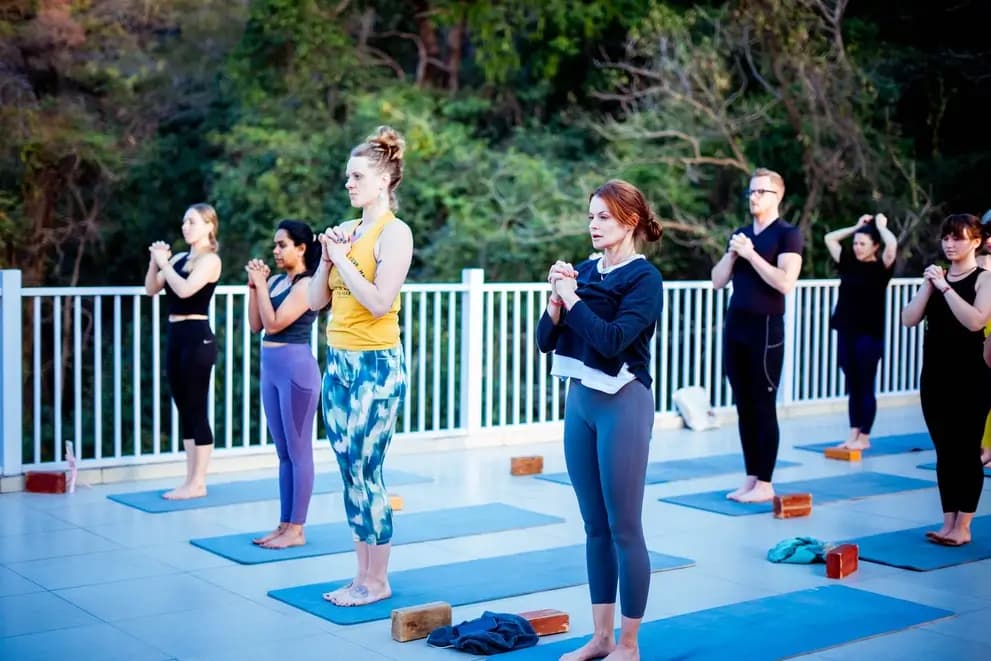
Nearly every yoga class you will ever take — fast or slow, sweaty or sleepy — grows from the same root: Hatha yoga, the physical branch of a much older tradition. The differences between the styles on a studio timetable come down to three things: pace (flowing or held), structure (fixed sequence or teacher's choice), and emphasis (fitness, precision, relaxation, or spiritual practice). Once you can read those three dials, no class name will ever confuse you again.
This guide explains the ten styles you are most likely to meet, each with its origin, what the class actually feels like, who it suits, and how intense it is — followed by a comparison table and an honest "which style is right for you" chooser. It is written from the teaching floor: our school trains teachers across several of these styles, and the advice below is the same advice we give students who arrive asking, "Which yoga should I do?"
First, a 30-Second Map of the Yoga Territory
Two clarifications save a lot of confusion.
Classical yoga names four paths, not class styles. In the older texts, "types of yoga" means Karma yoga (the path of selfless action), Bhakti yoga (devotion), Jnana yoga (knowledge and self-inquiry), and Raja yoga (meditation, systematised in Patanjali's Yoga Sutras). Every physical style below technically lives inside this larger map — postures were traditionally a preparation for meditation, not the destination.
Modern class styles are mostly variations of Hatha. Whether the sign says Vinyasa, Yin, Power or Restorative, the postures largely come from the Hatha tradition; what changes is pace, structure and intent. So the honest answer to "how many types of yoga are there?" is: four classical paths, one physical trunk, and a few dozen modern branches — of which about ten cover almost everything you'll encounter.
1. Hatha Yoga — The Steady Root
Origin: the umbrella term for physical yoga from medieval India. "Hatha" is popularly translated as sun (ha) and moon (tha) — balance of opposites — though scholars note the Sanskrit word literally means "force" or "effort."
What a class feels like: Unhurried. You move into a posture, hold it for several breaths while the teacher refines your alignment, rest briefly, and move to the next. Standing poses, seated poses, simple breathing practice, and a proper relaxation at the end. There is time to feel what you are doing.
Best for: Beginners, anyone who wants to understand postures rather than rush through them, and practitioners balancing a stressful life.
Intensity: Gentle to moderate. You will work, but you will rarely gasp.
At our school, Hatha is the calm afternoon anchor of teacher training — the class where alignment actually sinks in because nothing is rushing past.
2. Vinyasa Yoga — Breath in Motion
Origin: a modern flowing evolution of Hatha and Ashtanga. "Vinyasa" means "to place specially" — postures placed in sequence, linked by breath.
What a class feels like: continuous movement. One breath, one movement, poses strung into flowing sequences that differ every class, usually to the teacher's own creative arrangement, often with music. It can be gentle or genuinely athletic depending on the teacher — read the class description.
Best for: People who find stillness harder than movement, lovers of variety, and anyone coming to yoga partly for fitness.
Intensity: Depends heavily on the class; expect to warm up thoroughly either way.
Hatha vs Vinyasa: This is the comparison beginners ask about most, and the difference is pace and dwell-time. In Hatha you arrive in a pose, stay, refine and breathe; in Vinyasa the poses stream past, linked breath-to-movement, and the transitions are part of the practice. Hatha teaches you what a posture is; Vinyasa teaches you how postures connect. Most practitioners are well served by learning in Hatha and then flowing in Vinyasa — which is why the two make such natural companions on a weekly schedule.
3. Ashtanga Yoga — The Disciplined Sequence
Origin: A rigorous method from Mysore, South India, built on set sequences of postures linked by flowing movements, breath, and gaze points. (The name — "eight limbs" in Sanskrit — nods to Patanjali's classical eightfold path.)
What a class feels like: The same sequence, every time, in the same order, and that is the point. Led classes move through the Primary Series together; in traditional "Mysore style" classes each student practices the sequence at their own pace from memory while the teacher assists individually. The repetition turns the practice into a moving meditation and makes progress unmistakable.
Best for: Practitioners who thrive on structure, discipline and measurable progress; students with an established practice who want depth over novelty.
Intensity: Physically demanding. Beginners are welcome in principle, but expect to be humbled and to sweat.
Ashtanga is the sunrise practice at our school — ninety minutes before breakfast, taught to your level. Watch for our full Ashtanga guide (link when live) for the Primary Series in depth.
4. Iyengar Yoga — The Science of Alignment
Origin: Developed by B.K.S. Iyengar of Pune, whose obsessive attention to postural detail and pioneering use of props changed how yoga is taught worldwide.
What a class feels like: Precise and unhurried, sometimes spending ten minutes on a single pose. Blocks, straps, blankets, chairs and wall ropes are used without apology so that every body, flexible or not, can find the true shape of a posture. Teachers train for years and correct you individually.
Best for: Detail-lovers, students recovering from injury or working around limitations, and anyone whose "why does my back hurt in this pose?" questions have never been properly answered.
Intensity: Physically moderate, mentally exacting.
5. Yin Yoga — Long, Quiet Holds
Origin: a modern contemplative style blending Indian asana with Taoist principles, aimed at the body's deep connective tissue rather than muscle.
What a class feels like: floor-based stillness. You settle into a supported seated or reclining pose and simply stay — three to five minutes per pose, props everywhere, lights low. The challenge is not effort but surrender: the mind gets loud before it gets quiet.
Best for: stiff and busy people (they need it most), athletes balancing hard training, meditators, and anyone whose life is already full of "yang."
Intensity: Physically hard, mentally demanding. Stillness is harder than it looks.
Yin rewards proper study — long passive holds need intelligent, safe teaching. It's one of the styles we train teachers in specifically, on our Yin Yoga teacher training in Rishikesh.
6. Restorative Yoga — Deliberate Deep Rest
Origin: grew out of the Iyengar tradition's therapeutic use of props, developed into a practice of complete physical support and rest.
What a class feels like: four or five poses in an hour, each one arranged like a nest — bolsters, blankets and blocks holding you so completely that no muscle needs to work. Where Yin applies gentle stretch, Restorative removes even that: the goal is total support, so the nervous system can stand down.
Best for: the exhausted, the burned out, the recovering, the grieving — and anxious practitioners, for whom this is often the kindest entry point (see our guide to yoga for anxiety).
Intensity: The hardest thing you'll do is stay awake. Staying awake is optional.
7. Kundalini Yoga — The Energetic Practice
Origin: a tradition aimed at awakening kundalini — described in yogic texts as dormant spiritual energy at the base of the spine — through combined techniques rather than postures alone.
What a class feels like: unlike anything else on this list. Classes are built from kriyas — set combinations of repetitive movement, vigorous breathwork, chanting, mudras and meditation, sometimes practiced with eyes closed. It is less about the shapes of poses and more about the felt sense of energy; students tend to find it either profoundly moving or simply not their taste, with little in between.
Best for: experienced practitioners drawn to the meditative and devotional side of yoga, and those curious about breath- and mantra-led practice.
Intensity: Bursts of vigorous breath and movement inside a mostly seated practice. The strong breathwork is not suitable during pregnancy, and anyone with cardiovascular or panic-related conditions should check with a doctor first.
(We describe Kundalini here so you can recognise it on a timetable; it is not a style we offer training in.)
8. Power Yoga — the Fitness-First Flow
Origin: a Western adaptation of Ashtanga that kept the athleticism and dropped the fixed sequence, built for gym and studio settings.
What a class feels like: a workout, honestly and unapologetically. Strong flowing sequences, core work, longer holds of demanding standing poses, often a heated room, minimal chanting or philosophy. Closely related to "sculpt" and fitness-vinyasa formats.
Best for: athletes and fitness-focused practitioners who want strength, sweat and mobility — and who might later discover, as many do, that the breathing was the part they came back for.
Intensity: Expect to work hard.
9. Prenatal Yoga — Practice For Two
Origin: a modern therapeutic adaptation of gentle Hatha for pregnancy, developed with midwifery and obstetric knowledge.
What a class feels like: gentle, supported, and specific. Poses are chosen and modified trimester by trimester — space for the belly, no deep twists, no strong core work, no lying flat on the back in later months — with a big emphasis on breathing for labour, pelvic-floor awareness, and rest. The room usually has a lovely camaraderie to it.
Best for: mothers-to-be at any stage (with their doctor's or midwife's okay), including complete beginners.
Intensity: Deliberately gentle.
Teaching pregnant students safely is a specialisation with its own training — it's exactly what our 85-hour Prenatal Yoga teacher training exists for.
10. Chair & Gentle Yoga — Yoga Without the Floor
Origin: adaptive teaching that moves classical postures onto and around a sturdy chair, developed for older adults and anyone for whom floor work is a barrier.
What a class feels like: Seated and standing-supported versions of familiar poses — cat-cow on a chair, seated twists, supported balance work — with careful pacing and lots of breathing. No getting down to the floor, no pretzel shapes, no intimidation.
Best for: Seniors, office workers, people with limited mobility, injuries or balance concerns, and anyone returning to movement after illness. Our step-by-step guide to chair yoga for seniors is a complete free starting routine.
Intensity: Gentle by design, and better for you than skipping movement altogether, which is its real competition.
And one Practice That Isn't Quite a "Style": Yoga Nidra
You will also see Yoga Nidra — "yogic sleep" — on many timetables. It is not a posture style at all but a systematic guided relaxation: you lie down, and a teacher's voice leads your attention through the body and breath into a state between waking and sleep. Rooted in tantric rotation-of-consciousness practices, it asks for zero flexibility and is possibly the most accessible practice in all of yoga — and genuinely difficult to teach well, which is why we run a dedicated Yoga Nidra teacher training. If your interest in yoga is rest, sleep, or calming an overactive mind, start here.
(Related but from a different tradition entirely: Tai Chi and Qigong — flowing Chinese energy practices that attract many of the same students as gentle yoga. We teach them as their own discipline on the Tai Chi & Qigong teacher training.)
All 10 Styles Compared
Style | Pace | Physical intensity | Structure | Best for |
|---|---|---|---|---|
Hatha | Slow–steady | ●●○○○ | Teacher's choice, held poses | Beginners, foundations |
Vinyasa | Flowing | ●●●○○–●●●●○ | Creative, varies each class | Variety-lovers, fitness + flow |
Ashtanga | Flowing, brisk | ●●●●● | Fixed sequence, always | Discipline, structure, depth |
Iyengar | Very deliberate | ●●○○○ | Precise, prop-supported | Alignment, injuries, detail |
Yin | Very slow | ●○○○○ | Long floor holds (3–5 min) | Deep release, busy minds |
Restorative | Near-still | ●○○○○ | Fully supported rest poses | Burnout, recovery, anxiety |
Kundalini | Varies in bursts | ●●●○○ | Set kriyas + breath + mantra | Energetic, meditative practice |
Power | Fast, strong | ●●●●● | Teacher's choice, athletic | Strength and sweat |
Prenatal | Gentle | ●○○○○–●●○○○ | Trimester-adapted | Pregnancy (with doctor's okay) |
Chair/Gentle | Gentle | ●○○○○ | Seated/supported | Seniors, limited mobility |
(Yoga Nidra: no physical intensity — guided relaxation, lying down, for everyone.)
One Pose, Five Styles: How Different the Same Shape Can Feel
If the table above still feels abstract, here is the fastest way to grasp what "style" really changes. Take a single classic posture — Triangle Pose (Trikonasana) — and walk it through five classrooms:
In Hatha, you step wide, come into the shape, and stay for five or six breaths while the teacher talks you through your back foot, your hips, your reaching arm. You have time to feel it.
In Vinyasa, Triangle arrives mid-flow — one breath in Warrior II, exhale into Triangle, inhale out again. It is a station the river passes through, not a destination.
In Ashtanga, Triangle sits at a fixed address in the standing sequence — same place, same breath count, every single practice, which is exactly how you notice this month's Triangle is deeper than last month's.
In Iyengar, you might spend twelve minutes on Triangle alone — a block under the hand, a wall behind the hips, and three corrections you had no idea you needed.
In Yin or Restorative, Triangle simply doesn't appear: standing effort isn't the point. Its cousin might be a supported reclining side stretch, held quietly for minutes.
Same tradition, same geometry, five entirely different experiences. That — not the postures themselves — is what you are choosing when you choose a style.
Which Style of Yoga Is Right For You?
Read down the left column until you recognise yourself:
"I'm a complete beginner." Start with Hatha — it builds the vocabulary every other style assumes. Gentle Vinyasa is a fine second choice if stillness bores you.
"I want a workout as much as a practice." Vinyasa or Power. If you love routine and measurable progress, graduate to Ashtanga.
"I'm stiff, injured, or my body needs careful handling." Iyengar for precision, or Chair/Gentle if getting to the floor is the barrier.
"I'm exhausted, anxious, or burned out." Restorative first, Yin second, and add Yoga Nidra — effort is not what your nervous system needs right now.
"I sit all day, and everything is tight." Yin — long holds reach what quick stretches don't.
"I'm pregnant." Prenatal, with your doctor's or midwife's okay — general classes aren't built for you, and modifications matter.
"I'm drawn to the spiritual and energetic side." Kundalini for mantra- and breath-led practice — or explore meditation, pranayama and the flowing calm of Tai Chi & Qigong.
"I honestly don't know." Try one Hatha, one Vinyasa and one Yin class. Those three points map the territory; where you feel most like yourself is your answer.
Two truths we tell every new student: there is no "best" style, only a best style for you, right now — and the style that suits you today may not be the one that suits you in five years. Practitioners drift slower over time. That is not decline; it is refinement.
What If You Love More Than One? (Most Teachers Do)
Here is the quiet secret of this whole comparison: the styles are doors into the same house. Breath, attention, honest effort, deep rest — every good class serves them in different proportions. That is why serious training is usually multi-style: our own 200 hour yoga teacher training in Rishikesh is built around both dynamic Ashtanga (each sunrise) and classical Hatha (each afternoon), with pranayama, meditation and Yoga Nidra daily — so by the end of a month you know these traditions from the inside, not from a comparison table. Batches are capped at 20 students, and the training is Yoga Alliance–registered (RYS 200, 300 & 500). If you're weighing styles because you want to teach one day, that's the conversation we have with students every week — ask us anything on WhatsApp.
Frequently Asked Questions
Q1. Which is better, Hatha or Ashtanga yoga?
Ans. Neither — they serve different needs. Hatha is slower, held and foundational; Ashtanga is a vigorous, fixed flowing sequence. Beginners usually do better starting with Hatha and adding Ashtanga once the basic postures feel familiar. (In our teacher training, students practice both daily, which settles the debate better than any article can.)
Q2. Is Ashtanga the hardest yoga?
Ans. It is among the most physically demanding of the traditional styles — the fixed sequence includes challenging postures and the pace is brisk. Power yoga classes can match it for raw effort. But "hardest" depends on the measure: many strong Ashtangis find a silent 5-minute Yin hold or a still meditation far harder.
Q3. What is harder, Vinyasa or Ashtanga?
Ans. Usually Ashtanga: its sequence is non-negotiable and cumulative, so the practice never softens to meet your mood. Vinyasa difficulty depends entirely on the teacher — some classes are gentler than Hatha, others rival Ashtanga. Read the class description, or ask.
Q4. What is the healthiest type of yoga?
Ans. The one you will actually keep doing, practiced safely. Research on yoga's benefits spans many styles, and no single style is proven "healthiest." A balanced week — some strength and movement (Hatha/Vinyasa), some deep release (Yin/Restorative), some breath and rest (pranayama, Yoga Nidra) — covers more bases than any one class.
Q5. Which yoga is best for beginners?
Ans. Hatha, for the unhurried pace and time to learn alignment — with Iyengar a close second if you like precision, and Chair/Gentle if mobility is a concern. Avoid starting with Ashtanga, Power or fast Vinyasa unless you're already athletic; being overwhelmed in week one is the main reason people wrongly conclude "yoga isn't for me."
Q6. How many types of yoga are there?
Ans. Classically, four paths (Karma, Bhakti, Jnana, Raja). In modern practice, one physical trunk — Hatha — and dozens of named branches, of which the ten above cover nearly every class you'll find on a timetable.
Q7. Can I mix different styles of yoga?
Ans. Yes — and most long-term practitioners do. A common weekly blend: one or two stronger classes (Hatha, Vinyasa or Ashtanga), one deep-release class (Yin or Restorative), and short daily breathing or Yoga Nidra practice at home. The styles are complementary by design; mixing them is not cheating, it's balance.
Author Note (byline): Gangesha Adi (E-RYT 500, RCYT, RPYT), founder of Pure Soul Yoga School in Rishikesh, has taught Hatha, Ashtanga, Yin, prenatal and Yoga Nidra practices to students of 50+ nationalities — and "which style is right for me?" remains the question he is asked most.