Yoga for Anxiety: 7 Calming Practices and a 15-Minute Routine
Can yoga help with anxiety? Research suggests it may — gentle movement, slow breathing and guided relaxation appear to calm the body's stress response, and studies of people with anxiety report reduced symptoms after regular practice. What yoga is not is a treatment on its own. It works best alongside, not instead of, professional care, and if anxiety is interfering with your daily life, the most useful thing on this page is the section titled "When yoga isn't enough."
With that said honestly, here is what we teach anxious students at our school in Rishikesh: why slow breath changes how the body feels, seven calming practices you can do at home today, and a 15-minute routine that strings them together in a sensible order.
This article is for general education and is not medical advice. Anxiety disorders are real medical conditions. Please consult a qualified healthcare professional about your individual situation — especially before using yoga alongside any existing treatment.
How does yoga help with anxiety?
Anxiety lives in the body as much as in the mind: a racing heart, shallow chest breathing, tight shoulders and jaw, a stomach in knots. Yoga approaches the problem from the body's side.
The most studied mechanism is the breath. When you slow your breathing and lengthen the exhale, you appear to stimulate the parasympathetic nervous system — the "rest and digest" branch that counters the fight-or-flight response. Heart rate eases, muscles soften, and the mind often follows. Mindful movement adds a second ingredient: when attention is anchored in the sensation of a stretch or the rhythm of breath, there is simply less room for the looping "what if" thoughts that feed anxiety.
The research is encouraging but not miraculous, and it deserves to be described accurately. The National Center for Complementary and Integrative Health notes that some studies suggest yoga may reduce anxiety symptoms. A large randomized trial published in JAMA Psychiatry found that yoga helped adults with generalized anxiety disorder more than stress-management education did — but cognitive behavioural therapy helped more than yoga. That ordering matters: yoga is a genuinely useful support, and therapy remains the better-evidenced treatment. You do not have to choose; most people do best combining them.
Before you begin: 3 gentle ground rules
Slow beats deep. For anxiety, the calming effect comes from slowness and breath, not from how far you stretch. A modest pose breathed slowly does more than a deep pose held tensely.
Skip fast or forceful breathing. Rapid techniques (such as kapalbhati or breath of fire) can feel activating and, for some people prone to panic, may make symptoms worse. Everything below uses slow, natural breathing only.
If a practice raises your anxiety, stop. Closed eyes, stillness or attention on the breath occasionally feels threatening rather than soothing, especially with a trauma history. That is a known response, not a failure — keep the eyes softly open, shorten the practice, or work with a trauma-informed teacher.
7 calming yoga practices for anxiety
Each practice below includes what to do and why it earns its place. Together they form the 15-minute routine in the next section.
1. Extended-exhale breathing in Easy Pose (Sukhasana)
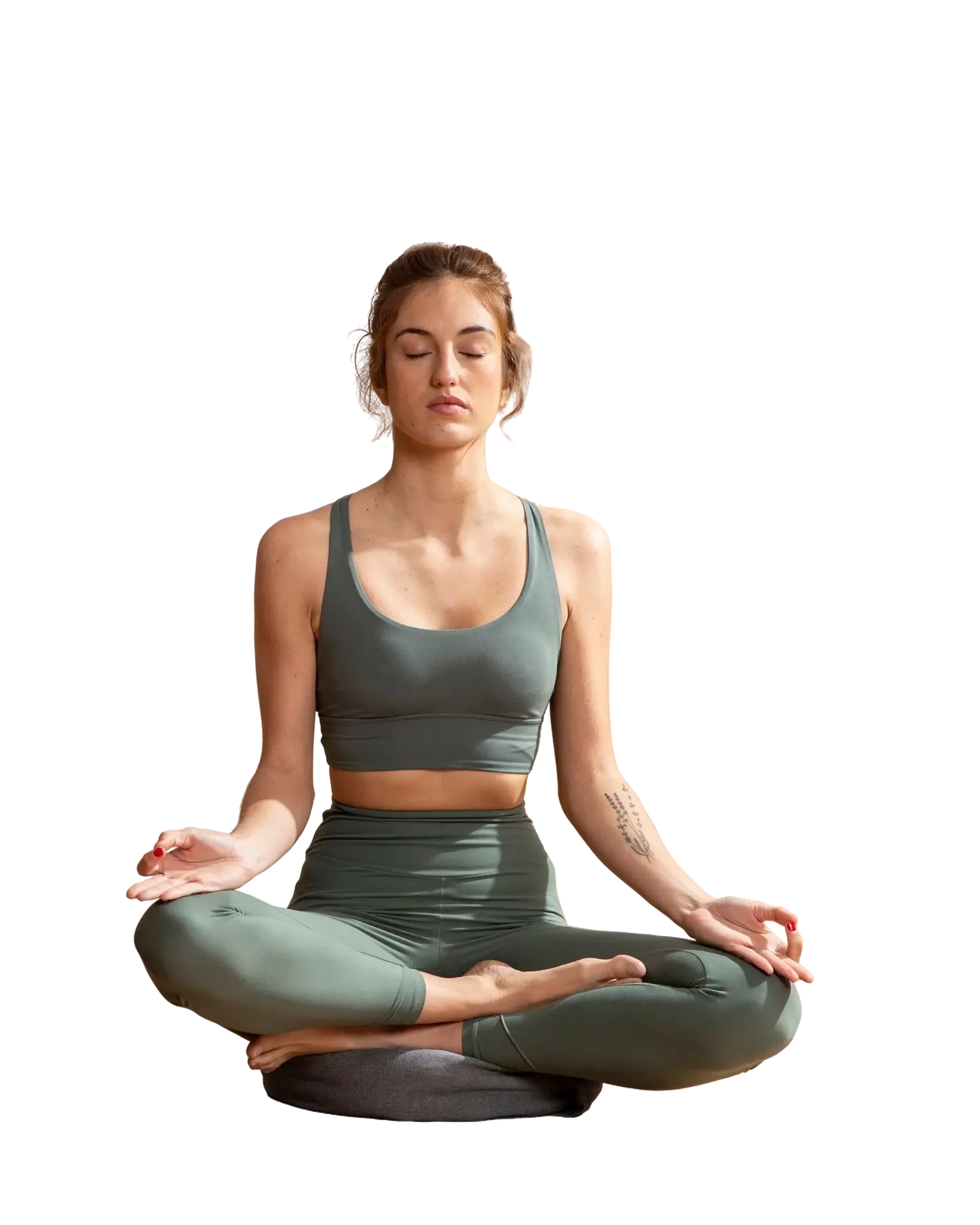
Sit cross-legged on a cushion (or upright in a chair — the shape of your legs does not matter). Rest your hands on your thighs. Breathe in through the nose for a count of four, then out for a count of six. Continue for two to three minutes.
Why it helps: a longer exhale is the most direct lever we have on the nervous system — it appears to shift the body toward its calming parasympathetic mode. This one practice, done anywhere, is the heart of yoga for anxiety. If breathing practice interests you, our full guide to pranayama breathing techniques goes deeper.
2. Humming Bee Breath (Bhramari Pranayama)
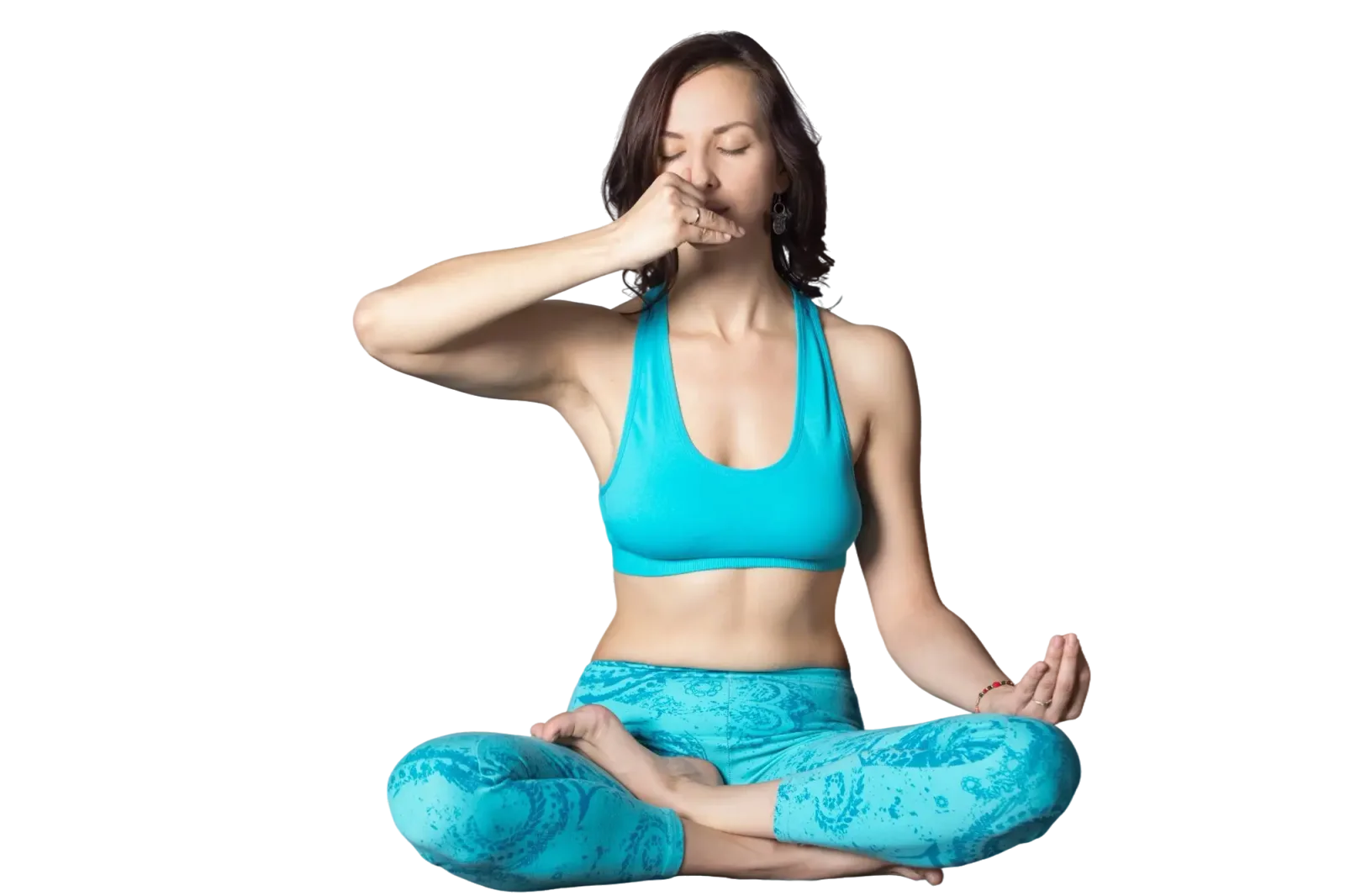
Sitting comfortably, inhale through the nose, then exhale making a soft, steady humming sound — like a bee — with lips closed. You can gently close your ears with your fingertips to amplify the vibration. Repeat five to seven rounds.
Why it helps: the hum lengthens the exhale naturally and gives the mind a single, soothing sensation to rest on. Many of our students call it the fastest way they know to interrupt spiralling thoughts. Skip it in public if humming feels awkward — practice 1 does the same job silently.
3. Child's Pose (Balasana)
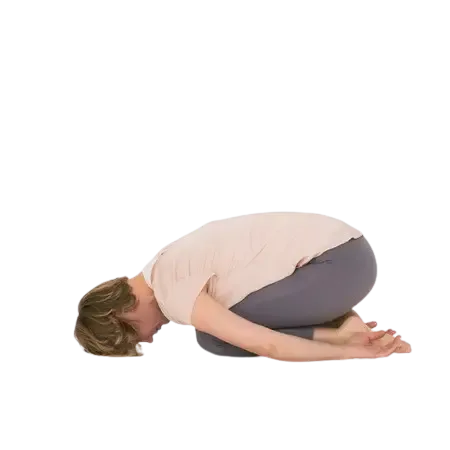
Kneel, bring your big toes together and knees wide, and fold your torso forward until your forehead rests on the mat (or on a cushion — the support matters more than the depth). Arms forward or alongside the body. Stay for one to two minutes, breathing into the back of the ribs.
Why it helps: folding inward with the forehead supported feels protective and quiet — many people describe an almost immediate settling. The gentle pressure on the belly also encourages the slow diaphragmatic breathing that anxiety tends to steal.
4. Cat–Cow (Marjaryasana–Bitilasana)
On hands and knees, inhale as you lift the chest and tailbone (Cow); exhale as you round the spine and tuck the chin (Cat). Move slowly, letting the breath set the pace — six to eight rounds.
Why it helps: anxiety often shows up as a rigid spine and held breath. This gentle rhythm restores both, and because movement is tied to breath, it doubles as moving meditation.
5. Legs-Up-the-Wall (Viparita Karani)
Sit sideways next to a wall, then swivel to lie on your back with your legs resting up the wall, arms open at your sides. A folded blanket under the hips is pleasant but optional. Stay three to five minutes, breathing naturally.
Why it helps: this is the pose we recommend most often for anxious evenings and restless nights. It asks for no effort or flexibility at all, and the combination of stillness, mild inversion and slow breath is deeply quieting. If you have uncontrolled high blood pressure or glaucoma, check with your doctor first.
6. Seated Forward Fold (Paschimottanasana), softened
Sit with legs extended, knees generously bent, and fold forward over your thighs, letting the head hang heavy — resting your chest on a cushion or your hands wherever they land. Three to five slow breaths.
Why it helps: forward folds turn the senses inward and release the back body, where many people carry tension. For anxiety, keep it soft and rounded — this is a sigh in the shape of a pose, not a hamstring achievement.
7. Guided rest: Savasana, or a short Yoga Nidra
Lie on your back, let your feet fall open, palms up, and rest for at least three minutes. If your mind won't settle in silence, use a guided Yoga Nidra instead — a systematic, voice-led relaxation practiced lying down, which many anxious students find easier than unguided stillness because the voice gives the mind a handrail. At our school, teaching days wind down with an evening meditation or Yoga Nidra session, and it's a practice we teach in depth on our dedicated Yoga Nidra teacher training.
Why it helps: deliberate rest is where the practice consolidates. Skipping it is like ending a bath by sprinting out the door.
A 15-minute routine for anxious days
Same order, sensible timing, no equipment beyond a mat and a wall:
Minutes | Practice |
|---|---|
0–3 | Extended-exhale breathing in Sukhasana |
3–5 | Bhramari (5–7 rounds) |
5–7 | Cat–Cow |
7–9 | Child's Pose |
9–12 | Legs-Up-the-Wall |
12–13 | Soft Seated Forward Fold |
13–15 | Savasana or short Yoga Nidra |
Daily consistency matters more than length. On the hardest days, do only practices 1 and 5 — three minutes of long exhales and a few minutes with legs up the wall is a complete practice, not a failure to do the full one.
When yoga isn't enough — please seek professional help
We teach yoga for a living, and we want to say this plainly: yoga is a support, not a treatment plan. Please reach out to a doctor or mental-health professional if any of these are true:
Anxiety is interfering with your work, sleep, relationships or daily functioning
You are experiencing panic attacks
Worry feels constant and uncontrollable most days, for weeks at a time
You are using alcohol or other substances to manage anxious feelings
You have thoughts of harming yourself — in this case please seek help immediately, through your local emergency number or a crisis helpline (in the US, you can call or text 988)
Anxiety disorders are among the most treatable mental-health conditions. Talking therapies such as CBT have strong evidence behind them, medication helps many people, and neither is a sign of weakness — any more than glasses are a weakness for the short-sighted. In our experience, students who combine professional care with a gentle daily practice do better than those who treat yoga as a substitute for it. If you are already in treatment, tell your clinician you are adding yoga; it is almost always welcomed as a complement.
Frequently asked questions
Which yoga is best for anxiety? Slow, gentle styles — Hatha, Yin, Restorative — plus breathing practice and Yoga Nidra. The stronger, quicker styles have their place, but for anxiety specifically, slow-with-long-exhales is the reliable recipe. Our guide to the types of yoga explains the differences.
Does yoga actually help with anxiety? Research suggests it may. Reviews of studies report meaningful reductions in anxiety symptoms with regular practice, and a randomized trial in generalized anxiety disorder found yoga more helpful than stress education — though less helpful than CBT. Honest summary: a useful complement with real evidence, not a stand-alone treatment.
What is the 3-3-3 rule for anxiety? A commonly taught grounding technique from outside yoga: name three things you can see, three sounds you can hear, then move three parts of your body. It works on the same principle as the practices above — pulling attention out of anxious thought and into present-moment sensation. Use it anywhere; nobody can tell you're doing it.
What are the best ways to reduce anxiety without medication? The best-evidenced non-drug approach is talking therapy, especially CBT. Alongside it, regular exercise, consistent sleep, limiting caffeine and alcohol, time outdoors, and mind-body practices like yoga and meditation may all help. "Without medication" should still mean "with professional guidance" if anxiety is significant — a therapist can tell you which combination fits your situation.
How often should I practice yoga for anxiety? Little and daily beats long and occasional. The 15-minute routine above, most days, is a realistic and worthwhile dose; even three minutes of extended-exhale breathing counts on the busiest days. Most students notice the immediate calming effect from day one; steadier day-to-day changes tend to take a few weeks of consistency.
If you need more than 15 minutes a day
Some seasons of life call for a full stop, not a daily routine. Our De-stress Yoga Retreat in Rishikesh is built for exactly that: days structured around gentle practice, breathing, Yoga Nidra and rest, a private room, and a consultation-first approach — you begin with a doctor's consultation, and any therapies are prescribed to you, not sold to you. It is not a treatment for an anxiety disorder, and we will never present it as one; it is a protected space to learn the practices on this page properly, with teachers beside you. Start dates are flexible, and real humans answer questions on WhatsApp.
References
National Center for Complementary and Integrative Health (NCCIH) — Yoga: What You Need To Know.
Simon N.M. et al. — randomized clinical trial of yoga, CBT and stress education for generalized anxiety disorder, JAMA Psychiatry.
National Institute of Mental Health (NIMH) — Anxiety Disorders (signs, symptoms, and when to seek help).
988 Suicide & Crisis Lifeline (US) — crisis support by call or text.
Reviewed for health accuracy by Dr. Bhupinder Singh Arora (M.D. Ayurveda), consulting Ayurvedic physician at Pure Soul Yoga School. This article is educational and not a substitute for personal medical or mental-health advice.
Author note (byline): Gangesha Adi (E-RYT 500) leads the teaching team at Pure Soul Yoga School in Rishikesh, where the evening meditation and Yoga Nidra sessions he oversees have closed the teaching day for students of 50+ nationalities.