Pranayama Breathing Techniques: A Complete Practice Guide
Pranayama is yoga's practice of conscious breathing — a set of techniques that use the rhythm, depth and pathway of the breath to steady the body and quiet the mind. The word comes from Sanskrit: prana (life force, carried on the breath) and ayama (to extend or draw out). In plain terms: instead of letting the breath run on autopilot, you learn to guide it — and because breath and nervous system are directly linked, guiding one begins to settle the other.
This guide teaches seven pranayama breathing techniques in the order we teach them at our school in Rishikesh: from gentle practices you can start today to strong techniques that deserve real caution and, ideally, a teacher. For each one, you'll find what it is, how to practice it, when it fits in your day, and who should avoid it.
This article is for general education and is not medical advice. If you are pregnant or live with high blood pressure, a heart condition, epilepsy, or any respiratory condition, please talk with your doctor before beginning breath practices — and stick to the gentle techniques unless a qualified teacher guides you further.
In this guide: - What is pranayama? - Benefits of pranayama - How to practice safely - The 7 techniques - Comparison table - Building a daily practice - FAQs
What is pranayama?
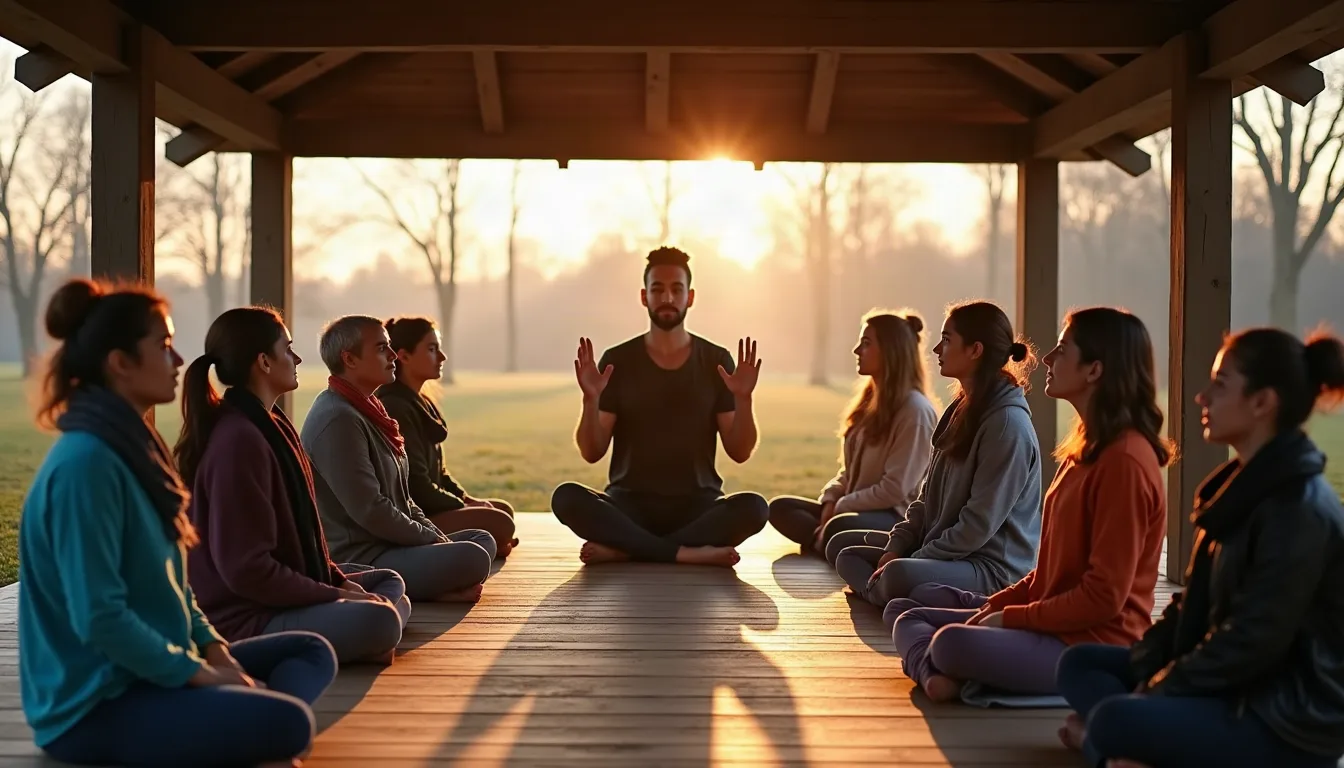
In the classical texts, pranayama is the fourth of the eight limbs of yoga described in Patanjali's Yoga Sutras — after ethical foundations and posture, before the inward limbs of concentration and meditation. Its position is the point: the breath is the bridge between the body you can control and the mind you usually can't.
Every pranayama technique is built from three simple components:
Puraka — the inhalation
Rechaka — the exhalation
Kumbhaka — retention, the pause between breaths (held in, or held out)
Different techniques emphasise different components. Slow practices stretch the exhalation to calm the system; energising practices sharpen the exhalation to wake it up; advanced practices work with retention — which is precisely why retention is the part beginners should leave alone at first.
Traditional yoga also describes a subtle anatomy behind the practice: energy channels called nadis, of which three matter most — ida (left, cooling), pingala (right, energising) and sushumna (central). Alternate-nostril techniques are traditionally said to balance ida and pingala. Modern research doesn't map these channels anatomically; what it does observe is that slow, controlled breathing is associated with measurable shifts in nervous-system activity. We teach both frames honestly — the traditional map for practice, the research lens for claims — and you don't need to accept either on faith to feel what ten slow breaths do.
Benefits of Pranayama
Here is an honest summary of the benefits of pranayama — what research suggests, and what tradition teaches — without the overselling this topic usually attracts.
What research suggests:
Calmer stress response. Studies on slow breathing practices suggest they may increase markers of parasympathetic ("rest and digest") activity, such as heart-rate variability. Many people notice this in practice within minutes: a slower heartbeat and a quieter mind.
Reduced feelings of anxiety. Reviews of breathing-practice studies suggest slow-paced breathwork may help reduce self-reported anxiety and stress. It is a support, not a substitute for professional care — if anxiety is interfering with your life, please see our note in yoga for anxiety and speak with a professional.
Breathing efficiency. Studies in yoga practitioners suggest regular pranayama may be associated with improvements in measures of lung function, such as breath-hold time and vital capacity. This is one reason breathing practices are being explored as a complement (never a replacement) for standard care in some respiratory conditions.
Better sleep and focus. Early research suggests slow breathing before bed may support sleep quality, and many practitioners report steadier concentration — consistent with what every meditator knows: an anchored breath anchors attention.
What tradition teaches: the Hatha Yoga Pradipika, one of hatha yoga's core texts, treats pranayama as preparation for meditation — steadying prana to steady the mind — and as a purifying discipline in its own right. Tradition attributes far wider effects to these practices than modern research has examined; we present those as teaching heritage, not medical claims.
What pranayama will not do: cure disease, replace medication, or transform your life in a weekend. Anyone promising that is overselling. What a daily ten-minute practice reliably offers is a trainable, portable way to downshift your own nervous system — which, for most modern lives, is worth more than the exotic promises.
Before you begin: how to practice pranayama safely
Six rules we give every new student:
Empty-ish stomach. Practice before meals or at least two to three hours after. Early morning is traditional and practical.
Sit tall, sit comfortably. Cross-legged on a cushion, in Vajrasana, or upright on a chair — the spine long, the shoulders soft. A collapsed chest cannot breathe well.
Nose, not mouth. Unless a technique says otherwise, inhale and exhale through the nose.
Never strain. Pranayama should feel like smoothing the breath, not fighting it. If you feel dizzy, tingly, or breathless, stop, breathe normally, and shorten the practice next time.
Skip retention at first. Holding the breath (kumbhaka) is the most advanced element of pranayama. Learn the flowing techniques for a few months before adding holds—ideally with a teacher.
Know your cautions. If you are pregnant or have high blood pressure, heart disease, epilepsy, glaucoma, a hernia, or recent surgery, avoid the forceful techniques (Kapalbhati, Bhastrika) and breath retention. The gentle practices below are generally considered fine for most people — but your doctor has the final word.
A tip from our teaching hall: students always want to know which technique is "the most powerful." The honest answer: the one you'll actually do every morning. Five minutes of Anulom Vilom daily will change more in a month than an occasional heroic session of everything at once.
The 7 Pranayama Breathing Techniques, Gentlest to Strongest
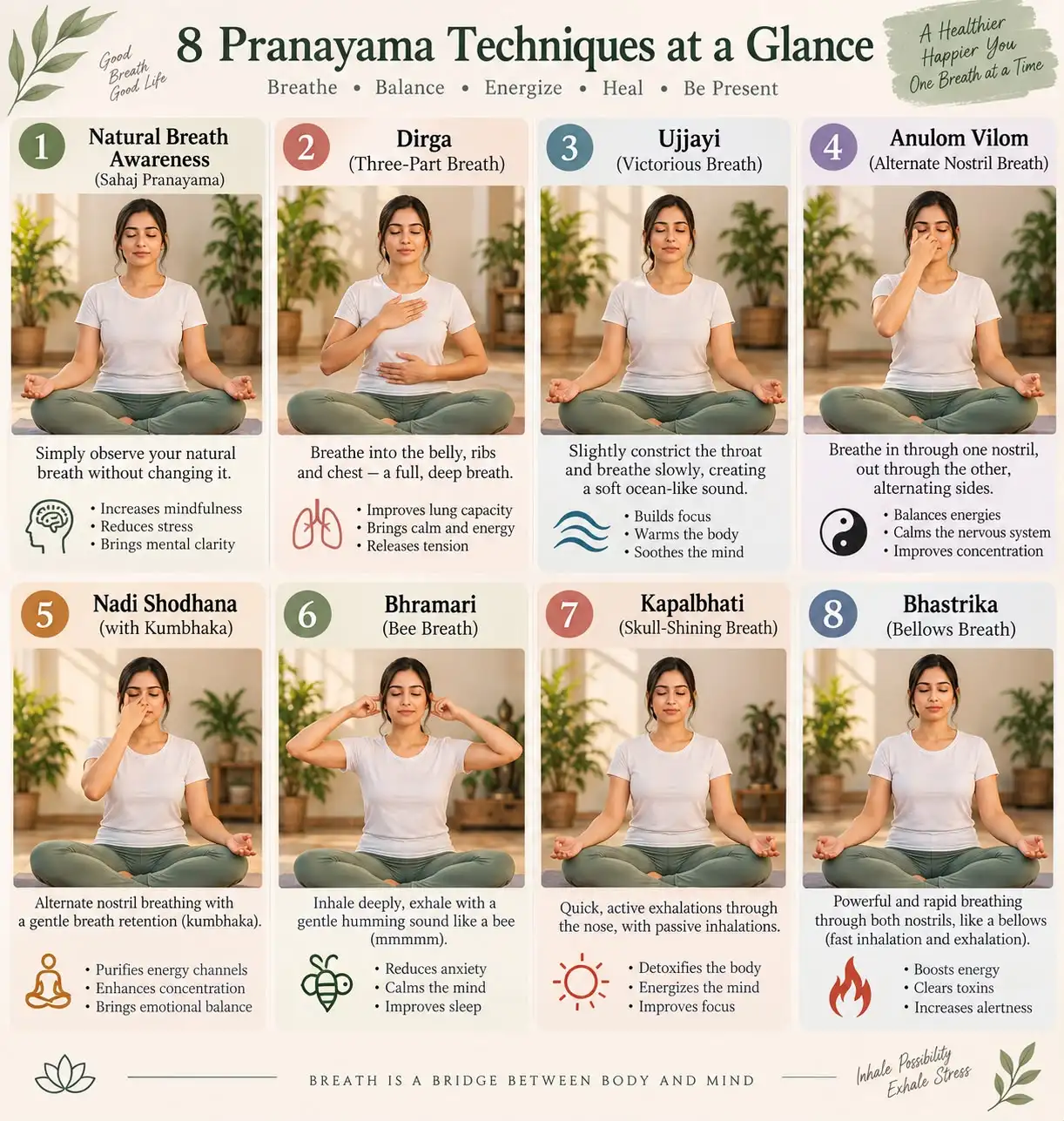
1. Natural Breath Awareness — the doorway
What it is: Not yet control — observation. You watch the breath exactly as it is: its length, its texture, where it moves in the body. Every tradition begins here, because you cannot refine what you have never noticed.
How to practice: 1. Sit tall, close your eyes, and rest your hands on your thighs. 2. Without changing anything, notice where the breath touches: nostrils, chest, belly. 3. Silently note "breathing in… breathing out" for two to three minutes. 4. Notice the small pause at the end of each exhalation. Don't stretch it — just see it.
When: Anytime. It is also the first and last two minutes of every practice session below.
Cautions: None. This is the one technique with no contraindications—which is why everyone, including pregnant students and complete beginners, starts here.
2. Dirga Pranayama (Three-Part Breath) — filling the whole vessel
What it is: Dirga means "long." You inhale in three stages — belly, ribs, chest — then release in reverse. Most adults breathe only into the upper chest; Dirga re-teaches the full, unhurried breath your body was designed for.
How to practice: 1. Sit tall (or lie on your back to feel it more easily). One hand on the belly, one on the chest. 2. Inhale slowly into the belly — feel the lower hand rise. 3. Continue the same inhalation into the ribs, feeling them widen sideways. 4. Top it off into the upper chest, beneath the collarbones. 5. Exhale in reverse: chest, ribs, belly softening last. 6. Continue for 8–10 rounds, smooth and seamless — one wave, not three jerks.
When: Beautiful at the start of practice, before meditation, or in bed before sleep.
Cautions: Very gentle. If deep breathing ever makes you light-headed, reduce the depth — a comfortable 80 % is better than a straining 100 %.
3. Ujjayi (Victorious Breath) — the ocean sound
What it is: Breathing through the nose while gently toning the throat, creating a soft ocean-like sound on both inhalation and exhalation. Ujjayi means "victorious." It is the companion breath of flowing asana practice, and a powerful focus anchor on its own.
How to practice: 1. Inhale through the nose, then exhale through an open mouth whispering "haaaa" — feel the throat's slight constriction. 2. Now close the mouth and make that same "haaaa" quality while exhaling through the nose. 3. Once the exhale is steady, bring the same gentle throat tone to the inhale. 4. Breathe slowly and evenly, the sound soft enough that only you can hear it. Continue 3–5 minutes.
When: During asana practice to pace movement with breath, or seated whenever the mind is scattered — the sound gives attention something to hold.
Cautions: The constriction should be feather-light. A loud, forced Ujjayi strains the throat and defeats the purpose. Generally considered safe for most practitioners.
4. Anulom Vilom and Nadi Shodhana (Alternate Nostril Breathing) — the balancers
What it is: The best-known pranayama family: breathing in through one nostril and out through the other, alternating sides in a set pattern. Traditionally this is said to balance the ida and pingala nadis — the cooling and energising currents — and practically, it is the most reliably calming technique we teach.
Anulom Vilom or Nadi Shodhana — what's the difference? The two names are often used interchangeably, and instructions online frequently blur them (an earlier version of this very article did). Here is the distinction as it is commonly taught, and as we teach it:
Anulom Vilom is the simple, flowing form: inhale left, exhale right, inhale right, exhale left — no breath retention. This is the version for beginners and for everyday calming practice.
Nadi Shodhana ("channel purification") is traditionally the fuller practice: the same alternate-nostril pattern, but with breath retention (kumbhaka) added between inhalation and exhalation, often in counted ratios that build gradually under a teacher's guidance.
In short: same family, same hand position, same pattern — Nadi Shodhana adds retention. (Naming varies between lineages; some teachers use "Nadi Shodhana" for the simple form too. What matters is the method, not the label — and that you leave retention out until you're ready.)
How to practice (Anulom Vilom — the form to start with): 1. Sit tall. Make nasagra mudra with the right hand: fold the index and middle fingers toward the palm, leaving thumb, ring and little finger free. 2. Close the right nostril with the thumb. Inhale slowly through the left. 3. Close the left nostril with the ring finger, release the thumb, and exhale slowly through the right. 4. Inhale through the right. 5. Close the right, release the left, exhale through the left. That is one round. 6. Continue for 5–10 minutes. Keep inhale and exhale equal, silent and unhurried. Finish on a left-nostril exhalation.
When: Before meditation, in the evening to unwind, or before anything nerve-wracking. Practicing at the same time daily deepens the effect.
Cautions: The no-retention form is gentle and generally considered suitable for almost everyone, including during pregnancy. Retention (the full Nadi Shodhana practice) is a different matter: it is traditionally avoided in pregnancy and commonly cautioned against for people with uncontrolled high blood pressure or heart conditions — learn it from a teacher, not a paragraph. Full guide to this family: Anulom Vilom: steps, benefits and variations.
5. Bhramari (Bee Breath) — sound as medicine
What it is: Bhramara is Sanskrit for a large black bee. You exhale while humming softly, ears gently closed, so the sound vibrates inside the skull. Of all the techniques, this is the one anxious and overstimulated students tend to love first — the vibration gives the racing mind something physical to rest on.
How to practice: 1. Sit tall, eyes closed. Raise the arms and close the ear flaps gently with your index fingers (or cover the ears with the palms). 2. Inhale fully through the nose. 3. Exhale slowly through the nose while humming — a smooth, medium-pitch "mmmmm" — until the breath is done. 4. Feel the vibration in the skull, jaw and chest. That felt vibration is the practice. 5. Repeat 5–7 rounds, then sit for a minute in the silence afterwards — often the best part.
When: Evening, before meditation, before sleep, or any moment of mental noise. Small studies on Bhramari suggest it may promote relaxation responses; practitioners have used it for centuries for exactly that.
Cautions: Keep the hum gentle — no throat strain, no forcing the ears shut. Best avoided with an active ear infection. Otherwise one of the safest techniques there is. (A dedicated Bhramari guide is coming to this series: Bhramari pranayama in depth.)
6. Kapalbhati (Skull-Shining Breath) — the cleanser
What it is: Rapid, rhythmic breathing where the exhalation is short and forceful — the belly snaps in — and the inhalation happens passively. Strictly speaking, Kapalbhati is not classified as pranayama at all: the Hatha Yoga Pradipika lists it among the six shatkarmas, the cleansing practices, valued for clearing the respiratory passages and energising the mind. Kapala means skull; bhati means shining.
How to practice: 1. Sit very stable — this practice needs a firm seat. Hands on knees. 2. Inhale halfway, naturally. 3. Exhale sharply through the nose by snapping the navel back toward the spine — a short, active puff. 4. Let the inhalation happen entirely by itself as the belly releases. 5. Begin with 20–30 strokes at a gentle pace, then rest and breathe naturally. That is one round; do up to three. 6. Speed and count grow over months, not days. Rhythm matters more than force.
When: Morning, on an empty stomach, after a few rounds of gentle breathing to warm up. Practitioners describe a bright, awake clarity afterwards — the "shining skull" of the name.
Cautions — please take these seriously: Kapalbhati is commonly advised against during pregnancy and for people with high blood pressure, heart conditions, hernia, epilepsy, glaucoma, or recent abdominal surgery; it is also traditionally paused during menstruation by many lineages and best skipped when you have an acute respiratory infection. If you feel dizzy, stop — that is your signal the pace or count is too much. If any of the above applies to you, stay with techniques 1–5; you lose nothing important. Full guide: Kapalbhati: benefits, steps and side effects.
7. Bhastrika (Bellows Breath) — the fire-stoker
What it is: The strongest common technique: both inhalation and exhalation are active and forceful, pumping like a blacksmith's bellows (bhastrika). Where Kapalbhati emphasises only the exhale, Bhastrika works both directions — which makes it more energising and more demanding.
How to practice (beginner form): 1. Sit stable, spine tall, hands on knees. 2. Inhale actively and fully through the nose, letting the chest expand. 3. Exhale actively and fully — equal force in both directions. 4. Continue at a moderate, even pace for 10 breaths. Then breathe naturally for 30 seconds. 5. Up to three rounds. Slower and steadier beats faster and ragged, always.
When: Morning practice, when energy is low, or before meditation in cold weather — tradition considers it a heating practice, and most practitioners agree it feels exactly like that.
Cautions: The same list as Kapalbhati, applied more strictly: generally advised against in pregnancy and with hypertension, heart conditions, epilepsy, hernia, glaucoma, or recent surgery — and worth extra care for anyone prone to panic or dizziness, since forceful fast breathing can feel overwhelming. This is the technique that most rewards learning in person. (Dedicated guide planned: Bhastrika pranayama in depth.)
A note on other practices: you may also meet Sheetali/Sheetkari (cooling breaths through the tongue or teeth) and Simha pranayama, the lion's breath — a wonderful tension-releaser we cover in our Simhasana guide. The seven above are the core curriculum; these are the electives.
The 7 techniques at a glance
Technique | Character | Best for | Level | Avoid / take care if |
|---|---|---|---|---|
Natural Breath Awareness | Neutral, observational | Starting out, meditation prep | Everyone | — |
Dirga (Three-Part Breath) | Slow, expansive | Shallow breathers, bedtime | Beginner | Reduce depth if light-headed |
Ujjayi (Victorious) | Slow, sonorous | Focus, asana practice | Beginner | Keep throat tone feather-light |
Anulom Vilom | Slow, balancing | Daily calm, before meditation | Beginner | Gentle for nearly all (no retention) |
Nadi Shodhana (with kumbhaka) | Slow + retention | Deepening an established practice | Intermediate+ | Pregnancy, hypertension, heart conditions; learn with a teacher |
Bhramari (Bee) | Slow, vibrational | Anxiety-prone minds, evenings | Beginner | Active ear infection |
Kapalbhati (Skull-Shining) | Rapid, forceful exhale | Morning energy, cleansing | Intermediate | Pregnancy, hypertension, heart conditions, hernia, epilepsy, recent surgery |
Bhastrika (Bellows) | Rapid, forceful both ways | Energy, heat | Intermediate+ | Same as Kapalbhati, applied strictly |
How to build a daily pranayama practice
The 10-minute beginner sequence (our standard prescription for new students):
Natural breath awareness — 2 minutes
Dirga three-part breath — 2 minutes
Anulom Vilom — 5 minutes
Sit in silence, breath natural — 1 minute
That's it. Same time daily — first thing in the morning is ideal, before bed is second-best. After a month of consistency, add Bhramari in the evenings, then Ujjayi during asana practice. The strong techniques (Kapalbhati, Bhastrika) come later, ideally learned face-to-face with a teacher who can watch your pace and posture.
Two habits make the difference between dabbling and practice: same seat, same time (ritual does the discipline for you), and short enough that you never skip — ten minutes done daily outperforms forty minutes done occasionally.
How we know this works: in our 200-hour teacher training, pranayama has its own dedicated hour every single morning — 8:25, right after asana practice, six days a week. Students routinely arrive assuming it will be the "filler" class between Ashtanga and breakfast. By graduation, it is the practice most of them name as the one they'll keep for life.
Frequently asked questions
How do you do pranayama breathing?
Sit upright, breathe through the nose, and begin with observation rather than control: two minutes watching the natural breath, then a few minutes of slow three-part breathing (belly, ribs, chest), then five minutes of Anulom Vilom — inhale left nostril, exhale right, inhale right, exhale left. Smooth, silent, unstrained. That simple sequence is pranayama breathing; everything else in this guide is refinement.
Which is the most powerful pranayama?
By intensity, Bhastrika — it works both breath directions forcefully and demands the most respect. But "powerful" is the wrong lens: the techniques that change lives are usually the gentle ones practiced daily. A modest Anulom Vilom habit will do more for your nervous system than occasional intense sessions of the strong practices — and carries none of their cautions.
How long should you practice pranayama?
Ten to fifteen minutes daily is plenty for beginners, and honestly, plenty forever. Experienced practitioners may sit for twenty to thirty minutes. Consistency beats duration in everything we observe with students: daily short practice, same time each day, is the pattern that produces results.
Which pranayama is best for the lungs?
Research on yogic breathing suggests slow, full techniques — Dirga, Ujjayi, alternate-nostril breathing — may support measures of lung function by training complete, efficient breaths. Kapalbhati and Bhastrika actively exercise the diaphragm and abdominal muscles, though their cautions apply. If you have asthma or another respiratory condition, stay with the slow techniques, avoid forceful breathing and retention, and read our guide to yoga for asthma — with your doctor's guidance first.
Can pranayama be dangerous?
The gentle techniques, practiced without strain, are generally considered low-risk for healthy people. The risks concentrate in two places: forceful practices (Kapalbhati, Bhastrika) and breath retention — which is why both carry the caution lists above and are best learned in person. The universal safety valve: any dizziness, tingling or anxiety means stop and return to natural breathing. Pranayama should never feel like a struggle.
Can I practice pranayama during pregnancy?
Gentle, retention-free practices — breath awareness, Dirga, soft Ujjayi, Anulom Vilom, Bhramari — are generally considered suitable in pregnancy and are taught in prenatal yoga, but please confirm with your doctor or midwife first. Kapalbhati, Bhastrika and breath retention are commonly advised against throughout pregnancy. More in our prenatal yoga guide.
When the breath asks for more than ten minutes
Everything in this guide can be learned at home, free, starting tonight — and for most people, the 10-minute sequence is genuinely enough. But some practitioners reach the point where the breath becomes the practice: they want the retention work, the ratios, the subtle practices, and the ability to teach it all safely. That is what our 100-hour Pranayama Teacher Training in Rishikesh is for — ten immersive days by the Ganga covering technique, theory and teaching practice, at the school where pranayama gets its own hour every morning. If you already hold an RYT, the hours also count toward Yoga Alliance Continuing Education (YACEP). Questions about whether it suits your level? Message us on WhatsApp — a real teacher answers.
This article is for general education and is not medical advice. Please consult a qualified healthcare professional about your individual situation, especially before beginning forceful breathing practices or breath retention.
References
National Center for Complementary and Integrative Health (NCCIH) — Yoga: What You Need To Know. (verify exact URL at publish)
Patanjali — Yoga Sutras, Sadhana Pada (pranayama as the fourth limb; classical definition). (cite published translation at publish)
Svatmarama — Hatha Yoga Pradipika, Chapter 2 (pranayama and the shatkarmas, incl. Kapalbhati's classification). (cite published translation at publish)
Peer-reviewed reviews on slow-paced breathing, heart-rate variability and psychophysiological outcomes. (select exact citations at publish — no specific statistics quoted in this article)
Peer-reviewed studies on yogic breathing and pulmonary function measures in healthy practitioners. (select exact citations at publish)
Reviewed for health accuracy by Dr. Bhupinder Singh Arora (M.D. Ayurveda), consulting Ayurvedic physician at Pure Soul Yoga School. This article is educational and not a substitute for personal medical advice.
Author note (byline): Gangesha Adi (E-RYT 500, YACEP) leads the pranayama curriculum at Pure Soul Yoga School, where breathing practice holds a dedicated daily hour in every teacher training — and has guided it for students of 50+ nationalities over the past decade.