Healing Meditation: 5 Gentle Practices for Emotional Recovery
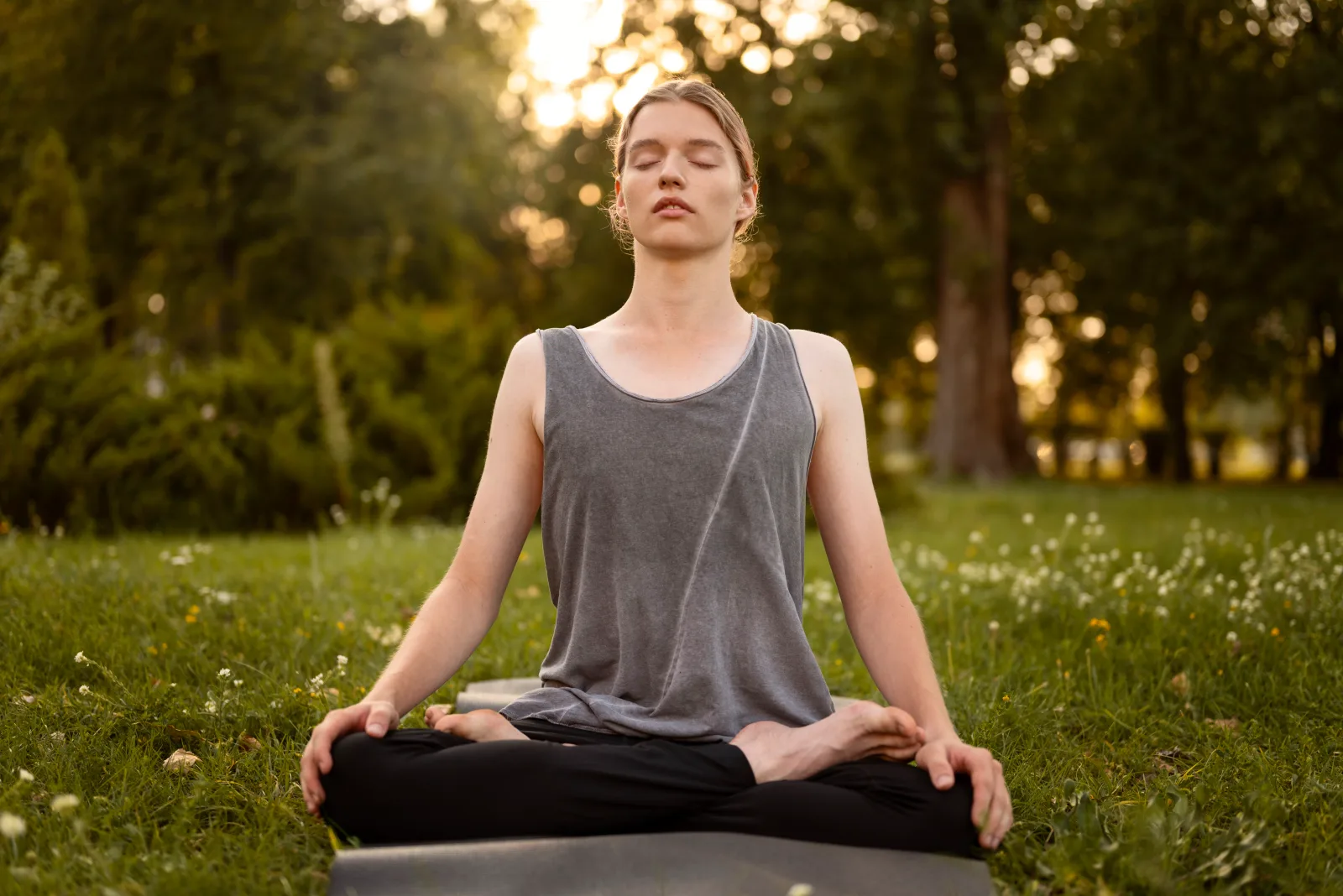
Healing meditation is a gentle, restful style of practice — body scans, loving-kindness, breath awareness, guided deep relaxation — used to support recovery from difficult seasons: illness, grief, burnout, emotional strain. Let's be precise about the word "healing" from the first paragraph, because it gets badly oversold online. Meditation does not cure disease, mend injuries or replace treatment. What research suggests it may do is lower stress, ease the mind's grip on pain, improve sleep and restore a sense of calm — conditions in which body and heart do their recovering better. Meditation complements, never replaces, medical or psychological care.
With that said honestly, here are five practices we teach in Rishikesh, how to begin today, and straight answers to the questions people actually ask.
This article is for general education and is not medical advice. If you are unwell, recovering from illness or struggling emotionally, please consult a qualified healthcare professional about your individual situation — and use these practices alongside their guidance, not instead of it.
What "healing" means here — and what it doesn't
In the yogic understanding, deep rest is not idleness; it is the state in which the nervous system settles and the whole person begins to reorganise toward balance. That is the sense in which we use "healing": the restoration of calm, steadiness and wellbeing — feeling whole again after a period that pulled you apart.
What it does not mean: meditation is not a treatment for cancer, infection, injury, depression or any other condition, and you should be wary of anyone who implies otherwise. The evidence-based claim is more modest and still valuable: studies of meditation and mindfulness-based programs suggest they may reduce stress, improve how people cope with chronic pain, ease symptoms of low mood, and support sleep. Those are real contributions to recovery — beside your doctor's care, never in place of it.
How to do a healing meditation: the simple shape
Every practice below follows the same shape, so learn it once:
Settle. Sit supported or lie down — comfort matters more than posture here. Set a gentle timer for 10–20 minutes.
Arrive. Take five slower breaths, letting the exhale lengthen, and let the body grow heavy.
Practice. Give attention one kind anchor — the body, the breath, a phrase — as described in each technique.
Wander and return. The mind will drift; that is not failure. Noticing and returning, gently, is the meditation.
Close slowly. Take a minute before rising. The transition is part of the practice.
5 healing meditation practices
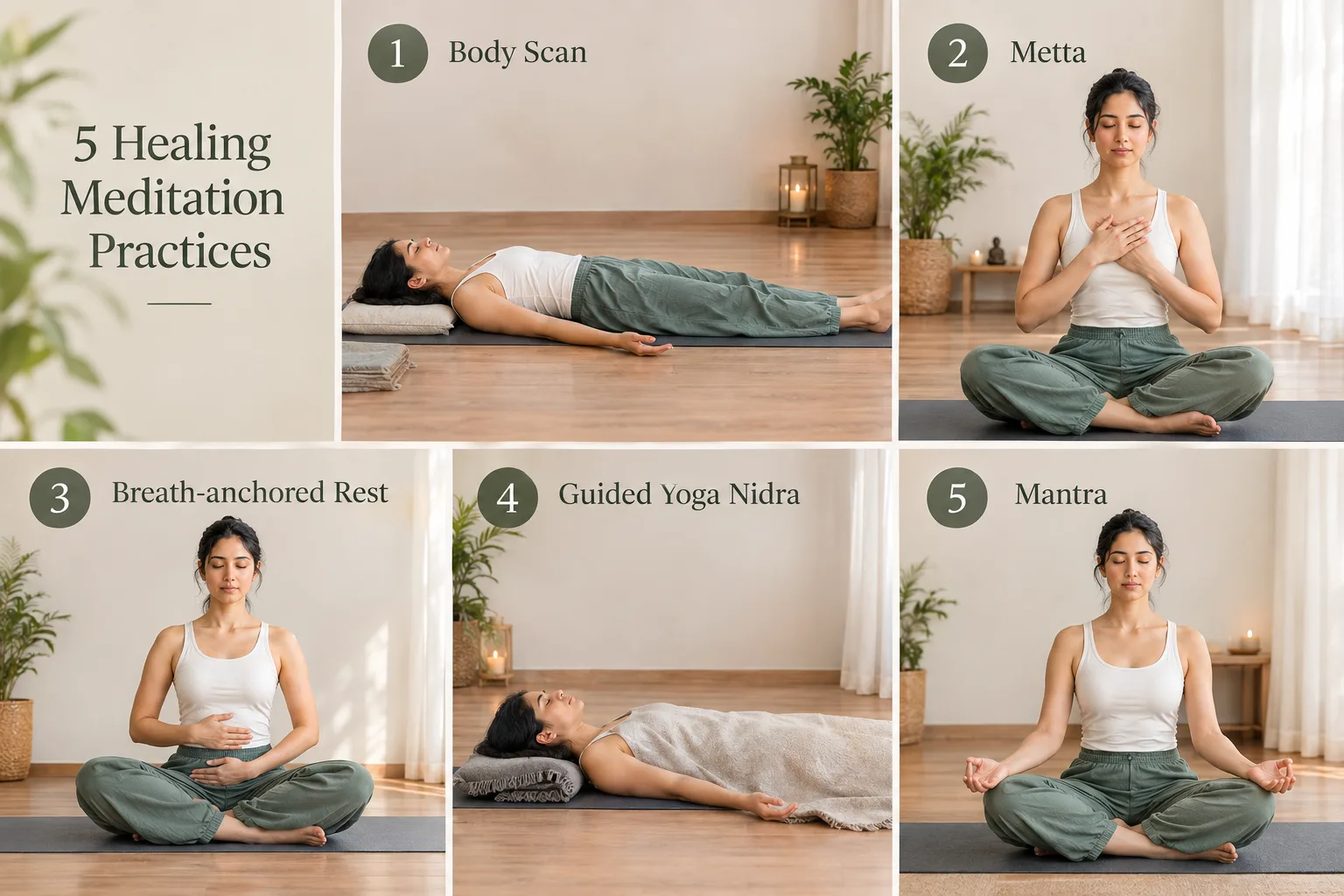
1. Body scan — meeting the body kindly
Lying down, move your attention slowly from the toes to the crown, region by region, simply noticing what is there — warmth, tension, ache, numbness, nothing — without trying to fix any of it. Ten to twenty minutes.
Why it helps: after illness, loss or long stress, many people quietly stop inhabiting their body. The body scan rebuilds that relationship on friendly terms, and it is the most-studied of these practices — a core component of mindfulness programs that research suggests may help with stress and chronic-pain coping.
2. Metta — loving-kindness meditation
Sitting comfortably, silently repeat a few simple phrases, first for yourself: may I be safe; may I be well; may I be at ease. After some minutes, offer the same phrases to someone you love, then gradually outward — a friend, a stranger, even someone difficult.
Why it helps: emotional wounds are usually tangled with self-criticism — for getting ill, for grieving "too long", for burning out. Metta practises the opposite movement, and studies suggest it may increase positive emotion and self-compassion over time. It can feel awkward or bring up sadness at first; that is common, and gentleness — not force — is the way through.
3. Breath-anchored rest
Sit or lie down, place one hand on the belly, and let your attention ride the natural breath — the rise, the fall, the small pause between. No counting, no control; just company. Five to fifteen minutes.
Why it helps: this is the simplest practice on the page and, for exhausted people, often the right one — there is nothing to achieve. A naturally slowing breath appears to settle the nervous system toward its rest-and-repair mode. If working with the breath draws you in, our guide to pranayama breathing techniques is the natural next step.
A tip from our teaching hall: students recovering from hard seasons often try to meditate the way they used to work — hard. If you notice effort creeping in, make the practice smaller, not stronger. Five genuinely gentle minutes restore more than twenty gritted ones.
4. Guided Yoga Nidra — rest that goes deep
Yoga Nidra is a systematic, voice-guided relaxation practiced lying down: rotation of attention through the body, awareness of breath, and a state of rest that hovers between waking and sleep. Follow any calm guided recording, or a teacher. At our school the teaching day closes with an evening meditation or Yoga Nidra session, and for depleted students it is reliably the most restorative hour of the day — we teach the method in depth on our dedicated Yoga Nidra teacher training.
Why it helps: because it is fully guided and asks for nothing, Nidra suits people too tired or raw for silent practice. Falling asleep during your first attempts is normal and allowed.
5. Mantra — giving the mind one kind thing to hold
Choose a simple sound or phrase — the traditional so-ham ("I am that"), a sacred word from your own tradition, or a plain English phrase like I am here. Repeat it silently in rhythm with the breath: so on the inhale, ham on the exhale. Ten minutes.
Why it helps: a grieving or frightened mind loops. Mantra doesn't argue with the loop; it offers a steadier rhythm to rest on, which is why this practice shines when thoughts are too loud for open awareness.
A gentle daily practice for hard seasons
Little and daily, never heroic:
When | Practice | Time |
|---|---|---|
Morning | Breath-anchored rest, then three rounds of metta phrases for yourself | 8–10 min |
Midday (optional) | Two minutes of breath awareness before eating | 2 min |
Evening | Body scan or guided Yoga Nidra, lying down | 15–20 min |
If that is too much, keep only the evening practice. In recovery, the kindest schedule is the one you can actually keep.
Can you heal your body through meditation?
Directly, no — and it matters to say so plainly, because this claim circulates widely. Meditation does not shrink tumours, repair tissue or cure illness, and choosing meditation instead of treatment can cause real harm.
Indirectly, it may genuinely support the conditions recovery depends on: research suggests regular practice may reduce stress and its physical wear, improve sleep, ease the suffering component of chronic pain, and support mood. Think of meditation as tending the soil, not performing the surgery. Both matter; only one belongs to your medical team. If what you're carrying is persistent worry rather than convalescence, our yoga for anxiety guide addresses that honestly, including when to seek professional help; if it's everyday overwhelm, we have a full guide to yoga for stress relief as well.
Frequently asked questions
What is the best meditation for healing?
The one you'll actually do daily. As a rule of thumb from our teaching: body scan or Yoga Nidra when you're physically depleted, metta when the wound is emotional, mantra when the mind is loud, breath-anchored rest when everything feels like too much. All five may help; none is magic.
What is the best meditation for pain relief?
Body-scan-based mindfulness has the most research behind it for chronic pain — studies suggest it may reduce pain's interference with life by changing your relationship to the sensation, even when intensity doesn't change much. It complements, never replaces, proper pain management; persistent pain should always be assessed by a doctor.
How long should I meditate for healing?
Ten to twenty minutes once or twice a day is a realistic, worthwhile dose — and five gentle minutes still counts. Consistency over weeks, not length on any single day, is what the encouraging research is built on.
Is healing meditation religious?
It doesn't have to be. Body scan and breath rest are entirely secular; metta and mantra come from contemplative traditions but work with plain-language phrases. Practitioners of any faith — or none — use these practices comfortably.
Can meditation replace therapy or medication?
No. If you are in treatment for a physical or mental-health condition, meditation is a complement — one worth telling your clinician about, as it's almost always welcomed alongside care. Stopping treatment in favour of meditation is the one way this gentle practice can become genuinely dangerous.
If you need more than ten quiet minutes a day
Some recoveries need more space than daily life allows. Our Healing Retreat in Rishikesh offers that space honestly: days of gentle yoga, meditation and Yoga Nidra beside the Ganga, a private room, unhurried food and rest — beginning consultation-first, with a doctor's consultation on arrival and any therapies prescribed to you, never sold to you. It is not a medical treatment and we will never present it as one; it is a protected place to practise everything on this page with teachers beside you. Start dates are flexible, and real humans answer questions on WhatsApp.
References
National Center for Complementary and Integrative Health (NCCIH) — Meditation and Mindfulness: What You Need To Know.
Goyal M. et al. — Meditation programs for psychological stress and well-being: systematic review and meta-analysis, JAMA Internal Medicine.
Research on mindfulness-based stress reduction (MBSR) and chronic pain (PubMed Central reviews).
Research reviews on loving-kindness meditation and positive emotion (PubMed Central).
Reviewed for health accuracy by Dr. Bhupinder Singh Arora (M.D. Ayurveda), consulting Ayurvedic physician at Pure Soul Yoga School. This article is educational and not a substitute for personal medical or psychological advice.
Author note (byline): Gangesha Adi (E-RYT 500) leads the teaching team at Pure Soul Yoga School in Rishikesh, where the evening meditation and Yoga Nidra sessions he oversees have closed the teaching day for students of 50+ nationalities — many of them arriving in seasons of recovery.