The 7 Chakras Explained: Meanings, Locations & the Map Behind Them
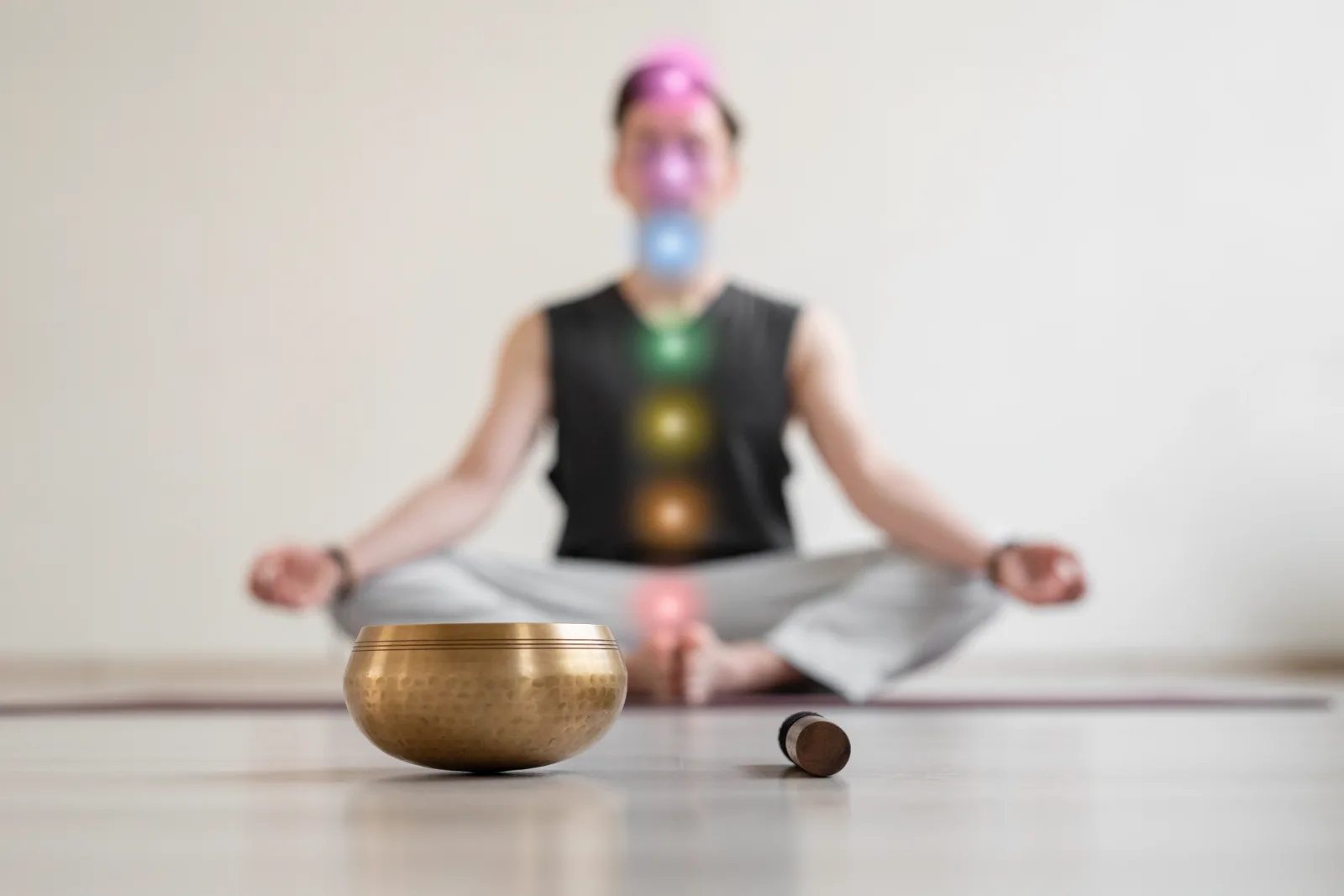
The 7 chakras are the seven principal energy centres described in the yogic and tantric traditions of India — points along the spine, from its base to the crown of the head, where prana (the life-force of yogic philosophy) is said to gather and circulate. From root to crown they are muladhara, svadhisthana, manipura, anahata, vishuddha, ajna and sahasrara, and each is traditionally associated with a region of the body and a theme of human experience: security, pleasure, will, love, expression, insight and transcendence.
One honest sentence before we go further, because most articles on this topic skip it: chakras are not anatomical structures. No scan will find them, and modern science has not verified them. What they are is something else — a contemplative map of inner experience that yogis have refined and taught for many centuries, and that millions of practitioners still find genuinely useful today. This guide explains that map faithfully: where each chakra sits, what it means, where the system comes from, and how to think about it with both respect and clear eyes.
What is a chakra, exactly?
The Sanskrit word chakra means "wheel" or "disc." In the yogic view of the person, you are more than a physical body: the tradition describes a subtle body — a non-physical dimension of energy and mind that overlays the physical one. Through this subtle body run channels called nadis, and prana is said to flow through them the way blood flows through vessels. The central channel, sushumna, runs along the axis of the spine, and the chakras are described as wheels or lotuses positioned along it — junction points where many nadis meet and where prana concentrates.
Each chakra is traditionally pictured as a lotus with a specific number of petals, a colour, an element, a seed syllable (bija mantra), and a cluster of psychological themes. In practice, teachers use the system less as a diagram to memorise and more as a language: a way of talking about layers of human experience — from survival instinct at the base to spiritual openness at the crown — in a single coherent picture.
Where does the chakra system come from?
The idea of an inner subtle body appears in early Indian contemplative literature, including the Upanishads, which speak of vital energies and channels within the person. The detailed seven-chakra scheme most people know today, however, was elaborated later, in the tantric traditions and in hatha yoga texts, which map the chakras along sushumna and connect them to practices of breath, mantra and meditation. In those traditions the map serves a purpose: kundalini, a latent spiritual energy pictured as coiled at the base of the spine, is said to rise through the chakras toward the crown as practice matures.
It is worth knowing that different texts and lineages describe different numbers of centres — five, six, seven, nine, even more. The seven-chakra model became the standard largely through influential translations and popular writing as the tradition travelled West, where the now-familiar rainbow colour scheme was also added. None of this makes the system less meaningful; it simply means you are looking at a living tradition with many voices, not a single fixed anatomy chart.
In our philosophy classes at Pure Soul Yoga School, this is usually the moment a student raises a hand and asks, "So… are chakras real?" Our answer: they are real the way a map is real. A map of a territory is not the territory, yet it can guide you through it beautifully. Hold the chakra system that way and it serves you well.
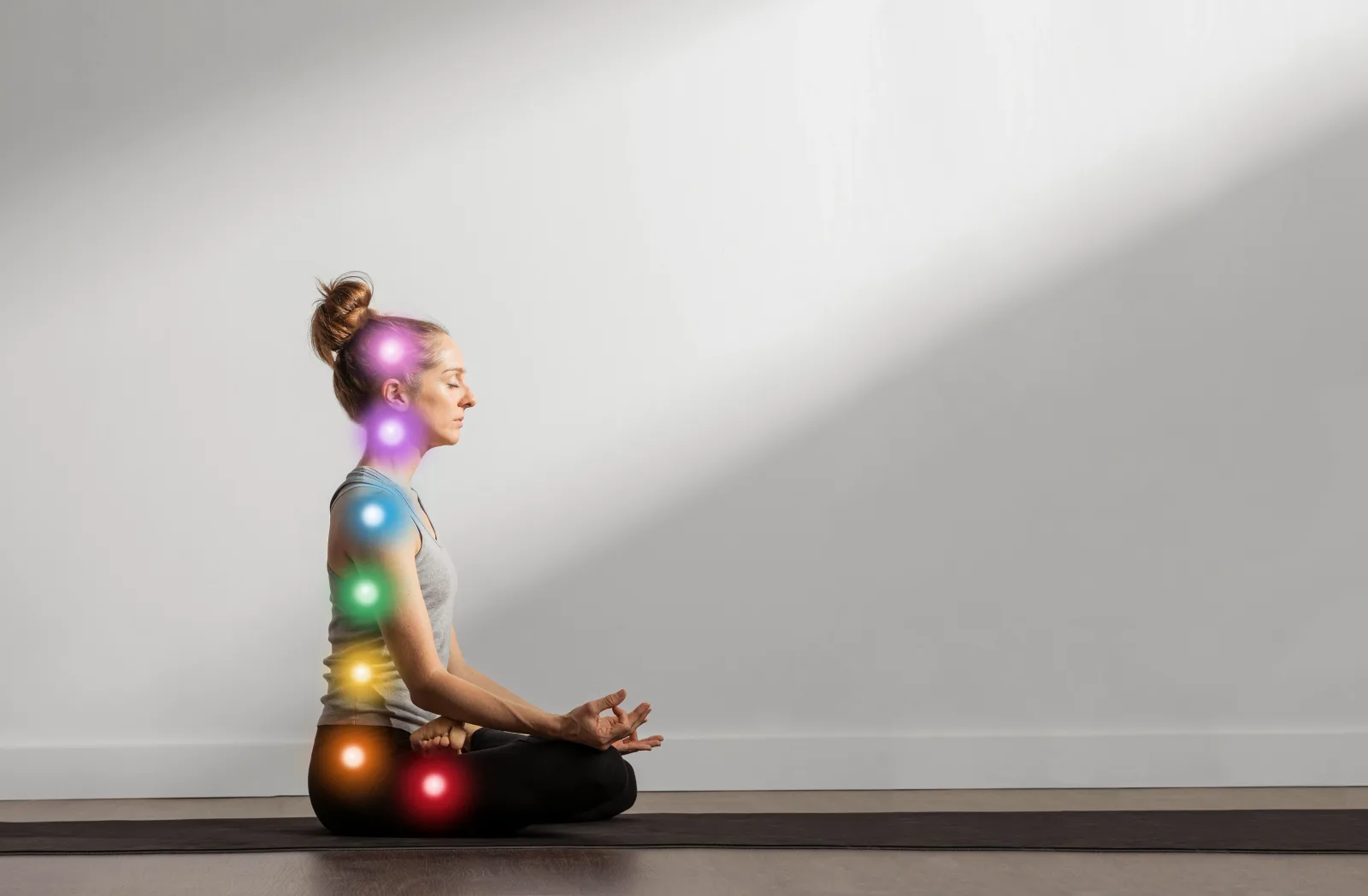
The 7 chakras at a glance
# | Chakra (Sanskrit) | Common name | Traditional location | Element (tradition) | Traditionally associated with |
|---|---|---|---|---|---|
1 | Muladhara | Root chakra | Base of the spine, pelvic floor | Earth | Stability, security, survival, groundedness |
2 | Svadhisthana | Sacral chakra | Lower abdomen, below the navel | Water | Pleasure, emotion, creativity, sensuality |
3 | Manipura | Solar plexus chakra | Upper abdomen, navel region | Fire | Willpower, confidence, self-discipline, "digestive fire" |
4 | Anahata | Heart chakra | Centre of the chest | Air | Love, compassion, connection, forgiveness |
5 | Vishuddha | Throat chakra | Throat | Ether/space | Expression, truthfulness, communication |
6 | Ajna | Third-eye chakra | Between the eyebrows | — (mind) | Intuition, insight, imagination, clarity |
7 | Sahasrara | Crown chakra | Crown of the head | — (beyond the elements) | Transcendence, unity, spiritual connection |
Now let's walk the ladder properly, root to crown.
Muladhara — the root chakra
Mula means "root" and adhara means "support" — the root support. Located at the base of the spine, muladhara is pictured as a four-petalled red lotus, associated with the earth element. It is traditionally associated with the most fundamental layer of being human: safety, survival, belonging, and the feeling of standing on solid ground.
When teachers speak of a "balanced root," they mean the felt sense that your basic needs are secure enough for you to relax — the precondition, in the yogic view, for everything above it. It is no accident the system starts here: the tradition insists that spirituality is built on stability, not instead of it.
Svadhisthana — the sacral chakra
Svadhisthana is usually translated as "one's own dwelling place." Seated in the lower abdomen, it is pictured as a six-petalled orange lotus and linked with the water element — fluidity, taste, flow. It is traditionally associated with pleasure, desire, emotion, sensuality and creativity: the waters of life that make existence enjoyable rather than merely survivable.
The tradition treats this centre with nuance. Desire is not condemned; it is understood as energy that can either scatter or be gathered. Much of yogic ethics — the yamas and niyamas of the eight limbs — is guidance on relating to this energy wisely.
Manipura — the solar plexus chakra
Manipura means "city of jewels." Located at the navel region and pictured as a ten-petalled lotus, it carries the fire element — and everything fire implies: heat, transformation, digestion, drive. It is traditionally associated with willpower, confidence, ambition and self-definition — the "I can" of the personality.
Classical hatha texts pay this region great attention, connecting the navel centre with agni, the transformative fire, which is why so many traditional practices — certain breathing techniques among them — focus on the belly. (You'll meet those in our guide to pranayama breathing techniques; this article stays with the map itself.)
Anahata — the heart chakra
Anahata means "unstruck" — a reference to the mystical idea of a sound not produced by two things striking, the soundless sound heard in deep meditation. Located at the centre of the chest and pictured as a twelve-petalled green lotus with the air element, it is traditionally associated with love, compassion, empathy, grief and forgiveness.
The heart chakra sits exactly in the middle of the seven — three below, three above — and teachers love that geometry: anahata is where the earthy, personal energies of the lower centres meet the subtle, transpersonal energies of the upper ones. In the traditional account, the quality of that meeting is the quality of your relationships.
Vishuddha — the throat chakra
Vishuddha means "especially pure." Located at the throat, pictured as a sixteen-petalled blue lotus and linked with the element of ether or space, it is traditionally associated with expression, communication, and truthfulness — satya, one of yoga's core ethical commitments.
The traditional teaching here is elegant: the throat is where the inner (thought, feeling) becomes outer (word, song, silence). Mantra chanting — a daily class in our trainings — is classically considered a throat-centre practice for precisely this reason.
Ajna — the third-eye chakra
Ajna means "command" or "perceive." Located between the eyebrows and pictured as a two-petalled indigo lotus, ajna sits beyond the five elements, in the territory of mind itself. It is traditionally associated with intuition, insight, imagination, and the witnessing awareness that meditation cultivates — the "seeing" that happens with the eyes closed.
In many lineages this is the primary seat of meditation: attention is gathered at the eyebrow centre, where the tradition says the major nadis converge before rising to the crown.
Sahasrara — the crown chakra
Sahasrara means "thousand-petalled" — the lotus of a thousand petals at, or just above, the crown of the head. Strictly speaking, many texts treat sahasrara as beyond the chakra system rather than the seventh rung of it: it represents not another category of experience but the transcendence of categories altogether. It is traditionally associated with unity, liberation and the meeting of individual consciousness with the universal — the destination of the kundalini's ascent, and of yoga itself, whose very name means "union."
Tradition and science: holding both honestly
Here is the part we insist on teaching plainly, because your trust matters more to us than a tidy story.
What the tradition says: the chakras are real features of the subtle body; prana flows through nadis; practice purifies these channels and awakens dormant energy, moving the practitioner toward liberation. This account is internally coherent, many centuries deep, and has guided serious practitioners for generations.
What science says: there is no anatomical or physiological evidence for chakras, nadis or prana as literal structures or energies. Research on yoga and meditation shows measurable effects on wellbeing and stress-related outcomes, but those findings concern the practices, not the chakra map itself. Claims that chakra work can diagnose, treat or cure medical conditions have no scientific support — and any teacher making them is overreaching.
How we hold it: as psychology by other means. Security, pleasure, will, love, expression, insight, transcendence — the seven themes are recognisably the layers of a human life, ordered from most basic to most subtle. Used that way — as a mirror for self-reflection and a framework for practice — the chakra system doesn't need laboratory validation to be valuable, any more than poetry does. What it should never be used for is replacing medical or psychological care.
How practitioners work with the chakra system
Traditionally, the chakras are engaged through meditation (attention placed at a centre), mantra (each chakra has its bija syllable — LAM, VAM, RAM, YAM, HAM, OM for the six below the crown), breathwork, visualisation of the lotuses and their colours, and ethical living as taught in the eight limbs of yoga (the pillar guide to that framework is coming to this blog soon). Physical postures are also traditionally mapped to the chakras — grounding poses to the root, heart-openers to anahata and so on — and we cover that practice side fully in our separate guide to yoga poses for the chakras, so we won't duplicate it here.
If the meditative side of this map is what draws you, that is exactly the territory our Meditation Yoga Teacher Training in Rishikesh lives in — chakra theory taught in its classical context, alongside daily meditation and mantra practice, in the town where these teachings have been passed down for generations.
Frequently asked questions
Are there 7 or 9 chakras?
Both answers appear in the tradition — along with five, six, ten and more. Different texts and lineages map the subtle body differently; the seven-chakra scheme is simply the version that became standard, especially in the West. If you encounter a nine- or twelve-chakra teaching, you're not seeing a contradiction so much as a different edition of the map.
What is the most powerful chakra?
The tradition doesn't rank them that way — the system is a ladder, and every rung matters. If pressed, texts give special status to two: muladhara, because everything rests on it and kundalini is said to sleep there, and sahasrara, because it represents the goal. But treating any centre as "the powerful one" misses the point: the map describes a whole person.
How do you know when your chakras are blocked?
"Blocked" is traditional language, not a medical finding — in the classical account it means prana is not flowing freely through a centre, felt as constriction in that centre's life-theme: persistent insecurity (root), creative flatness (sacral), collapsed will (solar plexus), a guarded heart, a swallowed voice, mental fog, spiritual dryness. Modern teachers use it as reflective shorthand. If what you're experiencing is a physical symptom or real distress, that's a conversation for a doctor or therapist, not a chakra chart.
What happens if all 7 chakras are open?
In the traditional account, a practitioner whose centres are fully purified and awakened experiences the free ascent of kundalini to the crown — described as profound peace, clarity, compassion and, ultimately, liberation (moksha). That is a description of the tradition's ideal, reached through decades of dedicated practice under guidance, not a weekend outcome — and honest teachers present it as such.
How do I awaken or start working with the chakras?
Start where the tradition starts: sit quietly, breathe consciously, and bring gentle attention to each region of the body from base to crown, noticing what you find. Add breath practices and mantra if they appeal to you, and let the framework prompt honest self-reflection — "how is my sense of security, really? my honesty? my heart?" That reflective use is the system's most immediate gift, and it's available on day one.
Do chakras belong to a religion? Can I engage with them from another faith?
The chakra system arose within Hindu and Buddhist tantric traditions, so its roots are spiritual and deserve respectful acknowledgment. Engaging with it, though, doesn't require adopting a religion — many practitioners of other faiths, and of none, use it as a contemplative framework for self-understanding. What your own tradition says about such practices is a personal matter we'd never presume to answer for you; we simply teach the map as it has been taught to us, and leave belief where it belongs — with you.
Keep walking the map
The chakra system rewards slow acquaintance: read it, sit with it, notice which of the seven themes is loudest in your life this season. If you want to go deeper, our guide to pranayama breathing techniques covers the breath practices the tradition pairs with this map, and the forthcoming pillar guide to the eight limbs of yoga sets the chakras in their wider philosophical home. And if you'd rather study all of this where it was taught for centuries — with teachers, texts and daily practice by the Ganga — you can ask us anything about the Meditation Yoga Teacher Training in Rishikesh on WhatsApp. Real humans answer, usually within hours.
References
The Upanishads (classical Indian texts) — early descriptions of prana and the subtle channels.
Hatha Yoga Pradipika (attributed to Svatmarama) — hatha yoga's account of nadis, kundalini and the energy centres.
Shat-Chakra-Nirupana (tantric text, translated in Arthur Avalon's The Serpent Power) — the classical description of the six centres and sahasrara.
National Center for Complementary and Integrative Health (NCCIH) — research overviews on yoga and meditation (practice outcomes; notes limits of evidence).
Author note (byline): Gangesha Adi (E-RYT 500) teaches yoga philosophy and meditation at Pure Soul Yoga School, Rishikesh, where the chakra system is part of the daily philosophy curriculum for students of 50+ nationalities.