Ardha Matsyendrasana Benefits: The Twist Named After a Sage
Most asana names describe animals, objects, or shapes. A rare few honour people — and Ardha Matsyendrasana is the most famous of them, named for Matsyendranath, the legendary "lord of the fishes" revered as a founding master of hatha yoga. Ardha means half: the half version of the sage's formidable full twist, and the seated rotation nearly every hatha lineage — and our own asana library — treats as the classical twist. Here is the direct answer to what it's for: ardha matsyendrasana keeps the spine's rotation alive — the turning movement adult life quietly abandons — and it does so more thoroughly than any other common seated pose. It may also ease back stiffness and support comfortable digestion, claims we'll hedge properly below. What it does not do, despite a thousand articles — including, frankly, the older one this guide replaces — is "detoxify" your organs. The twist is better than those claims: it just needs the truth told about it.
This article is for general education and is not medical advice. If you have spine, disc, or abdominal conditions, please read the cautions below and consult a qualified healthcare professional about your individual situation.
The shape, briefly
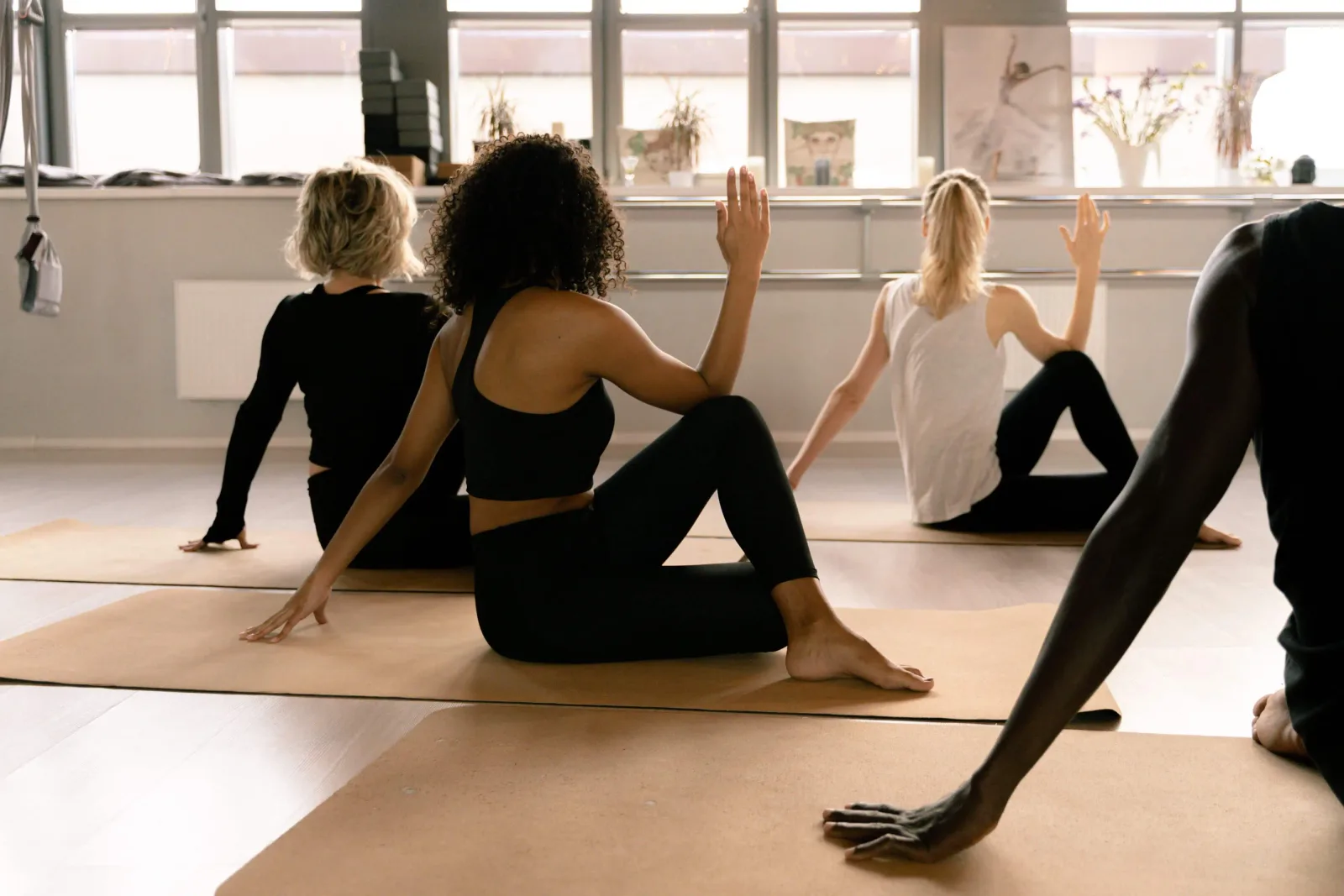
Sit with both legs extended. Bend the right knee and step the right foot over the left leg, sole flat to the floor outside the left thigh. (Classically the left leg then folds in, heel beside the right hip; keeping it straight is an equally respectable version.) Grow tall on an inhale, and on the exhale rotate the torso toward the upright knee — left arm wrapping or bracing against it, right hand on the floor behind you like a tent pole. The spine turns as a spiral staircase, from the base upward, the head turning last and least. Then the whole thing again to the other side, because a twist done once is a twist half-done.
What the twist actually gives you
Rotation, preserved. Daily life bends us forward constantly and rotates us almost never — yet turning is exactly what reversing a car, reaching a back seat, and most sports demand. A spine's unused ranges shrink over the years; a range regularly and gently visited tends to stay available. Ardha matsyendrasana is the practice's most systematic visit to rotation, and this — unglamorous, cumulative — is its headline benefit.
Stiffness, addressed sideways. The twist stretches the muscles along the spine, around the ribs, and across the outer hip of the crossed leg — regions that forward bends never quite reach. Many practitioners find it may help ease the ordinary stiffness of long sitting; the after-feeling of a slow, two-sided twist is one of the practice's more convincing arguments for itself.
Digestion — the claim, hedged to its honest size. Tradition holds that compressing and releasing the abdomen "massages" the digestive organs and kindles the digestive fire, and this pose is tradition's favourite example. What can honesty keep of that? The twist genuinely does compress and release the abdominal region, gentle movement in general is associated with more comfortable digestion, and many practitioners subjectively find twists settling for the belly. What the evidence does not support is a treatment effect — a pose that fixes constipation, cures indigestion, or tunes the liver. We pass the tradition on with respect, at that honest size. (For the tradition-minded: vajrasana is the posture classically most associated with after-meal digestion — on its own page, with the same hedging.)
Posture's rotating partner. Slumped sitting stiffens the mid-back in all directions. Restoring rotation there may help the whole region move — and a mid-back that moves is a friendlier neighbour to the neck and lower back above and below it.
What twists don't do (the detox correction)
The claim appears everywhere, so let's retire it properly: twisting does not wring toxins out of your organs. The image — squeeze the body like a wet cloth, watch impurities flow away — is vivid and physiologically fiction. Your liver and kidneys perform the body's actual filtering, continuously, unaided; blood flow briefly redirected by a stretch neither flushes nor purifies anything, and "toxins" in these articles are never named because no measurable substance behaves this way. The older version of this very post repeated the wet-cloth story, which is one reason it was rewritten. Drop the myth and nothing of value is lost — the pose's real gifts, mobility and ease, were never about detoxification.
How to build the twist, in stages
Stage one — easy cross-legged twist. Sit simply, spine tall (on a folded blanket if the lower back rounds), one hand to the opposite knee, the other behind you. Inhale to lengthen, exhale to rotate. This carries a surprising share of the full pose's benefit and is where stiff or new spines should live for a while.
Stage two — half pose, bottom leg straight. Step one foot over the extended leg and turn toward the upright knee. Most bodies meet honest work right here.
Full pose. Fold the bottom leg in, heel to the opposite hip; hug or brace the upright knee and rotate. Only if both sitting bones stay grounded — a lifted hip is the pose's way of saying "stage two, please."
In every stage, the sequence is the same: inhale, grow taller; exhale, turn a little; never yank with the arms — they steer, the spine's own muscles turn. Shoulders stay low, breath stays even, the head turns last and only as far as comfortable.
Hold 20–30 seconds a side, unwind slowly on an exhale, and always do both sides — finishing with a breath or two facing forward.
A tip from our teaching hall: if your twist stops improving, stop twisting harder and sit taller instead. A slumped spine has no room to rotate — every centimetre of height you find on the inhale is bought back as rotation on the exhale. Length first, turn second; that one ordering is most of twisting technique.
Who should be careful
Practice gently, modify, or take individual advice first if any of these apply: disc problems or significant back conditions — rotation under load is a direction injured discs may resent, so keep twists mild and professionally cleared; recent abdominal or spinal surgery, or hernia — the compression is exactly what to avoid until cleared; sacroiliac joint issues — deep seated twists can aggravate them, so stay at stage one; and pregnancy — closed twists that compress the belly are set aside in favour of gentle open twists learned from a qualified prenatal teacher. Sharp pain, tingling, or anything electric down a limb ends the twist immediately. Ordinary muscular stretch sensation along the back and hip is the pose working as intended.
Frequently asked questions
What are the benefits of Ardha Matsyendrasana?
In one honest paragraph: preserved spinal rotation (the demonstrable core), relief that may come for sitting-related stiffness through the back, ribs and outer hips, a traditional and gently plausible — but unproven — association with comfortable digestion, and the settled feeling that follows slow, symmetrical twisting. Not on the list: detoxification, organ cures, or fat loss.
How many times should we do Ardha Matsyendrasana?
Once per side, held 20–30 seconds and eventually up to a minute, is a complete daily dose; twice per side if your practice has room. Gentle daily twisting beats occasional aggressive twisting by every measure that matters here — range is kept by regular visits, not forced ones.
Which yoga is best for skin glow?
Honestly: no pose — this one included — has evidence for improving skin, and "glow" claims are marketing. General practice may support the things skin genuinely reflects: sleep, lower stress, circulation from regular movement, hydration. Any pose practiced consistently serves those; none serves them cosmetically on demand.
Can beginners do this pose?
Yes — at the right stage. The easy cross-legged twist (stage one) is genuinely beginner-safe for healthy spines, and the half pose with the bottom leg straight follows within weeks for most people. The full classical fold is a flexibility milestone, not an entry requirement; nothing important is locked behind it.
A sage's pose, told straight
A posture that has carried a master's name across the centuries deserves better than wet-cloth detox metaphors — and telling the difference between a pose's real gifts and its accumulated myths is a skill we drill deliberately on the 200-hour yoga teacher training in Rishikesh, because tomorrow's teachers inherit both. The twist family and its neighbours live in the asana library; the seated forward bend, paschimottanasana, makes a natural companion practice for the same sitting-stiffened back. Questions? We're on WhatsApp.
References
National Center for Complementary and Integrative Health (NCCIH) — Yoga: What You Need To Know (general evidence and safety notes).
NIH resources on back health, mobility, and safe exercise (context for the rotation and stiffness framing).
Traditional hatha yoga teaching on ardha matsyendrasana and Matsyendranath (classical Indian schools; digestion claims presented as tradition at honest size, detox claims declined).
Reviewed for health accuracy by Dr. Bhupinder Singh Arora (M.D. Ayurveda), consulting Ayurvedic physician at Pure Soul Yoga School. This article is educational and not a substitute for personal medical advice.
Author note (byline): Gangesha Adi (E-RYT 500) opens the twisting classes at Pure Soul Yoga School, Rishikesh by asking students to reverse an imaginary car — and then teaches them the pose that keeps that everyday turn easy for the rest of their lives.