Is Rishikesh Safe for Solo Female Travelers? Honest Answers
The honest answer, from people who live and teach here: Rishikesh is widely considered one of India's more comfortable towns for solo women travelers — and normal travel precautions still apply. Both halves of that sentence matter, so we're not going to give you the brochure version of either.
Rishikesh is a spiritual-tourism town. It has been receiving international seekers, students and travelers for generations; solo women are a completely ordinary sight in its cafés, yoga halls and riverside paths, and the local economy is largely built around welcoming them well. It is also, by religious custom, a vegetarian town where alcohol is not sold — which changes the character of its evenings in ways solo travelers tend to appreciate. And it is still a real town in a real country, where the sensible habits you'd use anywhere — in Lisbon, in Bangkok, in your own city — remain the right habits here.
We won't quote you crime statistics, because cherry-picked numbers are how travel articles mislead in both directions. Instead, here is what we can actually offer: what daily reality looks like for the solo women who study with us, the precautions we genuinely recommend, and exactly how our setup supports students traveling alone — nothing invented, nothing oversold.
What makes Rishikesh easier than most first-time-India fears expect
The core is walkable. Student life happens in a compact stretch — Tapovan, Laxman Jhula, the riverside paths — where cafés, yoga schools, shops and ghats sit within walking distance of each other. Most days, a solo student here doesn't need transport at all, and busy lanes with familiar faces are the fabric of daily life.
You will not be the only one. Sit in any Tapovan café and count: a meaningful share of the travelers around you are women, and many are alone. Solo female travel isn't an anomaly to be explained in Rishikesh; it's a normal Tuesday. That visible company changes how the town feels within your first hour.
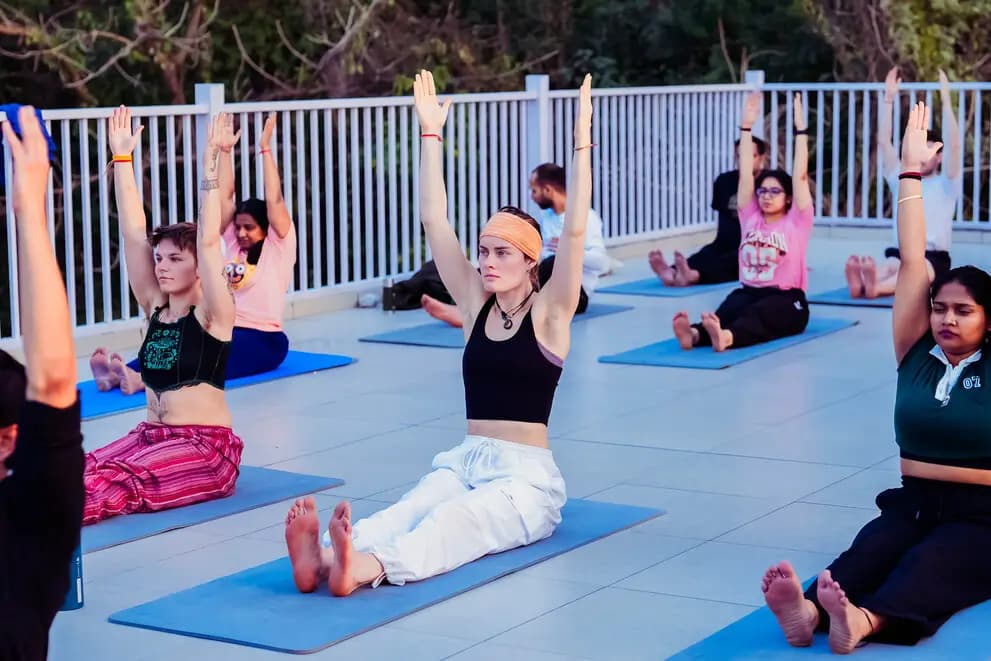
A residential yoga school is built-in community. This is the structural advantage of coming for a training or retreat rather than backpacking through: from day one you have a room on campus, scheduled days, shared meals, and classmates. Our batches are capped at 20 students, and they eat together, practice together, and explore together on Sundays. "Solo" describes your flight here, not your month.
The town's rhythm helps. Rishikesh rises early and sleeps early — the training day runs from morning tea at 6:25 to lights-off at 10 — so the town's energy peaks in daylight. Evenings center on the Ganga Aarti and dinner, not nightlife, because there is no bar scene. Many solo women tell us this is the single biggest difference they feel compared to party destinations.
Sensible precautions that still apply
None of the above suspends judgment. Here is the practical guidance we give our own students — specific, and hopefully free of both paranoia and wishful thinking.
Evenings. The main lanes of Tapovan and Laxman Jhula stay lively into the evening and feel comfortable; dimly lit shortcuts, empty beaches and isolated paths after dark are where we'd tell anyone — of any gender — not to walk alone. Go to the evening Aarti, enjoy it fully, and walk back with company or along the main routes. Residential students have a natural advantage: dinner is on campus at 7, so there's rarely a reason to be out alone late.
Dress. Think of this as practical, not moral: Rishikesh is a holy town where local dress is modest, and dressing roughly in tune with that — shoulders and knees covered in town and at temples — simply makes daily life smoother. It reads as respect, and it reduces unwanted attention. Leggings and a long top are completely normal; a scarf in your day bag solves every temple doorway. In the yoga hall, wear whatever you practice best in.
Attention and interactions. Curious looks and forward questions ("Which country? Married?") happen in India, and Rishikesh is on the milder end of it. Most of it is genuine curiosity. For the rest: a firm, unapologetic "no" — no softening, no explaining — plus walking on, works. Trust your instincts over your politeness; that rule outranks every other on this list.
Transport. Prearrange your arrival. Landing after a long-haul flight is the one moment a solo traveler is genuinely disoriented, which is why we arrange airport pickup from Dehradun (Jolly Grant) Airport — about 40 minutes away — at extra cost; send us your flight details and it's handled. Around town, use established taxi stands or have your school or guesthouse call a known driver, agree the fare before setting off, and prefer daylight for longer journeys.
The river. This one is under-discussed in safety articles and shouldn't be: the Ganga at Rishikesh is a powerful mountain river, and its currents are the most objectively dangerous thing in town. Swim or dip only at recognized bathing spots, hold the chains where provided, and stay out entirely during monsoon when the river runs high. Take this one more seriously than any lane at night.
The ordinary rest. Share your itinerary with someone at home. Keep your phone charged and your school's number saved — students can reach our staff on WhatsApp throughout the course. Use a crossbody bag in crowds, keep copies of your documents, and be politely skeptical of anyone whose friendliness comes with a shop, a donation, or a "special ceremony" attached. Standard traveler's toolkit, standard usefulness.
How our setup supports women traveling alone
We'll keep this section strictly factual, because this is the part where schools tend to inflate. What we actually provide:
On-campus accommodation — your room is a few minutes' walk from the practice halls, inside the school, with shared and private options for training courses (see accommodation). No commuting through town at 6 a.m., no separate guesthouse logistics.
Airport pickup, arranged — from Dehradun (Jolly Grant) Airport, about a 40-minute drive, at extra cost. The most vulnerable hour of solo travel — arrival — becomes a name board and a known driver.
Meals on campus — three vegetarian meals daily are part of the course, with filtered water throughout, so evenings never require going out.
Small batches, known faces — maximum 20 students per course; teachers know everyone within days, and absence gets noticed, which is exactly what you want structurally when traveling alone.
Reachable staff — questions, worries and 11 p.m. what-do-I-dos go to real humans on WhatsApp, before and during your course.
What we won't claim: that any town, school or setup makes precautions unnecessary. It doesn't work that way anywhere on earth, and we'd rather you arrive prepared than reassured into carelessness.
A simple plan for your first 48 hours
Most safety worry concentrates on arrival, so here is the plan we suggest to solo students, step by step:
Book pickup before you fly. Send us your flight details when you enrol; a known driver meeting you at Dehradun (Jolly Grant) with your name removes the entire "negotiating transport while jet-lagged" scenario. If you arrange your own transport instead, use the official prepaid counter at the airport.
Arrive in daylight if you can choose. Not because nights are dangerous — because everything is easier to read in your first hours when you can see it.
Land, message home, unpack, sleep. Your room is on campus; food and filtered water are downstairs. There is nothing you must do on day one.
Day two, walk the core with a purpose or a classmate. Tea in Tapovan, the walk to Laxman Jhula, an evening Aarti on the riverbank. By sunset of day two the town will have shrunk from "India" to "my neighborhood" — that shift is when most students report the worry quietly dissolving.
A tip from our teaching hall: save the school's WhatsApp number before you fly, and message us when you land in Delhi. Knowing someone at your destination is tracking your arrival changes how the whole journey feels.
Frequently asked questions
What should I avoid in Rishikesh?
Practically: isolated paths and beaches after dark, swimming outside recognized spots (the current, not crime, is the town's real hazard), unlicensed taxi touts at stations, monkeys on the bridges when you're carrying visible food, and anyone monetizing instant friendship. That's honestly most of the list.
Which is the safest place in India for a solo female traveler?
There's no official ranking, and any article claiming one is guessing. What can be said fairly: spiritual-tourism towns that have hosted international visitors for decades — Rishikesh among them — tend to feel most comfortable for solo women, because being a foreign woman traveling alone is normal there rather than notable. Comfort also comes from your setup: a residential program with community and structure changes the experience more than the pin on the map does.
What can you do in Rishikesh alone?
Almost everything the town offers: café mornings, ghat evenings, the Beatles Ashram, temple visits, yoga classes, sunrise viewpoints — our things to do in Rishikesh guide covers them, and every one of them is routinely done solo. For rafting and treks, go with established operators rather than alone — that's a safety-equipment matter, not a gender one.
When should solo travelers avoid Rishikesh?
No season is unsafe; seasons are just differently comfortable. Monsoon means slippery paths and a dangerous river (admire it, don't enter it); high summer is simply hot; December–January mornings are cold. Festival weeks bring the biggest crowds — energizing for some, overwhelming for others. Our month-by-month guide matches seasons to temperaments.
Is it weird to come to a yoga course completely alone?
Not at all — arriving alone is completely ordinary here. Our students come from more than 50 nationalities, a great many of them traveling by themselves, and batches typically bond within the first week; shared 6:25 a.m. tea does that. Arriving alone is not the brave exception in Rishikesh; it's a standard story.
The honest bottom line
Rishikesh will not ask you to be fearless, just sensible — the same sensible you'd be anywhere. What it offers in return is rare: a town where a woman drinking chai alone at sunrise by the Ganga is unremarkable, surrounded by hundreds of others doing versions of the same thing.
If you want to see what the days actually look like before deciding, read a day in the life at our school — it's the unpolished schedule, jet lag and all. And when you're ready, the 200-Hour Yoga Teacher Training in Rishikesh has dates, fees and room options; or just message us on WhatsApp with the questions you'd rather ask a human — including the safety ones. We answer those honestly, too.
Author note (byline): Gangesha Adi (E-RYT 500) founded Pure Soul Yoga School in Tapovan, Rishikesh, where the teaching team has welcomed students from more than 50 nationalities — a great many of them women who arrived alone and left with twenty new friends.