
What Is an Ashram? Meaning, Purpose & Daily Life Explained

An ashram is a spiritual community and place of retreat in the Indian traditions — traditionally the hermitage of a guru and their students, where people live simply and devote their days to spiritual practice: meditation, yoga, study, chanting and selfless service. The Sanskrit word is ashrama, from the root shrama, meaning effort or exertion — an ashram is literally a place of spiritual work, not a place of escape.
If you're researching a trip to India, you've probably met the word in two confusingly different senses: the ashram you can stay at, and the four "ashramas" of Hindu philosophy, which are stages of life, not buildings. This guide explains both, honestly — what an ashram is for, what daily life there actually involves, how long people stay, how to behave, and the question we're asked most at our own school in Rishikesh: what's the real difference between an ashram and a yoga school? (We are the second, with the daily rhythm of the first — and we'll be precise about that distinction rather than blur it.)
What does "ashram" mean?
There is no perfect English word for it. Dictionaries usually offer "hermitage" or "monastery," and both get part of the way there: like a monastery, an ashram is a residential community organised around spiritual life; like a hermitage, it is traditionally set apart — in the older texts, literally in the forest — from the noise of ordinary society.
But an ashram differs from the monastery of Western imagination in one important way: it is not only for monks. Ashrams have always received householders, seekers, students and travellers — people at every stage of life who come for a period of practice and then return to the world. The classical image is the forest hermitage of a sage, where students lived with their teacher, tended the fire and the garden, studied scripture, and learned as much from the chores as from the lessons.
That is still the essential DNA: a teacher (or a lineage), a community, a discipline, and simplicity. The architecture varies enormously — from riverside compounds to modern campuses — but where those four things are present, you are in an ashram in the meaningful sense.
The four ashramas: stages of life, not places
Here is the source of the naming confusion, and it answers one of the most-asked questions on this topic. In classical Hindu philosophy — codified in the Dharmashastra literature — ashrama also names the four stages of an ideal human life:
Stage | Sanskrit | Life phase | Traditional focus |
|---|---|---|---|
1 | Brahmacharya | Student | Study, discipline, learning under a teacher |
2 | Grihastha | Householder | Family, work, contribution to society |
3 | Vanaprastha | Forest-dweller | Gradual withdrawal, mentoring, simplicity |
4 | Sannyasa | Renunciate | Full dedication to spiritual liberation |
The shared root is the point: each stage is a field of effort — a stretch of life with its own proper work. The place called an ashram borrows the same word because it is where that spiritual effort is made deliberately and full-time.
So when you see "the four types of ashram" asked online, this is almost always what's being reached for: not four kinds of building, but the four life stages. A retreat visitor is, for a few weeks, living something like brahmacharya — a student's life of simplicity and study — whatever their age or passport.
What is the purpose of an ashram?
Strip away the specifics and every genuine ashram serves the same purpose: to remove, for a while, everything that isn't practice.
Ordinary life fragments attention — work, screens, obligations, choices. An ashram deliberately narrows life down to a handful of repeated things: waking early, sitting in meditation, practising yoga, studying, chanting, eating simply, serving the community, sleeping early. Within that narrowing, three traditional pillars do the work:
Sadhana — daily spiritual practice: meditation, yoga, prayer, breathwork, done at fixed hours whether you feel like it or not. The schedule is the teacher.
Seva — selfless service: cooking, cleaning, gardening, helping. In the ashram view, chopping vegetables with full attention is practice, not a chore between practices.
Satsang and study — time with the teacher and the teachings: discourse, scripture, chanting (kirtan), the evening arati (lamp ceremony), and questions.
The purpose is not comfort, and honest ashrams don't sell it. The simplicity — plain rooms, plain food, fixed hours, limited connectivity — isn't an inconvenience to be tolerated; it is the method.
What does daily life in an ashram involve?

Details differ by tradition, but the skeleton of an ashram day is remarkably consistent across India:
Before dawn: wake early (often between 4 and 6 a.m.), wash, and sit for the first meditation or prayer of the day while the world is still quiet.
Morning: yoga asana and pranayama practice, followed by a simple sattvic (vegetarian, lightly spiced) breakfast, often taken in silence.
Midday: seva — your assigned service — plus study or a discourse; lunch is the main meal.
Afternoon: rest, personal study, a second practice session or lecture.
Evening: kirtan or arati, a light dinner, sometimes satsang with the teacher; lights out early, because tomorrow starts before dawn.
Phones are typically pocketed or surrendered, meals are vegetarian, alcohol is absent, and silence is kept at set times. Most first-timers find days one to three hard and day five strangely wonderful — the same arc our students describe in a day in the life at our school, whose timetable runs on exactly this ancient rhythm, herbal tea at 6:25 to lights-off at 10.
A tip from our teaching hall: don't judge an ashram schedule by reading it — every timetable looks brutal on paper and most feel surprisingly humane by the fourth day. Judge it by one question instead: does the day alternate effort and rest? A rhythm that only demands is a bootcamp; a rhythm that demands and restores is a practice.
Ashram vs yoga school: an honest comparison
These get used interchangeably in travel writing, and they shouldn't be. They overlap — early mornings, sattvic food, daily practice, community living — but they exist for different reasons:
Traditional ashram | Yoga school | |
|---|---|---|
Primary purpose | Spiritual life around a guru or lineage | Structured yoga education |
Programme | Open-ended rhythm: sadhana, seva, satsang | Fixed curriculum with dates, syllabus, assessment |
Teaching goal | Your own inner development | Development plus the ability to teach others |
Certification | None — that's not what it's for | Certificate; at a Yoga Alliance–registered school, training can lead toward RYT registration |
Cost model | Often donation-based or modest fixed contributions | Published course fees |
Commitment | Flexible; some expect longer or open-ended stays | Defined course length (e.g., a ~3–4-week 200-hour training) |
Neither is "better" — they answer different questions. If your question is "I want to deepen my spiritual life in a traditional setting, with no certificate and no fixed end-point," an ashram answers it. If your question is "I want immersive, structured training in yoga — possibly to teach it," a school answers it.
And to be precise about ourselves, since this is the question we're most often asked: Pure Soul Yoga School is a yoga school, not an ashram — a Yoga Alliance–registered school (RYS 200, 300 & 500) with a fixed curriculum and certification. What we deliberately keep from ashram life is its rhythm: residential immersion, early sattvic mornings, mantra and meditation daily, evenings that end early, and batches capped at 20 students so the community stays a community. Many students tell us that combination — ashram-style days, school-level structure — is exactly what they were looking for without knowing the vocabulary for it. Rishikesh itself, a town shaped by generations of both ashrams and schools, is a large part of why that works — we've written about why so many people choose Rishikesh for yoga training.
How long do people stay at an ashram?
There's no standard answer, but stays cluster into a few patterns:
A few days to a week — a first taste, often mid-trip. Some ashrams accept short visits; others ask for a minimum stay so that guests settle into the rhythm rather than sampling it.
Two to four weeks — the most common serious visit, long enough for the routine to do its quiet work. (Structured trainings at yoga schools run on a similar length for the same reason.)
Months or longer — for committed practitioners, long-term students or residents, usually by arrangement and after a shorter first stay.
Practicalities bound the upper end: visas limit how long international visitors can remain in India, and most ashrams expect longer-term guests to take on more seva and more responsibility, not less. If you're planning a first trip, seasons matter too — our guide to the best time to visit Rishikesh for yoga applies just as well to any residential stay in the region.
Ashram etiquette: how to be a good guest
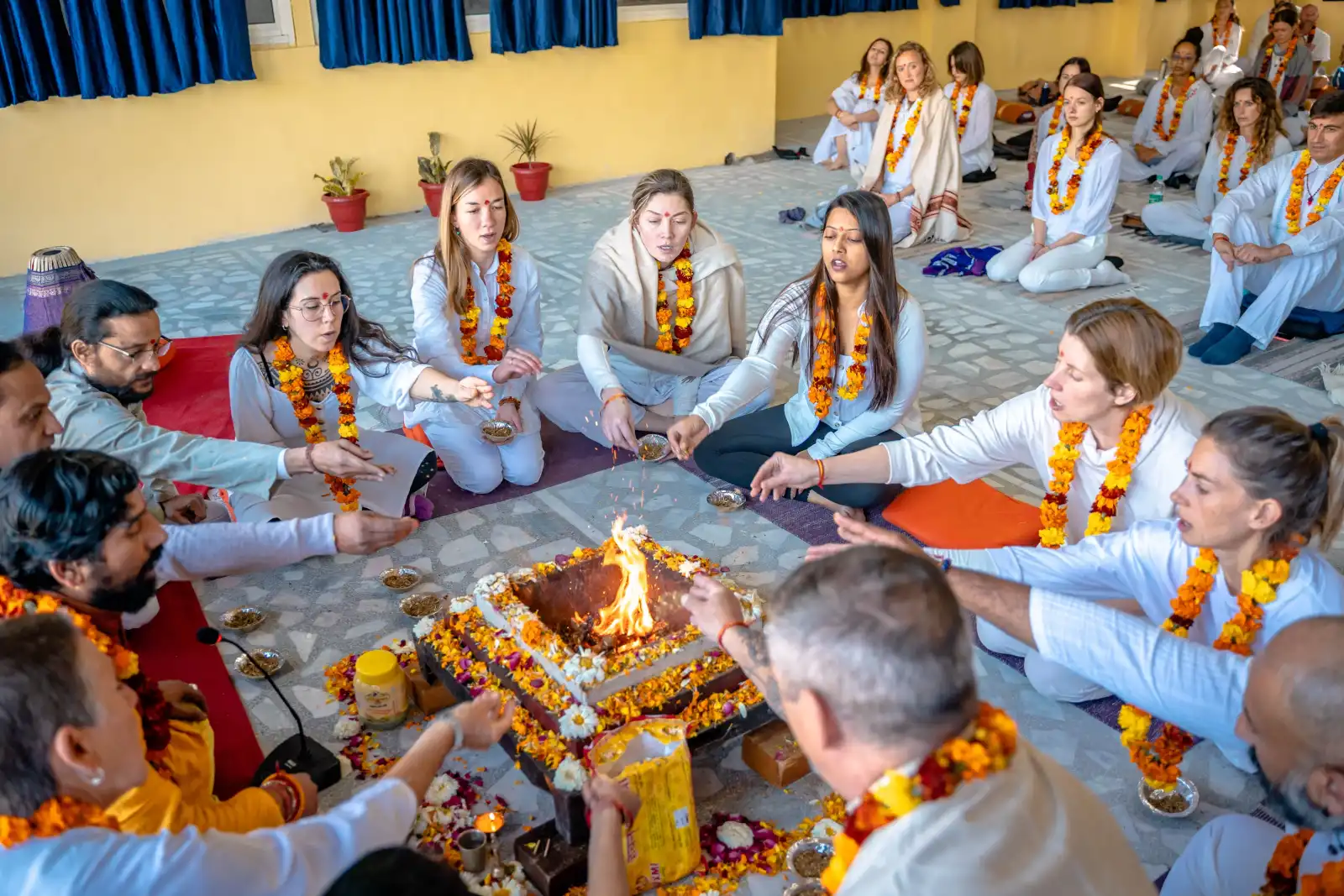
Every community has its own rules, and the first rule is to learn them. These apply almost everywhere:
Dress modestly — shoulders and knees covered is a safe default for all genders; loose, plain clothing fits the setting and the climate.
Remove shoes before temples, shrines and practice halls — watch where others leave theirs.
Keep silence where silence is kept — mealtimes and early mornings, in many places.
Arrive on time, to everything. Punctuality is considered part of the practice, not an administrative nicety.
Do your seva fully — service is the point, not the price of admission.
Ask before photographing people, ceremonies or shrines; some spaces are never photographed.
Follow the food and substance rules — vegetarian meals, no alcohol, and in most places no smoking; don't negotiate exceptions.
Respect the tradition without pretending. You aren't required to share the beliefs — you are required to be respectful around them.
None of this is exotic; it's the ordinary courtesy of entering someone's home, which is what an ashram is.
Frequently asked questions
What is the purpose of an ashram?
To provide a place where, for a while, everything unnecessary is set aside so that spiritual practice can be full-time: a community built around a teacher or lineage, a fixed daily rhythm of meditation, yoga and study, simple living, and selfless service. The simplicity is the method, not a hardship to endure.
What are the 4 types of ashram?
The "four ashramas" are stages of life in Hindu philosophy, not four kinds of building: brahmacharya (student), grihastha (householder), vanaprastha (gradual withdrawal) and sannyasa (renunciation). The residential ashram shares the same Sanskrit root — a place, or a phase, of dedicated effort.
What is an ashram called in English?
The closest English words are "hermitage" and "monastery," and "ashram" itself is now an English dictionary word. Neither translation is exact: unlike most monasteries, ashrams routinely welcome laypeople, families and travellers for temporary stays.
How long can you stay at an ashram?
Anywhere from a few days to many months, depending on the community's rules and your visa. Many ashrams set a minimum stay of several days so guests genuinely enter the rhythm; long-term stays are usually earned through a shorter first visit and come with more responsibility, not less.
How much does it cost to stay at an ashram?
Traditional ashrams often run on donations or ask a modest daily contribution toward food and lodging; some modern ones charge fixed programme fees. Expect simplicity at every price: the cost covers a plain room and sattvic meals, not hotel comforts. (Yoga schools differ here — they publish course fees, because they're providing structured education.)
Do ashrams still exist?
Very much so. India has thousands of active ashrams, from tiny riverside hermitages to large institutions, and towns like Rishikesh have been shaped by them for generations. The tradition has also travelled — ashram-style communities now exist on several continents — but India remains its living heartland.
If the rhythm calls you, choose your door
Whether you enter through a traditional ashram or a school, the daily rhythm — early mornings, practice, simple food, community, early nights — is the real teacher, and it's the same one. If what draws you is that rhythm plus structured training and certification, that is exactly what we built: see what makes our yoga school in Rishikesh the way it is — ashram-style days, a maximum of 20 students per batch, and teachers who'll happily answer the "is this right for me?" question honestly on WhatsApp before you commit to anything.
Author note (byline): Gangesha Adi (E-RYT 500) founded Pure Soul Yoga School in Rishikesh, where students of 50+ nationalities live a traditional ashram-style daily rhythm inside a structured, Yoga Alliance–registered training.
References
Merriam-Webster — dictionary definition and etymology of "ashram."
Classical Dharmashastra literature (e.g., Manusmriti) — the four-ashrama system of life stages.
Patanjali's Yoga Sutras and the Upanishads — the practice framework (sadhana, study, meditation) that ashram life is organised around.