Why Do Yoga Teacher Training in Rishikesh? An Honest Guide
Here is the short answer, from a school that teaches here every day: people do their yoga teacher training in Rishikesh because it is the one place where the tradition, the teachers, the price, and the setting all point in the same direction. Yoga grew up in this valley. Training here is residential and fully immersive, it costs a fraction of a studio course in the US or Europe, and you study a few minutes' walk from the Ganga, in the Himalayan foothills, in a town that has been receiving yoga students for longer than any of us has been alive.
And here is the honest part, which most articles skip: Rishikesh is also a real, noisy, living Indian town — not a postcard. Scooters honk in the lanes of Tapovan, the monsoon is genuinely wet, and December mornings are cold. We will cover all of that too, because you are considering giving a month of your life to this place, and you deserve the full picture — the same one we give students on the phone before they book.
In this guide: - Why Rishikesh is called the yoga capital of the world - What actually makes it a good place to train - What studying here is really like - A short guide to the town itself - Getting here - Visas, in one paragraph - Weather and when to come - Food, water, and staying well - The honest trade-offs - How to choose a school without drowning in options - FAQs
Why is Rishikesh called the yoga capital of the world?
The title is informal — no committee awarded it — but it is not marketing invention either. Three real things sit underneath it.
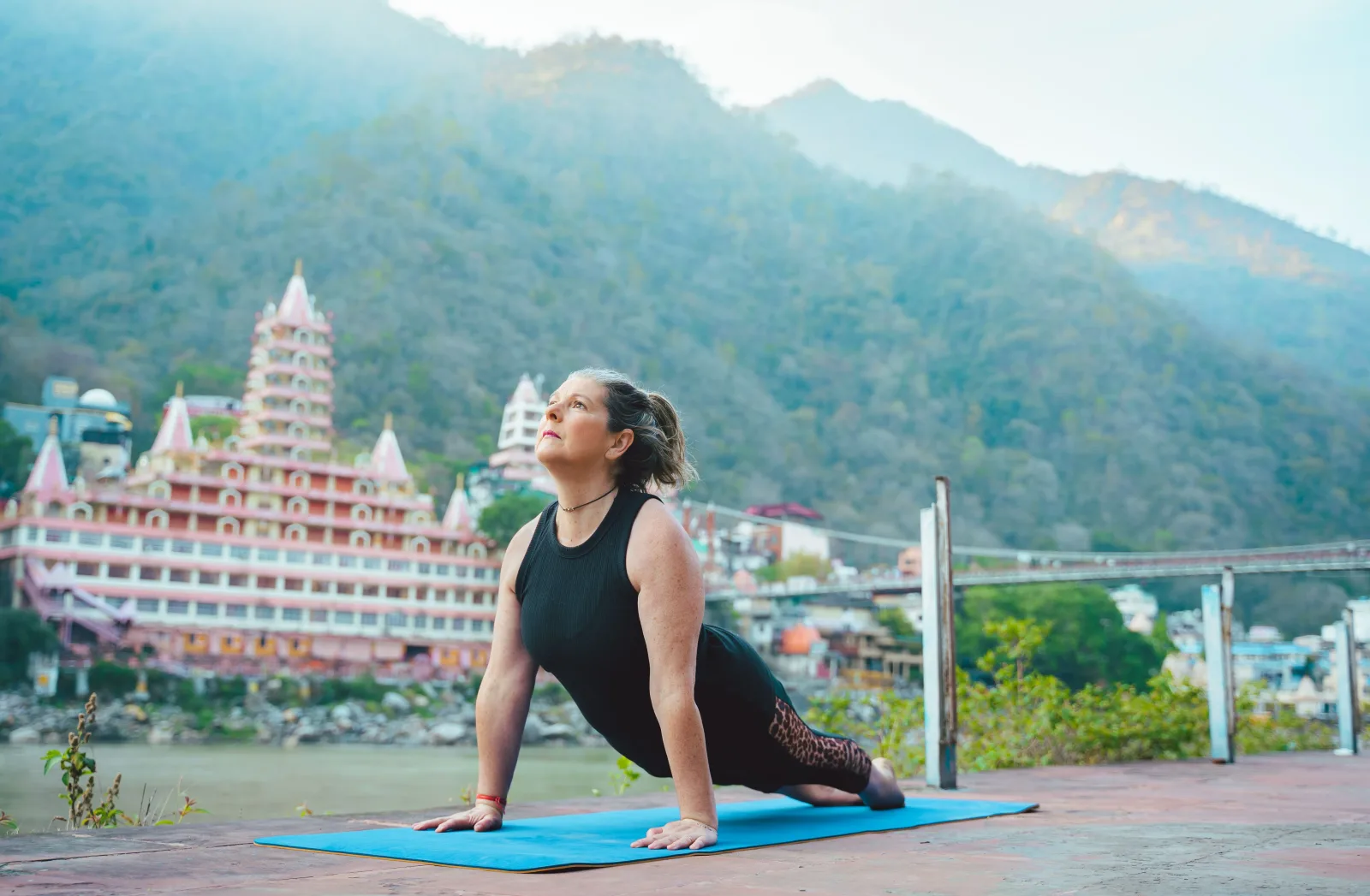
The river and the mountains. Rishikesh sits where the Ganga leaves the Himalaya and enters the plains. For many centuries, sadhus and seekers have walked this valley on their way to the high pilgrimage routes, and many stopped here to practice. The riverbank ashram culture that grew from that — hermitages, temples, chanting at dusk — long predates yoga tourism. When you sit by the river at the evening Ganga Aarti, you are joining a ritual, not a re-enactment.
The lineage of teaching. Rishikesh became a place where yoga was taught, systematically, to whoever came — Indian and foreign students alike. Teachers here typically grew up inside a living tradition: philosophy learned in Sanskrit-medium study, asana practiced daily since childhood or adolescence, pranayama treated as a discipline rather than a warm-up. That density of tradition-trained teachers, in one walkable town, exists almost nowhere else.
The world found out. The town's international fame arrived when the Beatles came to Rishikesh to study meditation and wrote much of an album here; the abandoned ashram where they stayed is now a graffiti-covered ruin you can visit. Ever since, each generation of Western seekers has kept a path worn to this valley — which is why today you'll hear a dozen languages over breakfast in any Tapovan café, and why Yoga Alliance–registered schools cluster here more densely than anywhere on earth.
None of this means every school in Rishikesh is good — we'll be blunt about that below. It means the raw materials of a serious yoga education are all here: teachers, texts, tradition, and a town organized around practice.
What actually makes Rishikesh a good place to train?
Set the romance aside for a moment. When our graduates explain why Rishikesh worked for them, four practical reasons come up again and again.
1. The training is residential — and immersion changes everything
In Rishikesh, teacher training is almost universally residential: you live where you study, usually with meals included. That single fact transforms the course. There is no commute, no grocery run, no evening switch back into your ordinary life. From herbal tea before sunrise to lights-off at night, the day is built around practice, study, and rest — six days a week, with Sundays free.
Compare that with a weekend-format course at home, where each session competes with your job, your inbox, and your Monday. Both formats can produce certified teachers. But a month of full immersion produces something a spread-out course rarely can: a lived experience of the yogic day — waking early, eating simply, practicing when the streets are still quiet — that you carry home in your body, not just your notes.
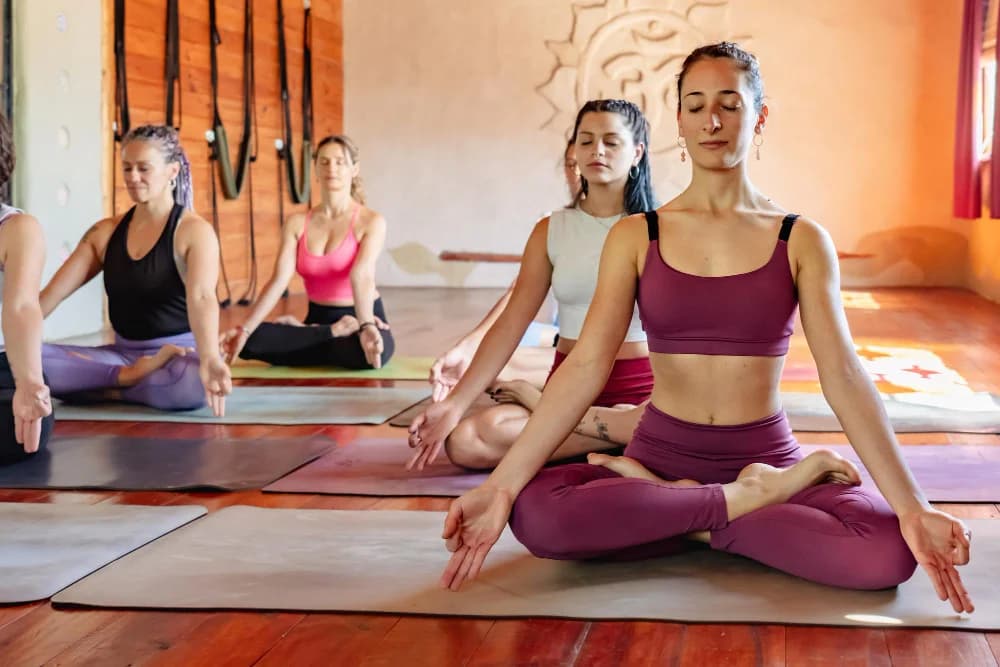
Immersion also builds the second thing students mention most: the people. You practice, eat, struggle, and laugh with the same small group for a month. With a maximum of 20 students per batch at our school, teachers know everyone's knees and shoulders by day three, and the friendships routinely outlast the course by years.
2. The cost advantage is real — and it isn't a quality discount
A residential 200-hour training in Rishikesh — accommodation and three daily meals included — starts from around $1,200 at our school. Studio-based 200-hour programs in the US and Europe commonly run into the low-to-mid four figures for tuition alone, before a single night's accommodation. The gap comes from India's cost of living, not from cutting corners; we've published a full fee-by-fee breakdown in our honest guide to yoga teacher training costs.
For many students, this is the difference between "someday" and "this year": the flight plus the full residential course in Rishikesh can total less than tuition alone at home.
3. You study close to the sources
Yoga philosophy lands differently when it is taught as a living subject rather than a history lesson. In Rishikesh, the Yoga Sutras, the Bhagavad Gita, and the hatha texts are taught by teachers for whom these are not exotic imports — and the town itself keeps reinforcing the lesson. You study the concept of sadhana in the morning and watch the whole town practice its own forms of it by evening: temple bells, river offerings, chanting drifting across the water.
Certification-wise, nothing is lost by coming here: reputable Rishikesh schools are Yoga Alliance–registered (ours holds RYS 200, RYS 300 and RYS 500 registrations), so a 200-hour course here makes you eligible to register as an RYT 200 exactly as a course at home would.
4. The setting does quiet work on you
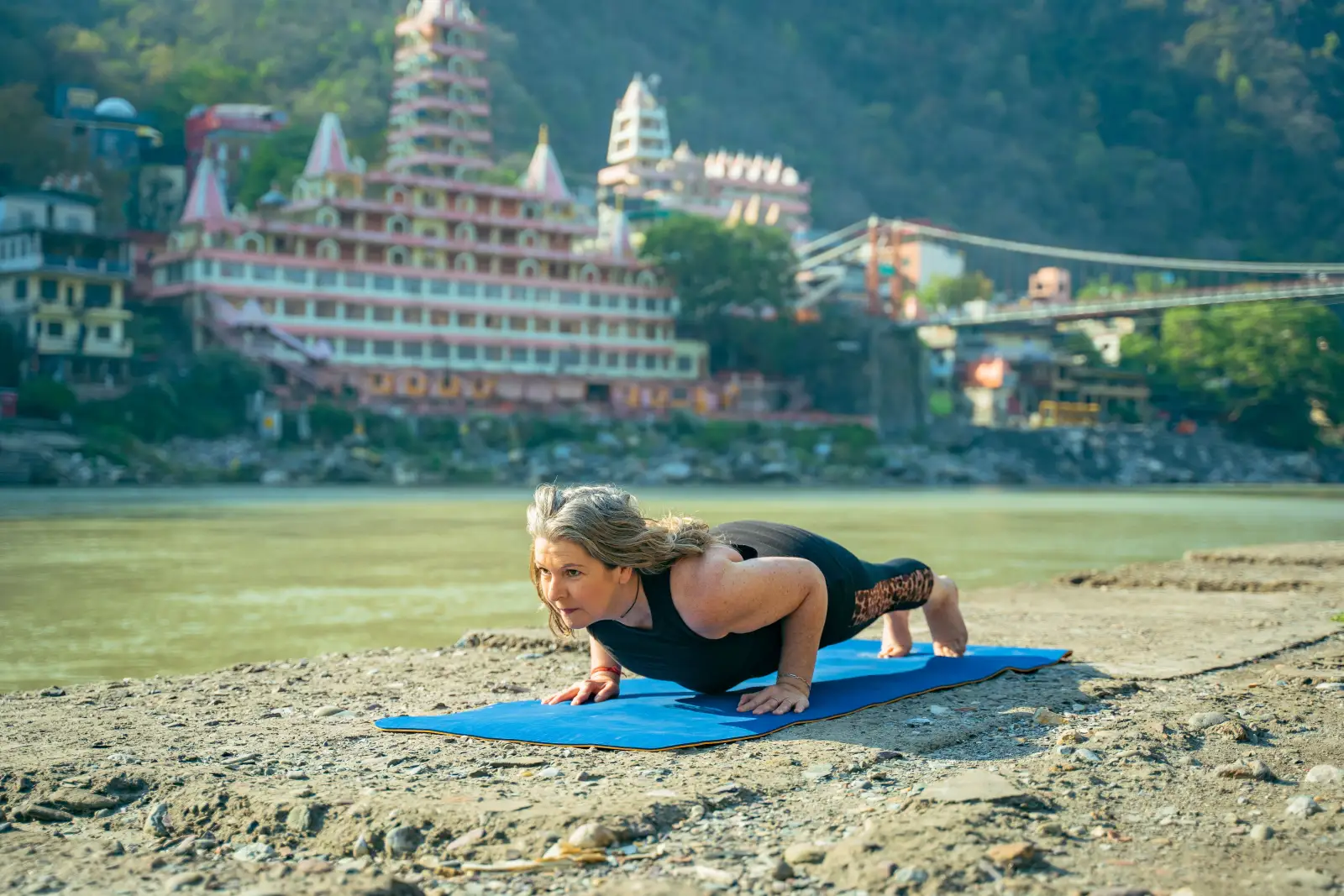
This is the hardest reason to put into words, so we'll keep it factual. You practice pranayama at eight in the morning with the windows open to Himalayan foothill air. You take your afternoon break at the river. The mountains close the horizon in every direction, the Ganga is a ten-minute walk away, and the evening Aarti happens whether tourists show up or not. A month inside that landscape lowers the volume of ordinary life in a way that is easy to dismiss until you've felt it.
What studying here is really like
A quick reality check: teacher training in Rishikesh is a full-time occupation, not a holiday with yoga attached. At our school the day runs from herbal tea at 6:25 a.m. through Ashtanga practice, pranayama, philosophy, alignment training, mantra, Hatha practice, and evening meditation or Yoga Nidra, with lights off at 10 p.m. — six days a week, with roughly two free hours after lunch and evenings after dinner.
We've written the complete hour-by-hour schedule, including the jet-lag week and why Sundays matter, in A Day in the Life at Pure Soul Yoga School — if you read only one other article before deciding on Rishikesh, make it that one, because the daily rhythm is the product. The syllabus tells you what you'll learn; the schedule tells you how you'll live.
Accommodation at reputable schools is on campus or adjacent — at ours, rooms are a few minutes from the practice halls, with shared and private options for training courses (see accommodation). Living on campus matters more than it sounds: when the morning class starts at 6:40, a two-minute walk is a mercy.
A short guide to the town itself
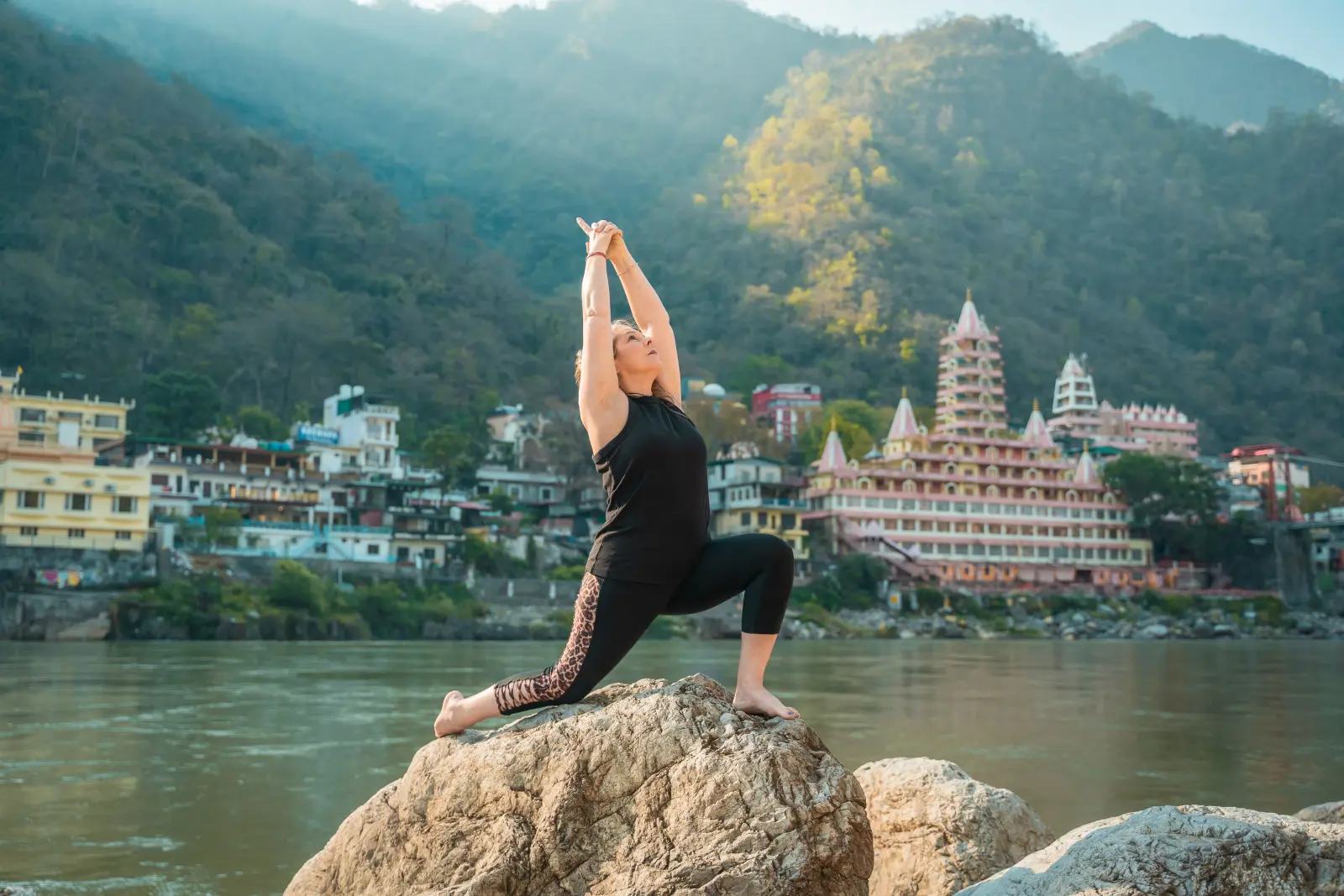
Most yoga schools — ours included — are concentrated in Tapovan, the neighborhood on the hill above Laxman Jhula, one of Rishikesh's two famous pedestrian suspension bridges across the Ganga (the other is Ram Jhula, downstream). Tapovan is effectively an international student village: within a ten-minute walk of our campus you'll find dozens of cafés serving everything from South Indian breakfasts to surprisingly good sourdough, juice stands, bookshops, yoga-prop shops, and small markets for daily needs.
Downstream, the town proper gathers around Triveni Ghat, the main bathing ghat, where the largest evening Ganga Aarti — the fire-offering ceremony to the river — draws locals and visitors every night at dusk. Across the river sits the Beatles Ashram (Chaurasi Kutia), the ruin mentioned earlier, now open to visitors with an entry fee. Further out are sunrise treks to the hilltop Kunjapuri Devi Temple, the ancient meditation cave of Vashishta Cave upstream, and the Neer Garh Waterfall walk — all of which our students reach easily on their free Sundays.
We've written a full student-angled guide — things to do in Rishikesh — covering twelve-plus places worth your Sundays, with honest seasonal notes.
One useful expectation to set: Rishikesh is a holy town. Alcohol is not sold in the main pilgrimage areas and meat is essentially absent from Tapovan and the river zone. Most students find that this makes the month easier, not harder — the environment quietly supports the discipline the course asks of you.
Getting here: airports, trains, and taxis
Rishikesh is one of the easiest Himalayan-foothill destinations in India to reach.
By air (recommended): Fly into Dehradun (Jolly Grant) Airport — about a 40-minute drive from our school. It connects through Delhi and other major Indian hubs several times daily. We can arrange airport pickup at extra cost; just send us your flight details.
Via Delhi: Most international students fly into Delhi and either take the short connecting flight to Dehradun or come by road (roughly a 5–7 hour drive depending on traffic — doable, but after a long-haul flight, the Dehradun connection is kinder).
By train or bus: Rishikesh is also reachable by rail (commonly via Haridwar, the major junction about an hour away) and by regular buses from Delhi — the budget-friendly route many Indian students take.
Practical tip from a decade of arrivals: aim to land a day or two before your course starts. It softens jet lag before the 6 a.m. rhythm begins, and gives you an unhurried first walk to the river.
Visas, in one paragraph
Most international students visit India on a tourist e-visa, applied for online before travel — check the current rules for your nationality on India's official government e-visa portal, and apply well ahead of your dates. Your passport should be valid for at least six months beyond your travel dates. If you train with us, we provide a visa invitation letter on request once your seat is confirmed, which many students include with their application. That's genuinely the whole story for most people; the paperwork is more tedious than difficult.
Weather and when to come
The one-line version: October to March is prime season (cool, clear, and busy), April to June is hot (fine for training in shaded halls, quieter town), and July to September is the monsoon (lush, dramatic, wet — with real trade-offs). Courses run year-round, and each season genuinely suits a different kind of student and budget.
Because the timing question deserves real detail — including a month-by-month table and the festivals worth planning around — we've given it its own guide: the best time to visit Rishikesh for yoga.
Food, water, and staying well
"Will I get sick in India?" is the single most common worry we hear from international students, so let us answer it the way we do on the phone.
At our school, all meals are sattvic vegetarian, cooked fresh daily, designed to be gentle on international stomachs, and filtered water is available throughout the school. Food safety is treated as seriously as anatomy here — it's covered in your arrival briefing. Students who eat at school and are sensible outside (busy popular cafés, cooked food, bottled or filtered water, fruit you peel yourself) very rarely have more than a brief adjustment period.
On general safety: Rishikesh is a pilgrimage town accustomed to foreign visitors, and the yoga neighborhoods are busy with international students year-round, including many women traveling alone. The same common-sense rules you'd apply anywhere apply here — and the residential format means you're never navigating a strange town at night alone unless you choose to be. The Ganga itself deserves respect: it is a powerful mountain river, so swim only at recognized safe spots and take local advice seriously.
The honest trade-offs: what the brochures leave out
We promised the full picture. Here is what we tell people who ask "what's the catch?"
Rishikesh is noisy.
Tapovan's lanes carry scooters, taxis, delivery bikes, street dogs, temple loudspeakers, and construction — often all at once. Practice halls are set back from the road and mornings are genuinely quiet, but if you're picturing a silent mountain hermitage, adjust the picture: this is a living town that practices yoga, not a soundproofed resort. Many students come to love the sound of the place; almost nobody expects it.
Traffic and construction are real.
The town has grown faster than its lanes. Crossing the main road can take patience, peak-season weekends bring crowds to the bridges, and somewhere nearby, something is always being built. Sundays out of town — a waterfall, a sunrise trek — are the pressure valve.
The monsoon means it.
July to September brings heavy, sometimes day-long rain, high humidity, and a brown, powerful river. Rafting closes for the season, treks get slippery, and laundry takes days to dry. Training continues comfortably indoors — and monsoon has its lovers (green hills, dramatic skies, the town at its quietest) — but choose it knowingly.
Winter mornings are cold.
December and January nights can drop to single digits Celsius, and most buildings here — like most of North India — are built for heat, not cold. Bring genuinely warm layers for 6 a.m. practice; you'll shed them by mid-morning.
Comforts are simpler.
Power can blip, hot water is solar or geyser-fed rather than unlimited, mattresses are firmer than Western hotel standard, and the monkeys on the bridges will absolutely try for your snacks. None of this is hardship — it is simply India's foothills, honestly described.
It can be commercial.
Success brought crowds, and crowds brought operators of every quality — some excellent, some not. The town's spiritual life is real and everywhere, but it sits alongside souvenir stalls and tour touts. Knowing how to filter (next section) matters more here than in quieter destinations.
If you read all that and thought "fine — that sounds like a real place," Rishikesh will almost certainly give you more than it asks. If you need silence and seclusion above all, consider whether a quieter setting might serve you better — an honest school would rather tell you that now than after you've flown.
How to choose a school here without drowning in options
Rishikesh has more yoga schools than any town on earth, and we won't pretend to rank them — every list you'll find online is either advertising or opinion. What we can give you is the filter we'd hand a friend:
Verify the registration yourself. Look the school up in the Yoga Alliance directory — confirm it holds a current RYS registration (ours: RYS 200, RYS 300 and RYS 500) rather than taking a logo on a website at face value.
Ask who is actually teaching. Named lead teachers with verifiable experience, not "a team of gurus." Ask how long the current teaching team has been with the school.
Check the batch size in writing. Above roughly 20 students, personal correction becomes arithmetic — there isn't enough teacher attention to go around. We cap at 20 for exactly this reason.
Ask for the real daily schedule, hour by hour. A serious school has one and will send it instantly. Vague answers about the timetable predict vague teaching.
Read reviews for patterns, not scores. Every school has a 4.8-something. Read the middle reviews — the three-star ones — for recurring specifics about food, cleanliness, and whether the advertised teachers actually taught.
Message them with a hard question — about refunds, food allergies, or teacher qualifications — and judge the answer's speed and honesty. How a school treats you before payment is the best available preview of after.
That filter will cut a hundred options down to a handful in an evening, whoever you end up choosing.
Frequently asked questions
Why is Rishikesh famous for yoga?
Because of geography, lineage, and history stacked together: it sits where the Ganga leaves the Himalaya — a centuries-old stopping point for sadhus and seekers — it developed a dense riverbank culture of ashrams and systematic yoga teaching, and the Beatles' famous stay put it on the world's map. Today it holds the densest concentration of Yoga Alliance–registered schools anywhere, which keeps the title self-reinforcing.
How much does yoga teacher training cost in Rishikesh?
Residential courses — food and accommodation included — start from around $730 for a 100-hour foundation and from around $1,200 for the standard 200-hour certification at our school, ranging up to about $2,700 for a 500-hour private-room immersion. That is typically less than tuition alone for a comparable course in the US or Europe. Full fee-by-fee breakdown, including the hidden costs no fee covers, in our cost guide.
Where is the best place in the world to do yoga teacher training?
Honestly: it depends on what you're optimizing for. For tradition, immersion, and value together, Rishikesh is the strongest single answer, which is why it draws more trainees than anywhere else. Beach settings (Goa, Bali, Kerala) trade some of the lineage density for climate and coast — we teach in those places too, and they suit some students better. What matters more than the pin on the map is a registered school, experienced named teachers, and a small batch.
Which is the best yoga teacher training school in Rishikesh?
We won't rank schools — including ourselves — because every "top 10 schools" list you'll find is marketing wearing a countdown. Use the six-point filter above: verified RYS registration, named experienced teachers, batch size capped in writing, a real hour-by-hour schedule, patterned (not averaged) reviews, and honest pre-sales answers. Any school that passes all six is a sound choice; we're happy to be measured against every one of them.
Is Rishikesh good for beginners, or only experienced practitioners?
Genuinely good for beginners. A 200-hour course assumes commitment, not advanced asana — practices are taught to your level, and with small batches the teacher adapts to the bodies in the room. What you need before arriving is a sincere personal practice and the willingness to keep a disciplined schedule, not a press handstand.
Is it safe to drink the water and eat the food?
Drink filtered or bottled water only — never tap. At reputable schools (ours included) filtered water and fresh-cooked sattvic meals are standard, and most students have no more than a brief adjustment period. Outside school, favor busy cafés and cooked food, and peel your own fruit.
If Rishikesh is calling
The truthful summary: Rishikesh gives you the tradition at the source, full residential immersion, honest prices, and the Ganga at the end of your street — and it asks you to accept a real, noisy, sacred, imperfect Indian town in exchange. Ten years of graduates tell us the exchange is worth it.
If you're ready to look at specifics, start with our 200-Hour Yoga Teacher Training in Rishikesh — dates, fees, curriculum, and how to reserve a seat with a 20% deposit — or get to know the school itself. And if you're still weighing it all up, message us on WhatsApp with your questions about the town, the course, or the season you're considering. Real humans answer, usually within hours, and we'll tell you the truth even when it isn't the salesy answer.
Author note (byline): Gangesha Adi (E-RYT 500) founded Pure Soul Yoga School in Tapovan, Rishikesh, and has guided students from more than 50 nationalities through residential trainings beside the Ganga over the past decade.