
Yoga Teacher Training Cost: An Honest Breakdown, Fee by Fee

Here is the direct answer most cost guides bury: a residential 200-hour yoga teacher training in India — accommodation and three daily meals included — starts from around $1,200 at our school in Rishikesh, and our full range of trainings runs from $730 for a 100-hour foundation course to $2,700 for a 500-hour private-room immersion. Studio-based 200-hour programs in the US and Europe are commonly advertised in the low-to-mid four figures — usually for tuition alone, before you've paid for a single night's accommodation or a single meal.
That gap is not a trick, and it is not a sign of lower quality. It comes down to what the fee actually buys, which is exactly what this guide unpacks. Every number below is our real, published price — the same figure you'll find on the course page it links to — because we think a cost guide written by a school should show the school's actual fees, not vague ranges designed to make you enquire.
In this guide: - What you're actually paying for - The cost components, item by item - Why training in India often totals less - Our full published fee table - The hidden costs checklist - How paying for it actually works - FAQs - Methodology — and how to cite this
What you're actually paying for
A yoga teacher training fee is easy to misread as "the price of a certificate." It isn't. When you pay for a serious 200-hour training, you are paying for four distinct things.
Contact hours with qualified teachers. The Yoga Alliance hour structure requires a substantial core of real, guided teaching — asana technique, teaching methodology, anatomy, philosophy, practicum. Faculty who can deliver that well are the single biggest cost driver anywhere in the world. At our school, batches are capped at 20 students, which means the teacher-to-student ratio — not marketing — is what the tuition sustains.
A place to live and food to eat — sometimes. This is where prices stop being comparable at a glance. Residential trainings like ours include your room and three vegetarian meals a day in the printed fee. Most studio-based trainings at home do not, because you sleep in your own bed and buy your own groceries. Neither model is dishonest; they're just different products wearing similar price tags.
Materials and certification. Training manuals, and the certificate that makes you eligible to register with Yoga Alliance as an RYT 200 after completing training at a registered school (RYS). Our fees include both.
The immersion itself. A residential month is also a container: no commute, no work emails between classes, a daily rhythm from morning tea to lights-off. You can't buy that separately, but it is a real part of what a residential fee funds — and a real part of why graduates describe the experience so differently from a weekends-only course.
The cost components, item by item
Here is how the pieces stack up, using our own residential model as the worked example. The middle column shows what our published course fee already covers; the right column is what remains yours to budget.
Cost component | Included in our course fee? | What to know |
|---|---|---|
Tuition (all classes and contact hours) | Yes | The core of the fee: asana, pranayama, philosophy, anatomy, teaching practice |
Accommodation for the full course | Yes | Private room on the 100-hour; shared or private options on most other courses |
Meals | Yes | Three vegetarian meals daily, with filtered drinking water |
Course materials | Yes | Training manual and study materials |
Certification | Yes | Issued on completion; basis for Yoga Alliance registration |
Flights | No | Varies enormously by season and departure city — price your own dates |
Visa fees | No | We provide a visa invitation letter on request for India courses |
Travel insurance | No | Strongly recommended for any international training |
Yoga Alliance registration | No | Paid directly to Yoga Alliance if you choose to register — check current rates on their site |
Personal spending | No | Cafés, laundry, souvenirs, day trips on your free Sundays |
When you compare schools — including comparing us against anyone else — put every program's numbers into a table like this one before deciding. A low headline price with nothing included and a higher all-inclusive price can land in the same place once the missing rows are filled in.
Why training in India often totals less than training at home
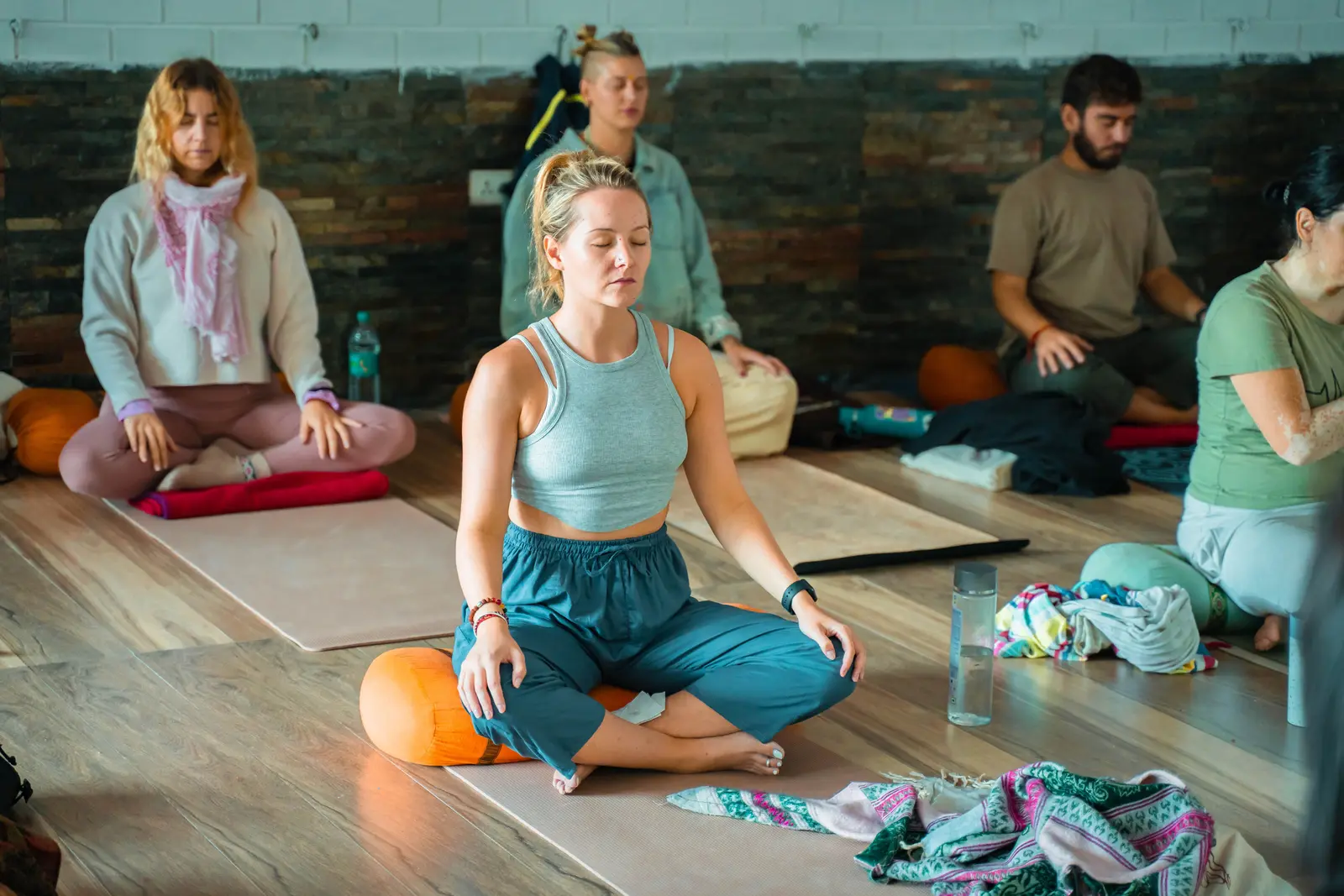
The honest comparison is not "India is cheap." It is that the two formats bundle costs differently, and the residential bundle usually totals lower for the same number of training hours.
A typical studio pathway at home runs part-time — evenings and weekends spread over several months. The advertised price, commonly in the low-to-mid four figures for a 200-hour program, generally covers tuition only. You then carry your normal cost of living for the entire duration: rent or mortgage, food, transport to the studio, and months of juggling training around work.
A residential training in India compresses the same certification hours into a few immersive weeks, and the fee you see is close to the fee you pay while you're here. Our 200-hour training in Rishikesh is 23 days, from $1,200, with your room and all meals inside that number. The big remaining variable is the flight — real money, but a one-time cost you can price precisely before committing.
There are two fair counterpoints, and we'd rather you hear them from us. First, a part-time course at home lets you keep earning your full salary throughout, which matters if taking three to eight weeks away from work is impossible. Second, if you want to teach in a specific local studio community, training inside that community has networking value no faraway school can replicate. Cost is one axis of the decision — our guide to becoming a certified yoga teacher walks through the others.
Our full published fee table — every course, every price
These are the exact fees published on our course pages — international student pricing, with the fee covering the full residential stay (accommodation, three vegetarian meals daily, all classes, materials and certification). "From" indicates the lowest-priced room category; private rooms cost more.
Course | Duration | Fee (international) | Room options at this price |
|---|---|---|---|
12 days | $730 | Private room for every student | |
23 days | From $1,200 (shared) · $1,350 private | Shared or private | |
27 days | From $1,280 (shared) · $1,480 private | Shared or private | |
58 days | From $2,400 (shared) · $2,700 private | Shared or private | |
23 days | From $1,274 (6-shared) · up to $2,024 private | Four room categories, current-offer pricing | |
23 days | From $1,460 (twin shared) · $1,570 private | Early-bird when booked 2 months ahead | |
23 days | From $1,350 (twin shared) · $1,450 private | Early-bird when booked 2 months ahead | |
23 days | From $1,300 (shared) · $1,575 private | Early-bird when booked 2 months ahead |
A few honest notes on reading this table. The room category is the main lever on price — sharing with one or more fellow trainees is how budget-conscious students bring the total down without changing anything about the teaching. The Bali, Goa, Kerala and Nepal prices shown are the current offer or early-bird rates published on those pages; the regular rates are listed there too, so you can see exactly what booking early saves. And the 500-hour course is the combined path — its 58 days cover both the 200- and 300-hour stages with two certificates, which is why its per-hour cost works out lower than taking the stages separately. If you're unsure which level fits you, our 100 vs 200 vs 300 vs 500 hour comparison is the decision guide.
The hidden costs checklist — what no fee covers
Wherever you train, in India or at home, budget for the items below. None of them are scandalous; the only scandal is a budget that forgets them.
Flights. The largest extra for international students. Prices swing widely by season and route, so get a real quote for your actual dates before committing to any school.
Visa fees. India requires a visa for most nationalities (we provide an invitation letter on request). Nepal offers visa on arrival for most nationalities; so does Indonesia for many. Check your own country's current requirements.
Travel insurance. Non-negotiable in our view for a month abroad. Shop for a policy that covers the full length of your stay.
Yoga Alliance registration. If you choose to register as an RYT after graduating, Yoga Alliance charges its own application and annual fees, paid directly to them — check current rates on their site. Registration is optional; your certificate is yours either way.
Gear. Comfortable practice clothing for daily use, and anything personal you like to practice with. Our preparation guide has the full packing list.
Buffer nights. Many students arrive a day or two early to soften jet lag before day one. Budget the extra nights' stay if you plan to.
Personal spending. Cafés by the Ganga, laundry, souvenirs, Sunday excursions. Modest in India, but real.
Lost income. The quiet one. If a residential month means unpaid leave, that belongs in the comparison honestly — it's often the deciding factor between formats, more than any tuition difference.
How paying for it actually works: the 20% deposit
We'd rather describe our real payment structure than a hypothetical financing menu, so here it is, exactly as it works.
You reserve your seat with a 20% advance deposit, which is non-refundable, and you pay the remaining balance when you arrive. That's the whole model. There is no mandatory payment plan, no interest, and no pressure mechanism — the deposit exists because batches are capped at 20 students and a reserved seat is a seat someone else can't take.
Two things we want to say plainly, because this corner of the industry doesn't always earn trust. First, the early-bird prices on our Goa, Kerala and Nepal pages are real published rates with the regular price shown beside them — book two months ahead and you pay the lower figure; book late and you pay the regular one. No countdown timers, no "only today" theatrics. Second, if the standard deposit-then-balance structure genuinely doesn't work for your situation, write to us. We're happy to discuss a payment arrangement that does — that's a conversation, not a product with fees attached.
Our practical advice for budgeting: pick your course, add your flight quote and the checklist items above, and you have a true total within a small margin — because the biggest line item, the course fee itself, is fixed and published.
Frequently asked questions
How expensive is it to become a yoga teacher?
Using our published fees as the concrete example: a 200-hour residential training — the standard entry credential — starts from $1,200 including accommodation and meals, and a foundation 100-hour course from $730. On top of any training, anywhere, budget for travel, insurance and the optional Yoga Alliance registration fee. Studio programs at home are commonly advertised in the low-to-mid four figures for tuition alone, so the total depends heavily on which format you choose.
How much does 200-hour yoga teacher training cost?
Our 200-hour residential courses range from $1,200 (shared room, Rishikesh) to $2,024 (private room, Bali), with every fee covering the full 23-day stay: accommodation, three vegetarian meals daily, all classes, materials and certification. Non-residential 200-hour programs in the US and Europe are commonly advertised at higher tuition-only prices — always check what's included before comparing numbers.
Can I write off yoga teacher training on my taxes?
Sometimes — but this genuinely depends on your country's tax rules and your situation. In broad terms, education costs are more likely to be deductible when they maintain or improve skills for work you already do than when they qualify you for a new profession, and the details vary by jurisdiction. Please ask a qualified tax professional in your country before counting on a deduction; we're yoga teachers, not accountants, and this paragraph is not tax advice.
Is 40 too old to become a yoga teacher?
No. Nothing in the Yoga Alliance pathway sets an age limit, and nothing in a well-run training assumes a 25-year-old body — our courses are taught to your level, not to an ideal one. Students in their 40s and beyond often arrive with exactly the qualities newer bodies lack: patience, self-knowledge, and a reason for being here that survives the hard days. If your body can practice, your age is an asset in front of a class, not a barrier.
Why do yoga teacher training prices vary so much between schools?
Mostly four factors: whether accommodation and food are included (the biggest one), the local cost of running a school, room category, and faculty depth. A price that looks surprisingly low deserves the same scrutiny as one that looks surprisingly high — ask exactly what's included, how large batches are, and whether the school is Yoga Alliance–registered, then compare totals rather than headlines.
Is a cheaper training worth less?
Not automatically. A residential training in Rishikesh costs less than a studio course in a Western capital largely because the cost of delivering it is lower here — not because the hours are fewer or the standards looser. The certification structure is the same Yoga Alliance framework. What you should never compromise on: small batches, experienced faculty, and a school that answers your questions directly before taking your deposit.
Methodology note — where these numbers come from
Two kinds of numbers appear in this guide, and we want the line between them to be unmistakable. Our own fees are exact: every figure attributed to Pure Soul Yoga School is the current published price on the linked course page, and those pages remain the source of truth if anything changes between updates of this article. Market figures are deliberately qualitative: phrases like "commonly advertised in the low-to-mid four figures" reflect prices commonly advertised by studios and schools generally — they are not averages, not survey results, and not a scientific study, because we haven't conducted one and won't pretend otherwise. Yoga Alliance's registration fees are set by Yoga Alliance; check current rates on their site.
Cite this data. If you're writing about yoga teacher training costs — as a journalist, blogger, or researcher — you're welcome to reuse our fee table and the breakdown above with attribution and a link to this page. We keep it current, and we'd rather the internet's cost conversations run on real published numbers than on guesses.
Ready to put real numbers on your own plan?
The fastest way to turn this from research into a plan is to pick the course that fits your life and look at its true total. Browse all our courses — every page publishes its full fee, dates and inclusions — or message us on WhatsApp with your budget and constraints. Real humans answer, usually within hours, and "what will this actually cost me, all in?" is a question we like being asked.
Author note (byline): Gangesha Adi (E-RYT 500) founded Pure Soul Yoga School in Rishikesh and has answered the "what does it really cost?" question for aspiring teachers from 50+ nationalities — this guide is the written version of that conversation.