The Eight Limbs of Yoga: Patanjali's Path Explained Simply
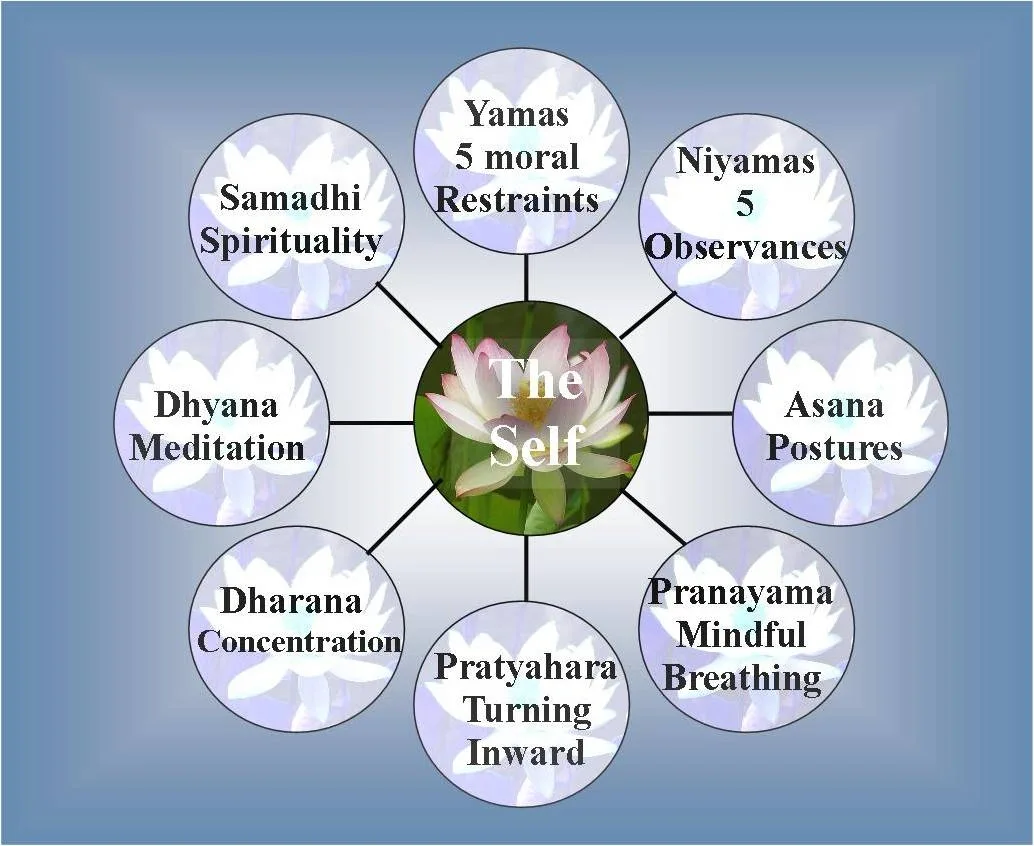
The eight limbs of yoga are the classical framework for the whole practice of yoga — not just the poses. Set out by the sage Patanjali in the Yoga Sutras, they are: yama (ethical restraints), niyama (personal observances), asana (posture), pranayama (breath regulation), pratyahara (withdrawal of the senses), dharana (concentration), dhyana (meditation) and samadhi (absorption). In Sanskrit the framework is called ashtanga — ashta meaning eight, anga meaning limb.
Notice what that means: of the eight limbs, only one is about postures. The rest describe how you treat people, how you treat yourself, how you breathe, and how you train attention. This guide walks through each limb in plain language — its classical meaning, what it looks like on an ordinary Tuesday, and how it shows up in a teacher training — without pretending any of it is easier than it is.
In this guide
Limb 1: Yama · Limb 2: Niyama · Limb 3: Asana · Limb 4: Pranayama · Limb 5: Pratyahara · Limb 6: Dharana · Limb 7: Dhyana · Limb 8: Samadhi
Where do the eight limbs of yoga come from?
The eight limbs come from Patanjali's Yoga Sutras, a collection of short aphorisms — sutra literally means "thread" — that systematised yoga philosophy and practice. Scholars place the text roughly in the early centuries of the common era, and it remains the foundational manual of what is often called raja yoga, the "royal" path of meditation.
Very early in the text, Patanjali defines his subject. The second sutra reads yogash chitta vritti nirodhah (Yoga Sutras 1.2): yoga is the stilling of the fluctuations of the mind. Everything that follows — all eight limbs — serves that one definition. The limbs themselves are listed in the second chapter, the Sadhana Pada ("the chapter on practice"), at sutra 2.29, and the five yamas and five niyamas are named at sutras 2.30 and 2.32.
One image is worth keeping from the start: Patanjali calls them limbs, not steps. A ladder you climb one rung at a time, leaving the lower rungs behind; limbs grow together, the way an arm and a leg belong to one body. You don't "finish" honesty before you're allowed to breathe. In practice the limbs feed each other — a steadier posture deepens the breath, a steadier breath quiets the senses, and treating people well removes the mental noise that makes concentration impossible.
The eight limbs at a glance
# | Limb (Sanskrit) | Plain meaning | In one sentence |
|---|---|---|---|
1 | Yama | Ethical restraints | How you treat the world: non-harming, truthfulness, non-stealing, wise use of energy, non-grasping |
2 | Niyama | Personal observances | How you treat yourself: cleanliness, contentment, discipline, self-study, surrender |
3 | Asana | Posture | A steady, comfortable seat — the body prepared for stillness |
4 | Pranayama | Breath regulation | Working with the breath to steady energy and mind |
5 | Pratyahara | Sense withdrawal | Turning attention inward, away from external pull |
6 | Dharana | Concentration | Holding attention on one point |
7 | Dhyana | Meditation | Concentration becoming a continuous, effortless flow |
8 | Samadhi | Absorption | Complete unity of attention — the meditator, meditating and object merge |
The tradition also groups them: the first five are often called the outer limbs (bahiranga — they deal with conduct, body, breath and senses) and the last three the inner limbs (antaranga — they happen entirely in attention). When dharana, dhyana and samadhi are practised together on one object, the Sutras call that combined discipline samyama.
"Ashtanga" the philosophy vs Ashtanga the yoga style
A genuinely confusing naming collision, so let's settle it early. Ashtanga yoga in Patanjali's sense is the eight-limbed path described in this article — a framework for living and meditating that is thousands of years old and involves no particular sequence of poses.
Ashtanga Vinyasa, the athletic, breath-synchronised style taught in modern studios, is a specific physical method systematised in Mysore in the modern era. Its founders named it in homage to Patanjali's framework, and its practice does engage several limbs — asana and pranayama most obviously — but the style and the philosophy are not the same thing. When someone says "Ashtanga is really hard," they mean the Vinyasa style, not the philosophy (although honestly, aparigraha on a difficult day is no joke either). For where Ashtanga Vinyasa sits among other styles, see our guide to the types of yoga styles.
Limb 1: Yama — five ethical restraints
The yamas answer a question people rarely expect yoga to ask: how do you treat everyone else? Patanjali lists five (Yoga Sutras 2.30), and the tradition regards them as universal — not dependent on culture, status or circumstance.
Ahimsa — non-harming
The foundation of the entire path. Classically, ahimsa means non-violence in action, speech and thought — the thought part being where the real work hides. In daily life it looks like the email you soften before sending, the joke at someone's expense you leave untold, and — the version our students find hardest — the way you speak to yourself when a pose doesn't come. A practice built on self-punishment contradicts its own first principle.
Satya — truthfulness
Truth in speech, and behind it, honesty with yourself. The tradition pairs satya with ahimsa deliberately: truth delivered as a weapon violates non-harming, and kindness built on falsehood violates truth. Daily-life satya is often small and unglamorous — not inflating a story, not agreeing to plans you know you'll cancel, admitting "I don't know" as a teacher rather than improvising an answer.
Asteya — non-stealing
Wider than not taking objects. Classically, asteya includes not taking what is not freely offered — time (chronic lateness), attention (talking over people), credit (claiming a colleague's idea), even someone's confidence. A useful daily test: did everyone in this exchange give freely, or did I quietly take?
Brahmacharya — wise use of vital energy
Classically associated with celibacy in renunciate traditions, brahmacharya is understood more broadly for householders — people with jobs, families and relationships — as the wise stewardship of vital energy, sexual energy included. The honest modern application: notice where your energy leaks — endless scrolling, gossip, overcommitment — and choose where it goes instead. It is a limb about not squandering the fuel the other limbs run on.
Aparigraha — non-grasping
Non-possessiveness: taking what you need, holding it lightly, and letting go of the rest. It applies to objects, but just as much to outcomes, opinions and identities — including the identity of "good yoga practitioner." Students meet aparigraha vividly in training: the moment you stop grasping for a posture is usually the moment your body stops fighting you.
Limb 2: Niyama — five personal observances
If the yamas govern how you meet the world, the niyamas (Yoga Sutras 2.32) govern the private culture of your own life — five habits that keep the inner environment workable.
Saucha — cleanliness
Purity of body, surroundings and mind. Practically: the hygiene and simple, fresh food that yogic tradition has always emphasised, an uncluttered practice space, and — the subtler layer — noticing what you feed your mind daily, because attention has a diet too.
Santosha — contentment
Not forced positivity, and not resignation. Santosha is the practised ability to be at peace with what is true right now while still acting to change it — content, not complacent. In daily life it is the antidote to the "I'll be happy when…" loop. In training it sounds like a student saying, halfway through the course, "I stopped comparing my practice to the person on the next mat, and everything got quieter."
Tapas — discipline
Literally "heat" — the friction of doing the practice on the days you don't feel like it. Tapas is not self-punishment; the tradition frames it as the cheerful acceptance of useful difficulty, the way holding a posture ten more seconds builds what skipping it never will. A 6 a.m. alarm in Rishikesh is tapas. So is a ten-minute home practice defended against a busy calendar.
Svadhyaya — self-study
Two meanings, both intended: study of the classical texts (traditionally including recitation), and study of yourself — watching your own patterns, reactions and stories with the same attention you'd give a text. Journalling after practice, honest reflection after a conflict, reading the Sutras slowly rather than quickly: all svadhyaya.
Ishvara pranidhana — surrender
Dedication of one's efforts to something larger than the personal self — classically, surrender to Ishvara, the divine principle. For students uneasy with theological language, teachers have long offered an honest bridge: practise wholeheartedly, then release your grip on the results. (If that sounds like karma yoga, you're paying attention — the Bhagavad Gita builds an entire path on that release; we explore it in our guide to karma yoga.)
A tip from our teaching hall: don't try to adopt all ten yamas and niyamas at once — that's a New Year's resolution, not a practice. In our philosophy classes we ask students to pick one for a full week and simply observe it everywhere. One is transformative. Ten at once is decorative.
Limb 3: Asana — posture
Here is the surprise for most modern practitioners: in the Yoga Sutras, asana — the limb the modern world calls "yoga" — receives only a few sutras. The most famous is sthira sukham asanam (Yoga Sutras 2.46): posture should be steady and comfortable. For Patanjali, asana chiefly means a seat for meditation stable enough that the body stops interrupting the mind.
The rich vocabulary of postures practised today grew later, especially in the hatha yoga tradition, whose texts (such as the Hatha Yoga Pradipika) developed asana as a way to prepare the body's strength, flexibility and energy for the deeper limbs. That history doesn't demote physical practice — it locates it. Every down-dog is legitimate yoga; it is also, in the classical map, preparation. The measure of an asana practice, by Patanjali's definition, isn't the depth of the backbend but the steadiness and ease it produces — can you, at the end of it, sit still and comfortably? That reframe alone changes how people practise.
Limb 4: Pranayama — breath regulation
Once the posture is steady, Patanjali turns to the breath. Prana is the vital energy the breath carries; ayama means extension or regulation. Classically, pranayama works with the three movements of breath — inhalation, exhalation and retention (kumbhaka) — to make the breath slow, subtle and long, which the tradition teaches steadies prana and, with it, the mind.
Anyone who has taken five genuinely slow breaths before a stressful conversation has met the principle in miniature. The full discipline is progressive and technique-rich — alternate-nostril breathing, ujjayi, bhramari and more — and it rewards patient, correctly-taught practice; strong techniques with retention should be learned from a teacher, not a video. We've written a complete plain-language guide to pranayama breathing techniques covering seven core practices, their methods and their cautions.
In the classical sequence, pranayama is the hinge of the whole path: the last limb that works with something physical, and the doorway to the limbs that work purely with attention.
Limb 5: Pratyahara — withdrawal of the senses
Pratyahara is the least famous limb and, in an age engineered to capture attention, arguably the most needed. The word means "withdrawal" — the senses turning inward, no longer chasing every sound, sight and notification. The classical image: as a tortoise draws its limbs into its shell, the practitioner draws attention back from the sense-world.
You have already experienced involuntary pratyahara — absorbed in a book, you didn't hear your name called. The limb trains that absorption deliberately. In practice it often begins in savasana or seated stillness: sounds continue (in Rishikesh, temple bells and river make sure of it), but attention stops leaving to follow them. Daily-life versions are humble and effective: one meal a day with no screen, a walk with no headphones, the phone in another room for an hour. Pratyahara is the bridge between the outer limbs and the inner ones — without it, "meditation" is mostly listening to the neighbours.
Limb 6: Dharana — concentration
Dharana means binding attention to a single point — the breath at the nostrils, a candle flame, a mantra, a point in the body. Nothing mystical is claimed here: it is attention training, and it behaves like training. You place attention on the object; attention wanders; you notice; you return. That cycle — place, wander, notice, return — repeated without self-criticism, is the practice, not a failure of it.
Beginners are often relieved to hear that a "bad" concentration session, full of returns, is a productive one — each return is a repetition, the way each lift in a gym is. Daily life offers dharana practice constantly: one task, done with full attention, without tab-switching, is concentration training wearing work clothes.
Limb 7: Dhyana — meditation
When concentration matures, the effortful returning quiets and attention rests on its object in a continuous, unbroken flow — that is dhyana, meditation proper. The classical distinction is elegant: dharana is placing attention again and again; dhyana is attention staying, like oil poured in a steady stream rather than water in drops.
This is why the honest answer to "how do I meditate?" is usually "learn to concentrate first." Dhyana is not a technique you perform but a state that arises when the earlier limbs have done their work — which is exactly how the eight-limb structure is meant to function. Meditation is a daily practice in our training programs, and for students who want to go deeply into this limb and learn to guide others, our meditation teacher training in Rishikesh is built around it.
Limb 8: Samadhi — absorption
The eighth limb is the one most often oversold, so let's be careful. In the Sutras, samadhi describes the culmination of the inner limbs: absorption so complete that the sense of a separate observer fades — attention, its object and the act of attending merge. Patanjali describes samadhi not as a single destination but in stages of increasing subtlety, and the tradition presents it as the direct fulfilment of sutra 1.2: the mind's fluctuations fully stilled, awareness resting in its own nature.
What we can say honestly: samadhi is the tradition's description of where this path leads, held with reverence for thousands of years; it is not a weekend achievement, and nobody credible promises it on a certificate. What students do report along the way — moments of deep absorption in practice, when effort disappears and time goes strange — the tradition would call glimpses in samadhi's direction. The eighth limb's practical gift to a modern practitioner is orientation: it tells you which way the path points, so the other seven limbs make sense as one road rather than eight hobbies.
Living the eight limbs in daily life
You do not need a Himalayan cave. A workable week of eight-limbed practice, drawn from what we actually suggest to students going home after training:
Yama: choose one yama as the week's lens (say, satya) and simply notice it in every conversation.
Niyama: one act of tapas daily — the ten-minute practice happens especially when you don't feel like it.
Asana: practise with Patanjali's measure — end every session with two minutes of genuinely steady, comfortable sitting.
Pranayama: five slow, even breaths, three times a day, attached to existing habits (kettle, commute, log-off).
Pratyahara: one screen-free meal daily.
Dharana: ten minutes, one point of focus, count every return as a repetition, not a failure.
Dhyana: don't chase it — on the days concentration goes quiet by itself, let it.
Samadhi: hold the destination lightly; your job this week is the road.
How the eight limbs are taught in yoga teacher training
In a serious training, the eight limbs are not a one-off lecture — they are the syllabus's skeleton. At our school, philosophy is a daily class in the 200-hour yoga teacher training: every mid-morning, after asana and pranayama practice, students sit with the Yoga Sutras — the eight limbs, karma, the mind — taught conversationally and connected to the life you actually live rather than recited at you. It is, students repeatedly tell us, the class where yoga stops being exercise.
The deeper point is that a training day enacts the limbs rather than merely explaining them: ethics in how a small group of twenty lives together for a month, tapas in the early alarm, asana and pranayama each morning, pratyahara and dhyana in the evening meditation and yoga nidra, svadhyaya in the nightly self-study hour. If you want to see how that fits into an actual timetable, read our honest day in the life at the school.
Frequently asked questions
What are the 8 limbs of yoga in detail?
Yama (five ethical restraints: ahimsa, satya, asteya, brahmacharya, aparigraha), niyama (five observances: saucha, santosha, tapas, svadhyaya, ishvara pranidhana), asana (steady posture), pranayama (breath regulation), pratyahara (sense withdrawal), dharana (concentration), dhyana (meditation) and samadhi (absorption). The full explanations are in the sections above.
Who wrote the eight limbs of yoga?
The sage Patanjali, in the Yoga Sutras — the eight limbs are set out in the second chapter (Sadhana Pada, sutra 2.29). Little is known historically about Patanjali himself, and scholars debate his dates; the tradition reveres him as the compiler who systematised much older yogic knowledge into 196 concise sutras.
Is Ashtanga the hardest yoga?
Two different things share the name. Ashtanga Vinyasa — the modern physical style — is genuinely demanding: set sequences, brisk pace, daily practice culture. Whether it is "the hardest" depends on the body asking; many find slow Yin practice harder to endure. Patanjali's ashtanga — the eight limbs — is a life framework, not a workout, and its difficulty is of another kind entirely: telling the truth for a week can be harder than any arm balance.
What are the 8 kumbhakas?
A related but separate "eight" from the hatha tradition. Kumbhaka means breath retention, and the Hatha Yoga Pradipika classically lists eight retention-based pranayama practices: surya bhedana, ujjayi, sitkari, shitali, bhastrika, bhramari, murcha and plavini. These belong to limb four's extended family and should be learned under an experienced teacher, as several involve strong retention.
Which is the 7th limb of ashtanga yoga?
Dhyana — meditation: the state in which concentration (dharana, the sixth limb) becomes a continuous, effortless flow of attention toward one object. It precedes samadhi, the eighth limb.
Do I have to practise all eight limbs to "really" do yoga?
No gatekeeping here: a posture-only practice is still yoga, and still valuable. The eight limbs are an invitation, not an entry requirement. Most people find that the limbs arrive on their own anyway — you start for flexibility, and one day you notice you're breathing differently in traffic and telling fewer small lies. That is the framework working from the inside.
Where to go deeper
If this framework has hooked something in you, three good next steps: read our plain-language guide to pranayama breathing techniques to begin limb four properly; explore karma yoga to see how the Bhagavad Gita approaches the same goal through action; or, if you're ready to live all eight limbs for a month beside the Ganga — daily philosophy class included — see the 200-hour yoga teacher training in Rishikesh. Questions about whether a training is right for you? Message us on WhatsApp; real humans answer.
References
Patanjali, Yoga Sutras — especially 1.2 (definition of yoga), 2.29 (the eight limbs), 2.30 (the five yamas), 2.32 (the five niyamas), 2.46 (on asana). Any faithful translation with commentary is suitable for study.
Hatha Yoga Pradipika — classical hatha text; source for the eight kumbhakas and the developed asana tradition.
Bhagavad Gita — companion classical text on the paths of yoga, including karma yoga.
Author note (byline): Gangesha Adi (E-RYT 500) leads the teaching team at Pure Soul Yoga School, Rishikesh, where he has taught the Yoga Sutras and the eight limbs as a daily class to teacher-training students from 50+ nationalities over the past decade.