Yoga Nidra for Sleep: Why Rest You Stay Awake For Works
Yoga nidra helps many people sleep — which is odd, because yoga nidra is not sleep, and the classical practice actually asks you to stay awake. That paradox is the whole story: nidra is a guided, lying-down relaxation practice that walks body and mind down the same staircase they descend every night at sleep onset — muscles releasing, breath slowing, senses withdrawing. Practice that descent regularly and two useful things happen: pre-sleep arousal (the wired, racing-mind state that keeps you staring at the ceiling) drops, and the route into sleep becomes familiar, rehearsed ground. Early research is genuinely encouraging here, and honest limits apply: nidra is a wind-down practice, not a treatment for a diagnosed sleep disorder.
This article covers only the sleep side of the practice — how to use it before bed, what the evidence does and doesn't support, and how it compares with other sleep aids. For what yoga nidra is, its full benefits and a complete session walkthrough, start with our complete yoga nidra guide.
In this article: - Why a staying-awake practice helps you sleep - What the research suggests — and what it doesn't - A bedtime yoga nidra practice, step by step - Nidra vs sleep meditation vs white noise - When nidra isn't enough: insomnia, honestly - FAQs
Why a practice about staying awake helps you sleep
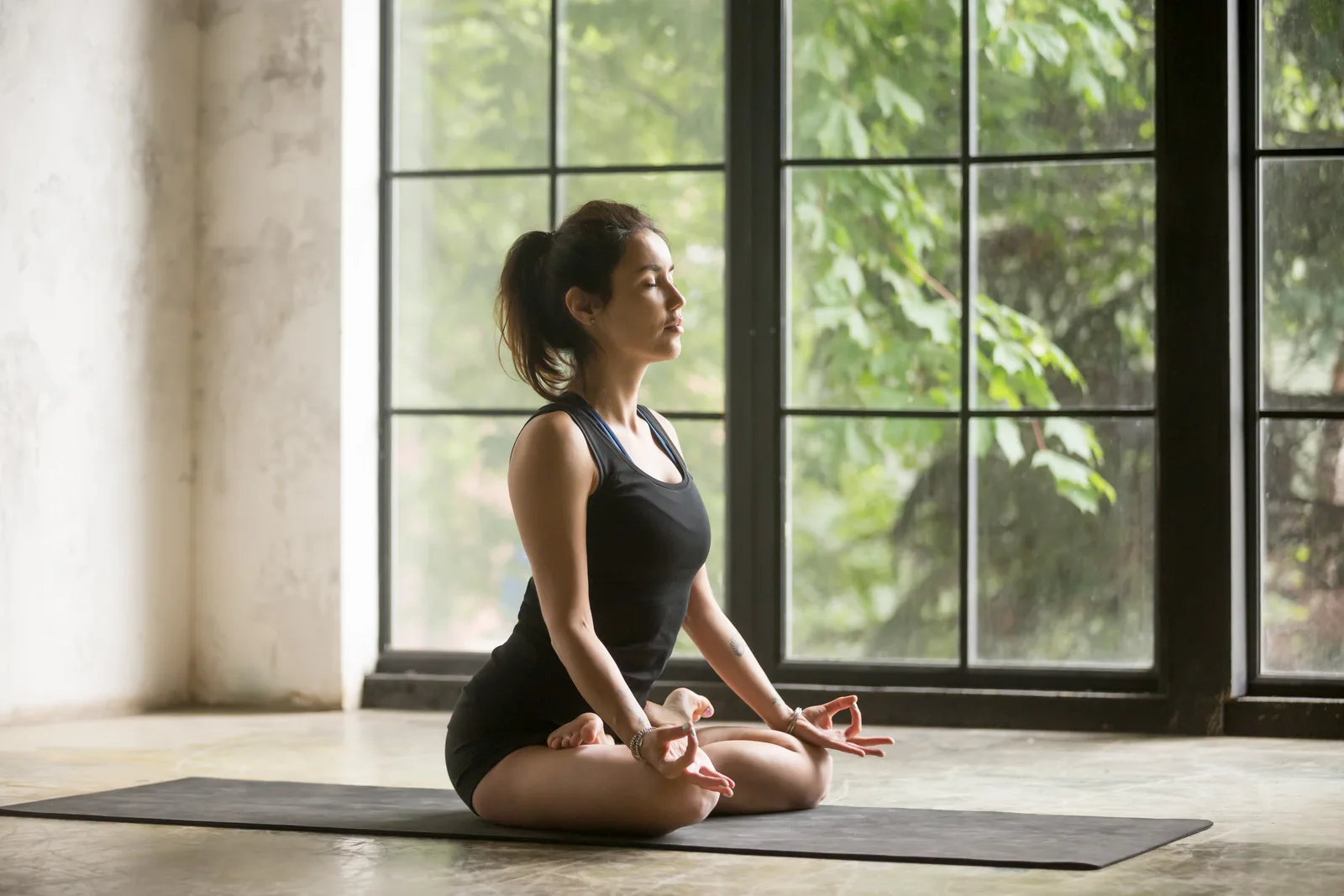
Most people who can't sleep don't have a sleepiness problem — they have an arousal problem. The body is tired, but the stress physiology is still running: heart rate a little high, muscles holding low-grade tension, the mind looping through tomorrow. Sleep won't land on a runway that busy.
Yoga nidra is, mechanically, an arousal-lowering machine. A voice leads your attention point by point through the body — the rotation of consciousness — then through slow breath awareness and simple felt sensations. Following it occupies the thinking mind (no bandwidth left for rumination), releases tension you didn't know you were holding, and engages the relaxation response — the parasympathetic rest-and-digest state that is sleep's natural on-ramp. Most practitioners drift toward the border between waking and sleeping within minutes.
In a daytime session, the teacher asks you to hold awareness at that border — that's the classical practice, and the full guide explains why. Used for sleep, you simply stop holding on: the practice carries you to the border and you step over it. Same staircase; you just don't stop on the landing. Nobody sleeping through the ending is doing it wrong — at bedtime, that's the point.
There's a longer-term effect too. People who sleep badly often come to dread the bed — it's where the nightly fight happens. Rehearsing a pleasant, reliable descent, night after night, retrains that association: the wind-down stops being a battle and becomes a routine the body recognises.
What the research suggests — and what it doesn't
We hold to the same rule across everything we publish: hedge honestly, or don't claim it.
What early research supports. Guided relaxation practices in nidra's family are consistently associated with reduced self-reported stress and lower pre-sleep arousal — the least controversial claim in the field. For sleep specifically, small studies and pilot trials suggest yoga nidra may help people fall asleep more easily, improve self-reported sleep quality, and increase the sense of feeling rested. The mechanism — down-regulating arousal at exactly the moment it blocks sleep — is plausible and consistent with relaxation research generally.
What it doesn't support. The studies are mostly small, short, and often without strong control groups — promising is the honest word, proven is not. No good evidence shows nidra replaces sleep (the "one hour equals four hours" line is a traditional saying, not a finding — our main guide's FAQ takes that one apart). And nidra has not been shown to treat diagnosed sleep disorders: chronic insomnia, sleep apnea and their relatives are medical territory, covered honestly below.
That's a narrower claim than much of what you'll read online. It's also enough: a free, low-risk practice that reliably lowers the state most responsible for keeping tired people awake is worth having, without one exaggerated promise attached.
A bedtime yoga nidra practice, step by step

What follows is the generic structure of a sleep-adapted nidra — the shape almost every recorded session shares, whoever made it. Use it with any guided recording whose voice genuinely relaxes you, or run it from memory once you know the route. (Recorded sessions are widely and freely available; length of 15–25 minutes suits bedtime.)
Close the day first. Lights low, screens away, room cool, tomorrow's list written down and set aside. Nidra lowers arousal; it can't compete with a phone actively raising it.
Practice in bed. Daytime nidra belongs on a firm floor precisely because beds invite sleep — tonight, that's the feature. Lie on your back, pillow under knees if the lower back asks; side-lying is fine too, especially in later pregnancy or with reflux. Settle completely before you begin — the same care we teach for savasana, the pose nidra borrows.
Drop the stay-awake instruction. The one deliberate change from classical practice. Give yourself the opposite permission: if sleep comes, I go.
Rotate attention through the body, slowly. Right-hand thumb, second finger, third… palm, wrist, elbow, shoulder; then the left side; then back, front, head. Bedtime rotations go slower than daytime ones — you're not keeping the mind bright, you're letting it dim. Just hear (or silently name) each part and notice it. No moving, no effort.
Count the breath backwards. From 27, or 11 if you're tired: "27, breathing in… 27, breathing out… 26, breathing in…" Losing count isn't failure — it's data that the descent is working. Start again anywhere.
Invite heaviness and warmth. The whole body heavy on the mattress, then pleasantly warm — two sensations that track the physiology of sleep onset. The tradition knew what it was doing when it placed them here.
Let the ending go. A daytime session closes with a guided return to alertness; a bedtime session should simply trail off. If you're using a recording, choose one designed for sleep, with no wake-up call at the end. Still awake when the voice stops? Stay with the slow breath — you're resting either way.
A tip from our teaching hall: the 3 a.m. waking is where this practice earns its keep. Don't check the clock — the arithmetic of "hours left" is pure arousal. Instead, begin a slow rotation from the right thumb, from memory. Students tell us they rarely get past the second shoulder. And even when sleep doesn't come back, you've spent the hour resting instead of ruminating — which is a materially better night than the ceiling-staring alternative.
Consistency beats intensity here, as everywhere in yoga. A modest 15-minute practice most nights outperforms a heroic 45-minute session once a week — the retraining effect lives in the repetition.
Yoga nidra vs sleep meditation vs white noise
These three get recommended interchangeably, and they shouldn't be — they do different jobs. Honest comparison:
Bedtime yoga nidra | Sleep meditation | White noise | |
|---|---|---|---|
What it is | Guided, fixed-sequence body/breath practice adapted to end in sleep | Broad label: guided imagery, breath practices, body scans aimed at drifting off | Steady masking sound (fan, static, rain) played all night |
How it helps | Actively lowers arousal; rehearses the descent into sleep | Similar pathway, structure varies widely by recording | Masks environmental noise; cues habit |
What you learn | A repeatable skill — eventually works from memory, no device | Depends on the method; less standardised | Nothing — it works only while playing |
Best for | Racing mind, tension, stress-flavoured sleeplessness | Those who prefer variety or imagery-led wind-downs | Noisy environments, light sleepers, habit cue |
Honest limit | Needs 15–25 minutes; a practice, not a switch | Quality varies enormously | Solves noise, not arousal |
The honest read: white noise and nidra aren't even competitors — one treats a noisy room, the other a noisy nervous system, and they combine well. "Sleep meditation" is a shelf label rather than a method; a good guided body scan is essentially a nidra fragment. Nidra's distinct advantage is that it's a structured, learnable skill: after a few weeks, most people can run the sequence themselves, anywhere, with nothing to plug in. To build the skill from the seated side too, our meditation techniques for beginners guide covers body scan and breath practices step by step — and nidra sits alongside its gentler cousins in our healing meditation overview.
When nidra isn't enough: insomnia, honestly
We teach this practice and love it, so take the following at full weight.
Occasional bad nights — stress patches, travel, big-event eves — are exactly nidra's territory. A wind-down practice, kept consistent, is a reasonable and low-risk response, alongside ordinary sleep hygiene: regular hours, morning daylight, caffeine honesty, a dark cool room.
Persistent insomnia is different. If you've struggled to fall or stay asleep several nights a week for three months or more, and it's degrading your days, that pattern deserves a professional — not another recording. The first-line treatment for chronic insomnia is structured behavioural therapy delivered by clinicians (often called CBT-I), and it has stronger evidence behind it than any relaxation practice, nidra included. Speak to your doctor. Nidra can sit comfortably alongside that care as the relaxation component — it complements treatment, it never replaces it.
Two red flags that skip the queue: loud snoring with gasping or breathing pauses (possible sleep apnea), and daytime sleep attacks. Both need medical assessment regardless of how well any evening practice feels.
If deep-relaxation practice reliably surfaces distress rather than calm — which can happen, particularly for people carrying trauma — practice with a qualified teacher's or therapist's support rather than alone at night.
This article is for general education and is not medical advice. Please consult a qualified healthcare professional about your individual situation.
Frequently asked questions
Does yoga nidra help you fall asleep? For many people, yes — by lowering pre-sleep arousal, the wired state that most often blocks sleep in tired people. Early research suggests it may shorten the time to fall asleep and improve self-reported sleep quality; the studies are small, so "promising" is the honest grade. It's most useful for stress-flavoured sleeplessness, least useful for diagnosed sleep disorders, which need medical care.
How do you do yoga nidra for sleep? In bed, lights out, 15–25 minutes: settle completely, give yourself permission to fall asleep (the reverse of daytime practice), follow a slow rotation of attention through the body, count breaths backwards, invite heaviness and warmth, and let the ending trail off. Use any guided recording designed to end without a wake-up return, or run the sequence from memory once you know it.
Can I do yoga nidra by myself, without a recording? Eventually, yes — and for sleep it's the goal. Classical nidra wants a live or recorded voice, because reading a script to yourself keeps the thinking mind employed. But after a few weeks of guided bedtime practice the sequence becomes memory, and a slow self-run rotation — thumb, fingers, palm, wrist — works with nothing playing. That's also the best tool we know for the 3 a.m. waking.
What are the disadvantages of yoga nidra? Genuinely few, honestly stated: it takes 15–25 minutes nightly (not a switch); deep relaxation can occasionally surface difficult emotions, particularly with unresolved trauma — practice supported, not alone, if that's you; relying on it instead of treatment for chronic insomnia or suspected apnea delays care that works better; and never practice anywhere you must stay alert, such as driving. It doesn't replace sleep itself.
What happens if you do yoga nidra every day? Daily practice is the traditional pattern and low-risk for most people. Used nightly for sleep, the realistic trajectory is gradual: the wind-down becomes routine, the descent gets familiar, pre-sleep dread softens, and many people need the recording less over time. It won't reduce your need for actual sleep — the one wrong dose is using nidra to justify shorter nights.
Where we teach this
At our school in Rishikesh, guided practice closes every training day — the 18:00–19:00 slot alternates meditation and yoga nidra — and the students who arrive as poor sleepers are usually the ones asking for the nidra evenings by the end of week one. If the practice becomes yours and you want it from the inside — stages, scripts, delivery, and how to guide others down the same staircase — our Yoga Nidra Teacher Training in Rishikesh is a residential immersion built for exactly that. No pressure either way; the bedtime practice above is free and complete as it stands. Questions? Ask us on WhatsApp — a real person answers.
References
National Center for Complementary and Integrative Health (NCCIH) — relaxation techniques for health and sleep (evidence characterisation; final URLs at publish).
Peer-reviewed pilot studies and reviews of yoga nidra for sleep quality and insomnia symptoms (PubMed Central–indexed; exact citations pasted at publish per flip checklist).
Clinical guideline literature identifying CBT-I as first-line treatment for chronic insomnia (professional-society source; final URL at publish).
Sleep-medicine publisher overviews of pre-sleep arousal and sleep hygiene (final URLs at publish).
Author note (byline): Gangesha Adi (E-RYT 500) leads the teaching team at Pure Soul Yoga School, Rishikesh, where the training day ends in guided stillness — and where he has heard "I slept properly for the first time in months" from more first-week students than any other single sentence.