How to Improve Your Yoga Practice: 7 Honest Ways to Grow
Improving your yoga practice rarely means learning harder poses. It means practising more consistently, letting the breath lead the movement, refining where your attention goes — gaze, core, alignment — and getting honest feedback from a teacher. Do those four things for three months and your practice will change more than a year of chasing advanced postures ever manages.
That's the short answer. The longer one starts with a question we hear constantly from students arriving at our school in Rishikesh: "I've been practising for two years — why do I feel stuck?" Almost always, the answer isn't effort. It's that the practice has quietly gone onto autopilot. So before the seven ways, a moment of diagnosis.
Why yoga progress stalls: diagnosing the plateau
Plateaus in yoga have a small number of predictable causes, and it's worth spotting yours before choosing a fix:
Autopilot repetition. You do the same sequence, the same way, at the same effort — comfortable, familiar, and no longer asking anything new of you.
Practising only your strengths. Flexible students float into forward folds and skip strength work; strong students avoid the hip openers that humble them. The practice grows lopsided, then stalls.
Irregularity dressed up as practice. One long session a week feels substantial but rebuilds the same ground each time. The body adapts to what happens often, not what happens occasionally.
No feedback loop. Without a teacher's eye, small alignment habits calcify into limits — and the poses stop teaching.
Chasing shapes, not principles. If progress is measured only by "can I do the pose yet," the deeper levers — breath, attention, steadiness — never get pulled.
Recognise yourself somewhere in that list? Good. Every one of them has a remedy below.
1. Build a consistency system, not a motivation habit
The single biggest difference between students who transform and students who plateau is not talent — it's frequency. Motivation is unreliable; a system isn't. What works, in our experience with thousands of students:
Anchor practice to a fixed cue. Same time, same trigger — after your morning tea, before your shower. Decisions drain willpower; anchors remove the decision.
Set a minimum viable practice. Fifteen minutes counts. On low days, do the minimum rather than nothing — the habit survives, and the habit is the asset.
Prepare the night before. Mat out, clothes ready. Trivial, and remarkably effective.
Track it simply. A tick on a calendar is enough. Chains of ticks defend themselves.
Four shorter practices a week will outperform one heroic Sunday session every time. And if mornings are an option for you, they're worth a serious look — the early slot is the one part of the day other people haven't scheduled yet, which is why morning practices survive busy seasons that quietly kill evening ones. (Our morning yoga guide, publishing alongside this one, makes the full case.)
2. Let the breath lead — this is the real "level up"
Ask any experienced teacher what separates an intermediate practitioner from a beginner and the answer is rarely flexibility. It's breath. When the breath leads and the movement follows, practice becomes steady, focused and genuinely meditative; when the breath is held or ragged, even a technically correct pose is a struggle.
Two places to begin:
Ujjayi breath — a soft constriction at the back of the throat creating a quiet ocean sound. It gives the mind something to hold and sets a metronome for flowing practice.
Nadi shodhana (alternate-nostril breathing) — a balancing practice best done seated, before or after asana, that settles the nervous system noticeably.
Both are covered step-by-step, with cautions, in our full guide to pranayama breathing techniques. Ten minutes of dedicated breathwork after your poses will deepen your practice faster than ten extra minutes of poses.
3. Refine your attention: drishti and the bandhas
These two ideas are where yoga stops being stretching. Both come from the traditional practice and both are trainable from your very next session:
Drishti (gaze point). Every pose has a place for the eyes to rest — the thumb in Warrior I, a spot on the floor in balances. A wandering gaze scatters the mind and the balance with it; a settled gaze steadies both. Next wobbly tree pose, fix your eyes on one unmoving point and watch what changes.
Bandhas (energy locks). Subtle internal engagements — most usefully mula bandha (a gentle lift of the pelvic floor) and uddiyana bandha (a light drawing-in below the navel) — that stabilise the core and protect the lower back in transitions. They are felt, not forced, and take months to find. Our guide to the bandhas in yoga explains each one and how to begin safely.
A tip from our teaching hall: if a balancing pose keeps falling apart, check the eyes before the feet. Nine times out of ten the gaze is wandering, and the body simply follows it.
4. Cross-train your practice with a second style
If you always practise one style, a different one will expose exactly what your practice is missing — and fill it. Vinyasa builds breath-linked stamina; Hatha slows everything down until alignment has nowhere to hide; Yin holds poses for minutes and works the deep tissues dynamic practice never reaches; Restorative teaches the surprisingly difficult skill of doing less.
You don't need to switch loyalties. One class a week in a complementary style is enough to break the autopilot pattern. Our guide to the types of yoga styles can help you choose the counterweight to your current practice.
5. Practise with intention, measured honestly
"Get better at yoga" is not a goal your practice can act on. Useful intentions come in two layers:
An intention for the practice — one word or phrase at the start of each session: patience, steadiness, softness. It sounds small; it quietly changes how you move for an hour.
A goal you can measure — practise four times a week for the next month; hold a one-minute unbroken ujjayi count; touch the floor in a forward fold by season's end. Specific, dated, written down.
Revisit both monthly. The intention keeps the practice honest; the goal keeps it moving. And measure the right things — steadier breath in a hard pose is more progress than a deeper bend with a held breath.
6. Use props without ego
Somewhere along the way, props picked up a reputation as beginners' equipment. Teachers know better: blocks, straps and bolsters are precision tools. A block under the hand in Triangle brings the floor to you so the spine can actually lengthen; a strap in Seated Forward Bend lets tight hamstrings work honestly instead of the lower back cheating; a bolster turns a restorative pose from fidgety into genuinely restful.
The pattern worth internalising: a supported pose done with integrity improves your practice; an unsupported pose done by compromise erodes it.
7. Get real feedback — and consider concentrated time
Self-taught habits are invisible to the person who has them. A teacher's eye — in a small class where you're known by name, not one of forty mats — catches in seconds what you'd reinforce for years. If you practise mostly at home or online, even an occasional in-person class with individual attention pays for itself many times over.
Two feedback tools that cost nothing: film one practice a month on your phone and watch it back — the gap between what a pose feels like and what it looks like is where the useful information lives — and keep a two-line practice journal (what you practised, what you noticed). Patterns emerge within weeks: the pose you always avoid, the day of the week you always skip, the breath that always shortens in the same transition. Plateaus hide in patterns, and journals surface them.
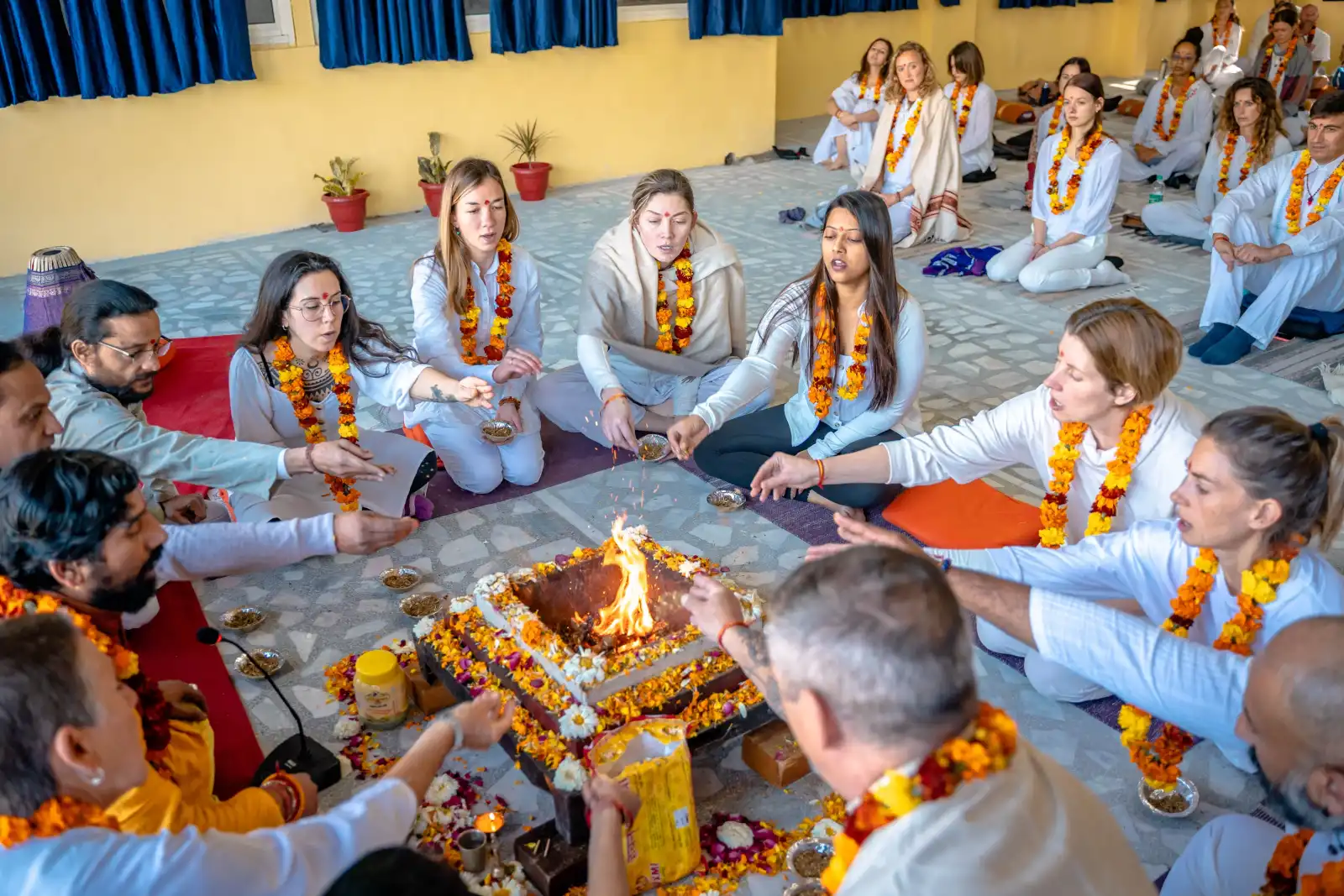
And when you're ready for a bigger jump: concentrated immersion does what weekly classes cannot. A week of daily guided practice — asana, pranayama, meditation, rest — compounds in a way that one class a week never quite does, which is why practitioners have travelled to Rishikesh for generations. A yoga retreat in Rishikesh is one honest version of that reset; it's also perfectly fine to build the same intensity at home with a self-directed practice week. The point is concentration, not geography.
Frequently asked questions
What are the 8 rules of yoga?
This usually refers to the eight limbs of yoga from Patanjali's Yoga Sutras — ethical principles (yama, niyama), posture (asana), breath regulation (pranayama), and four progressive stages of attention through to meditative absorption. They're a framework for the whole practice, not "rules" to pass — see our full guide to the eight limbs of yoga.
Why am I struggling to do yoga?
Usually one of three things: inconsistency (the body never gets to adapt), a style mismatched to your current condition, or held breath making everything harder than it is. Fix frequency first — short and regular beats long and rare — then check the breath before blaming the body.
How do I deepen my yoga practice?
Add what's missing rather than more of the same: dedicated breathwork after asana, attention tools like drishti and gentle bandha engagement, a complementary style once a week, and periodic feedback from a teacher. Depth comes from refinement, not difficulty.
How long does it take to improve at yoga?
With three to four practices a week, most people feel a real difference — steadier balance, easier breath, less stiffness — within four to eight weeks. Visible changes in strength and flexibility typically take a few months. The honest caveat: irregular practice resets the clock each time.
When you want the foundations rebuilt properly
If this article has a single theme, it's that improvement comes from foundations — breath, attention, alignment, consistency — not from harder poses. Some practitioners reach a point where they want those foundations taught properly, from the beginning, all day, for a couple of weeks. That's precisely what our 100-Hour Yoga Teacher Training in Rishikesh is for — despite the name, most students come to deepen their own practice, not to teach. Small batches (maximum 20 students), daily pranayama and philosophy alongside asana, and teachers who will know your practice personally by day three. If a question is on your mind first, ask us on WhatsApp — real humans answer.
Author note (byline): Gangesha Adi (E-RYT 500) leads the teaching team at Pure Soul Yoga School, Rishikesh, and has spent over a decade helping practitioners from 50+ nationalities move past exactly these plateaus.