Bhujangasana Benefits: Cobra Pose Without the Strain
Most modern spines spend their days folded forward — desks, phones, driving. Bhujangasana (Cobra Pose) bends the spine the other way, and does it from the floor, where gravity is kind and the range is easy to control. That combination is exactly why it earns its benefits: practiced well, cobra strengthens the muscles along the spine, opens the chest and shoulders, and may ease the stiffness that forward-hunched days leave behind. Practiced badly — pushed up by the arms into a pinched lower back — it delivers the opposite. The line between the two is thinner than most tutorials admit, so this guide walks it carefully: exact steps, honest benefits, the mistakes we correct most often, and the pose it constantly gets confused with.
This article is for general education and is not medical advice. If you have a back injury or ongoing back pain, please consult a qualified healthcare professional before practicing.
What is Bhujangasana?
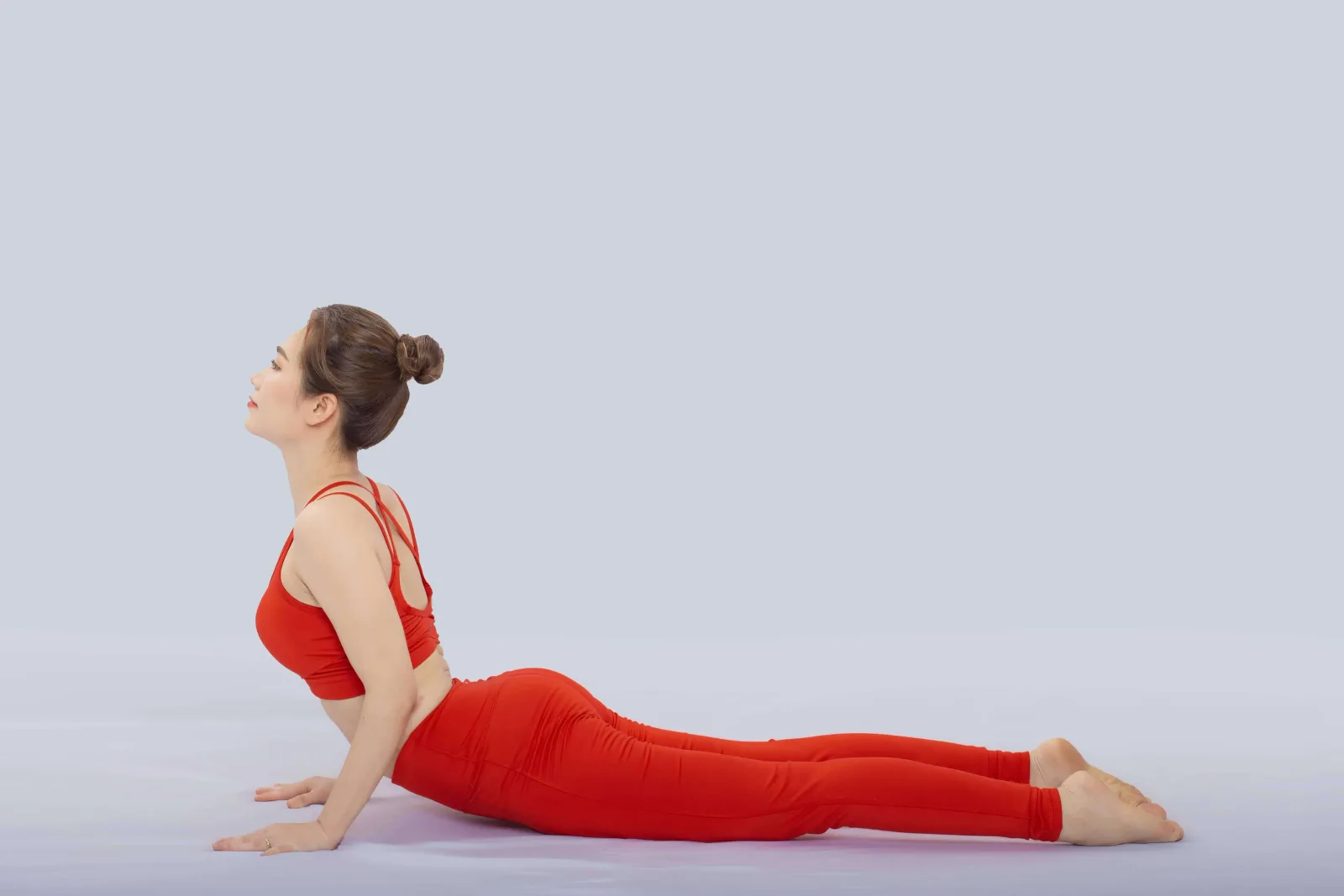
Bhujanga is Sanskrit for serpent or cobra; asana means pose. The image tells you the technique: a snake raises its hood with the strength of its own body, not by pushing off the ground with limbs it doesn't have. In bhujangasana the lift of the chest should come primarily from the back muscles — the arms assist, they don't do the work. It is one of the foundational prone backbends of hatha yoga, appears as step 7 of Surya Namaskar, and belongs in nearly every beginner's weekly practice.
How to do Bhujangasana (step by step)
Lie on your belly, legs extended, tops of the feet on the floor, legs about hip-width.
Place your palms flat under your shoulders, fingertips level with the front of the shoulders, elbows hugging your ribs.
Press the pubic bone and tops of the feet gently down — this protects the lower back.
Inhale and lift the chest forward and up, leading with the breastbone, using the back muscles first.
Let the arms help only as much as needed; elbows stay bent and close to the body.
Draw the shoulders down away from the ears; keep the back of the neck long, gaze slightly forward and up.
Stay for 15–30 seconds of smooth breathing, then exhale and lower slowly.
Repeat 2–3 times, resting a breath or two between lifts.
A useful self-test from our teaching hall: at your full height, lift the palms off the floor for one second. If your chest crashes down, the arms were holding you up and the back muscles were on holiday — lower an inch or two and rebuild the lift from the spine.
Bhujangasana benefits — the honest list
Back strength where sitting erodes it. The lift is active work for the spinal extensors and the muscles between the shoulder blades — precisely the musculature that long sitting weakens. This is cobra's most defensible benefit, and it's a strengthening effect, so it comes from regular practice, not occasional visits.
Counter-movement to flexion posture. Spending the day flexed forward and never extending is what leaves backs feeling elderly. Gentle, frequent spinal extension restores the other half of the spine's range. Prone extension movements very similar to cobra are widely used in back-care exercise generally, and many practitioners report their backs feel freer with regular practice — though responses to back exercise are individual, and pain that worsens with extension is a signal to stop and seek advice.
Chest and shoulder opening. The front of the shoulders and the chest get a sustained stretch, which many students experience as an antidote to the rounded-shoulder slump.
Traditional claims about the abdominal organs. Classical teaching holds that cobra massages and stimulates the abdominal organs — digestion and kidneys included — through the gentle stretch and pressure across the belly. Modern evidence for specific organ effects is limited, so take these as tradition respectfully passed on, not as clinical claims.
A note on what cobra won't do: it will not, by itself, reduce belly fat. No single pose spot-reduces fat anywhere. It strengthens and mobilises; body composition is governed by overall activity and diet.
Cobra vs Upward-Facing Dog: not the same pose
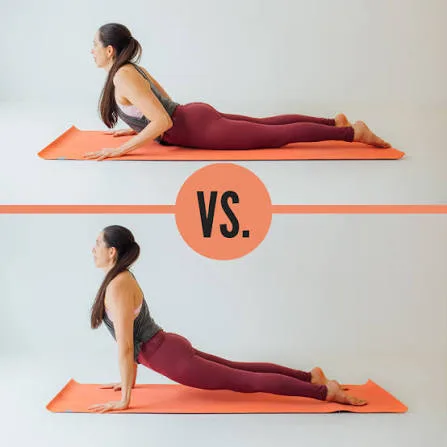
These two are confused constantly — including, once upon a time, in this site's own old pose library — so here is the distinction, plainly:
Bhujangasana (Cobra) | Urdhva Mukha Svanasana (Upward-Facing Dog) | |
|---|---|---|
Hips and thighs | On the floor | Lifted off the floor |
Elbows | Bent, hugging the ribs | Straight |
Weight in hands | Light — back muscles lead | Substantial — arms bear the body |
Feet | Tops down, relaxed | Tops down, actively pressing |
Level | Beginner | Intermediate — a stronger, deeper backbend |
If your hips are off the floor and your arms are straight, you have left cobra and entered upward dog — a legitimate pose, but a bigger demand on the lower back, wrists and shoulders. Beginners should own cobra first.
Common mistakes
Pushing up with the arms alone. Straight-armed, shrugged cobra hinges all the bend into the lumbar spine. Bend the elbows, lower the chest, lift from the back.
Shoulders climbing to the ears. Slide the shoulder blades down the back; the neck should stay long.
Throwing the head back. The neck follows the curve of the rest of the spine — it doesn't crank independently.
Clenching the buttocks hard. A light engagement is fine; a fierce grip compresses the lower back. Keep the legs active, the glutes easy.
Holding the breath. If the breath can't flow, the height is too ambitious for today.
Who should be careful (contraindications)
Pregnancy — belly-down poses need replacing; work with a qualified prenatal teacher on alternatives.
Recent abdominal surgery or hernia — the front-body stretch and pressure make clearance from your doctor essential first.
Acute back injury, sciatica or diagnosed disc problems — extension helps some backs and aggravates others; this is a pose to learn under individual professional guidance, not from a page.
Wrist problems — usually workable, since cobra loads the hands lightly; the sphinx variation removes wrist extension entirely.
Sharp pain in the spine at any height means lower down or come out — effort should be felt as broad muscular work, never as a pinch.
Variations and props
Baby cobra — chest lifts only a few inches, hands barely weighted. The best starting point, and a complete pose in its own right.
Sphinx pose (Salamba Bhujangasana) — forearms on the floor, elbows under shoulders. Gentler angle, no wrist demand, easy to hold longer.
Hands-free cobra — palms hover; pure back strength. Excellent 3–5 breath training drill.
Blanket under the pelvis — softens the pressure on the hip bones on firm floors.
Wider legs — taking the feet slightly wider often relieves lower-back crowding for stiffer bodies.
Frequently asked questions
What are the 10 benefits of Bhujangasana?
Lists of ten circulate widely, but honesty shrinks them. The well-supported benefits are: back-muscle strengthening, restored spinal extension, chest and shoulder opening, better tolerance for upright posture, and — practiced slowly with breath — a calming, focusing effect. Traditional teaching adds digestive and organ stimulation, which we frame as tradition rather than evidence.
How often should you do Bhujangasana?
Daily practice is fine and is how the strengthening benefit actually arrives — 2–3 lifts of 15–30 seconds each, within a balanced session. Alternate-day practice works too. What matters is months of consistency, not marathon holds.
Is Bhujangasana good for the kidneys?
That claim comes from traditional teaching about stimulating the abdominal organs, and we present it as exactly that — tradition. There is no solid modern evidence of a specific kidney benefit. Cobra's demonstrable value lies in the back, chest and posture.
Can Bhujangasana reduce belly fat?
No pose reduces belly fat by itself — spot reduction isn't how bodies work. Cobra strengthens the back and stretches the front; fat loss, if that's a goal, comes from overall activity and eating patterns. It can still be part of the active routine that supports those.
Where cobra fits in your practice
Cobra is one pillar of a balanced practice, not the whole building — see how it sits among the backbends, folds and twists in the complete asana library. And if teaching poses like this one — including how to correct the arm-pushing mistake in someone else's body — appeals to you, that skill is the daily bread of our 200-hour yoga teacher training in Rishikesh. We're on WhatsApp for any question.
References
National Center for Complementary and Integrative Health (NCCIH) — Yoga: What You Need To Know (general evidence on yoga for wellbeing and low-back pain).
National Institute of Neurological Disorders and Stroke / NIH — Low Back Pain Fact Sheet (context on exercise and back care).
Traditional hatha yoga teaching on bhujangasana (as taught in classical Indian schools; organ-stimulation claims presented as tradition, not clinical evidence).
Reviewed for health accuracy by Dr. Bhupinder Singh Arora (M.D. Ayurveda), consulting Ayurvedic physician at Pure Soul Yoga School. This article is educational and not a substitute for personal medical advice.
Author note (byline): Gangesha Adi (E-RYT 500) corrects the straight-armed cobra more than any other pose mistake in beginner classes at Pure Soul Yoga School, Rishikesh — this article is the correction, written down.