Surya Namaskar Benefits: The 12 Steps with Breath Cues
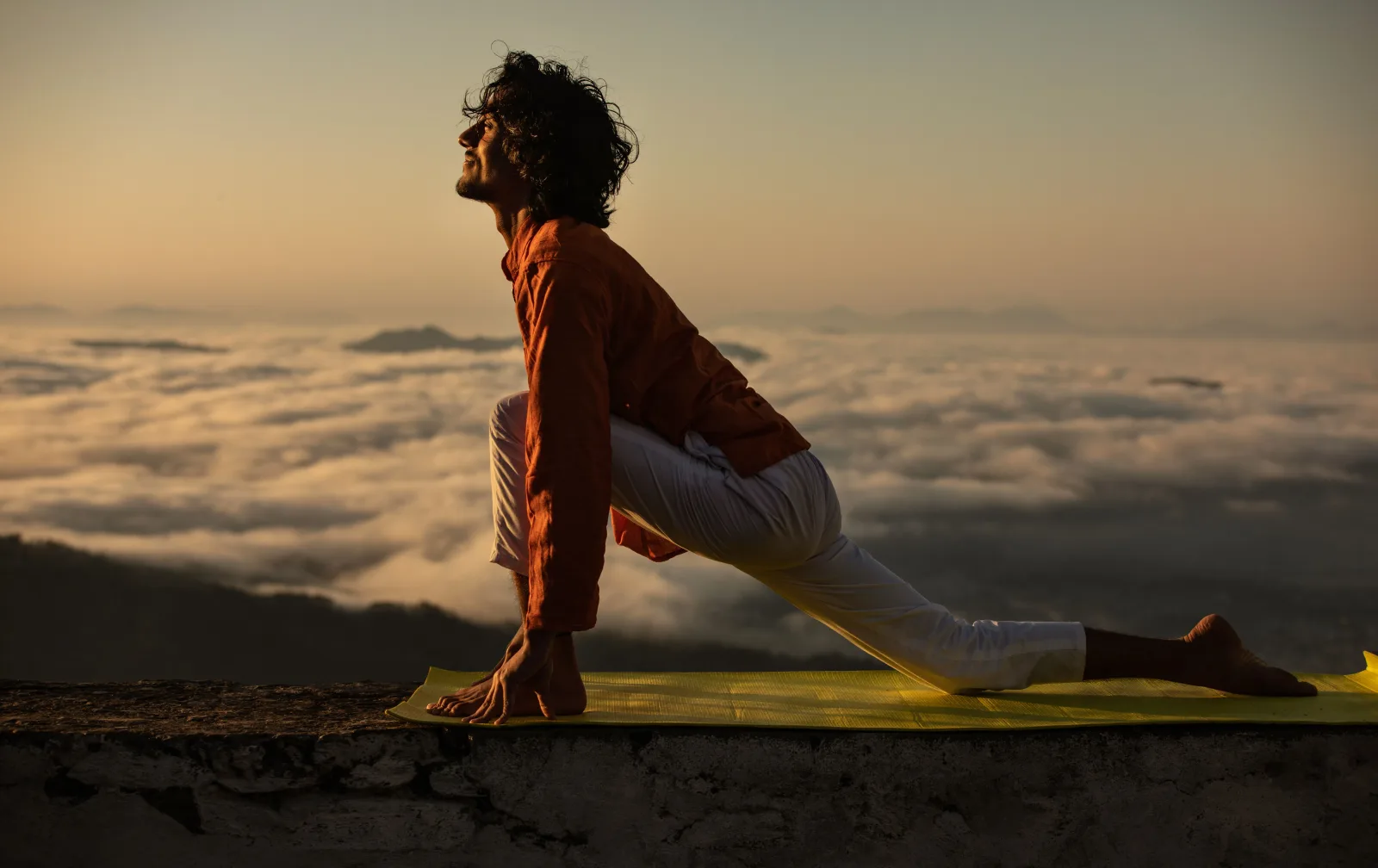
Surya Namaskar — the Sun Salutation — is not a single yoga pose. It is a flowing sequence of 12 positions, one movement per breath, that stretches the whole back body, opens the whole front body, and builds strength and stamina in a few minutes of practice. That's the source of its benefits: because it moves the spine through every direction and links each movement to the breath, regular practice may improve flexibility, muscular endurance and breath awareness — and done briskly in continuous rounds, it becomes genuinely aerobic. It is, for most people, the highest-value piece of yoga you can learn.
This guide gives you the full sequence — all 12 steps with their breath cues — then an honest look at the benefits, how many rounds to practice, the traditional guidance on timing, and who should be careful.
This article is for general education and is not medical advice. If you have a heart condition, high blood pressure, back or joint problems, or you are pregnant, please talk with your doctor before starting this practice.
What is Surya Namaskar?
Surya Namaskar means "salutation to the sun" (surya — sun; namaskar — greeting or bow). Traditionally practiced at sunrise facing east, it is an old expression of gratitude to the sun as the source of life — and, on the mat, a complete warm-up sequence that has become the backbone of modern practice worldwide.
One correction worth making plainly, because even yoga blogs get it wrong: Surya Namaskar is often described as "a pose with 12 postures inside it". It isn't a pose at all. It is a vinyasa — a breath-linked sequence — of 12 positions, several of which (standing forward bend, cobra, the mountain/downward shape) are standalone asanas from the wider pose library. The second half of the sequence mirrors the first, so by learning six shapes you know all twelve.
The 12 steps of Surya Namaskar (with breath cues)
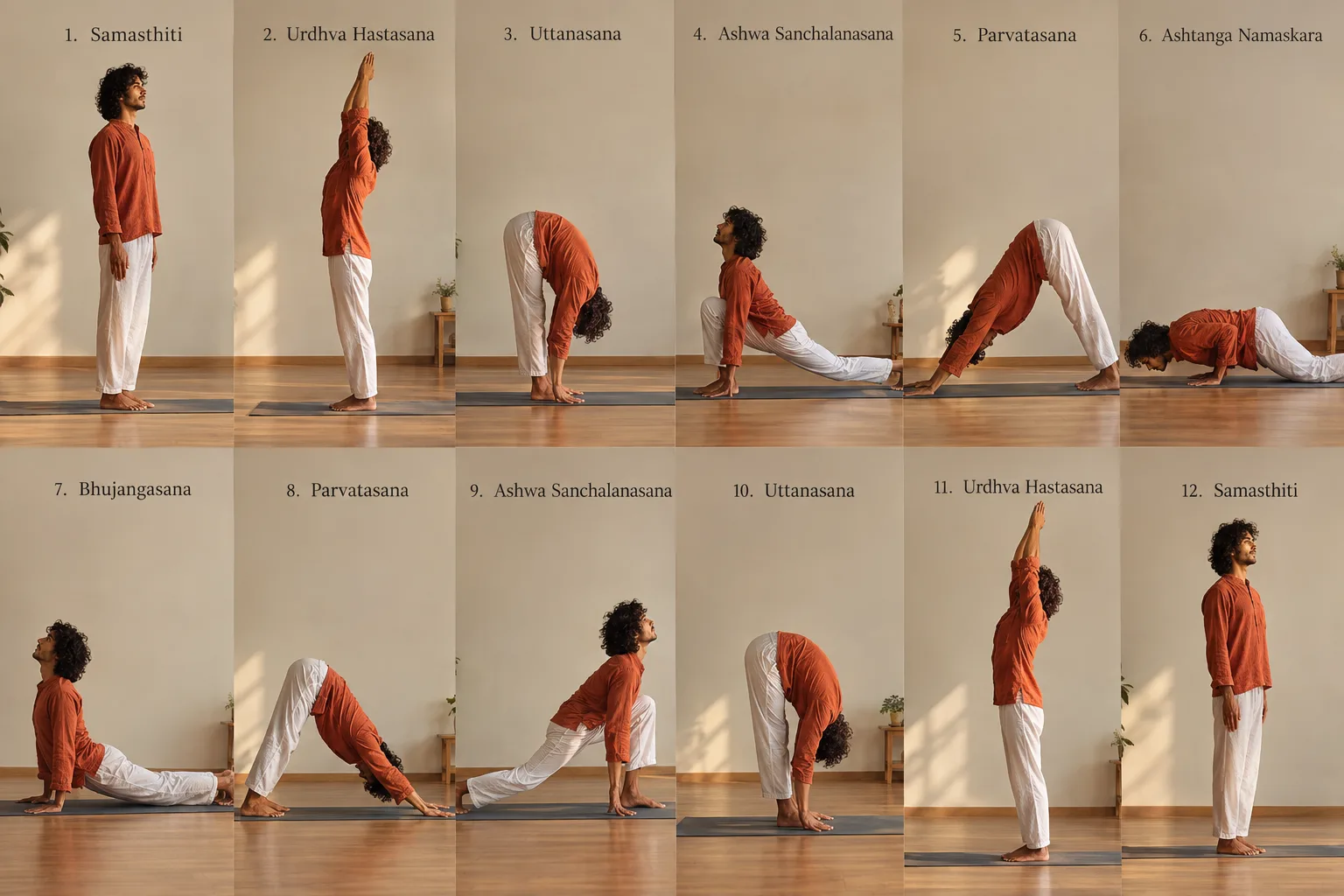
One round moves through these 12 positions, one breath per movement. Steps 8–12 retrace steps 5–1, which is why the sequence feels like a wave going out and coming back.
Samastithi (Prayer Pose) — exhale. Stand tall, feet together, palms joined at the chest.
Urdhva Hastasana (Raised Arms Pose) — inhale. Sweep the arms up and slightly back, lifting the chest.
Uttanasana (Standing Forward Bend) — exhale. Fold forward from the hips, hands toward the floor; knees soft as needed.
Ashwa Sanchalanasana (Equestrian/Low Lunge Pose) — inhale. Step the right leg far back, knee down, chest forward, gaze up.
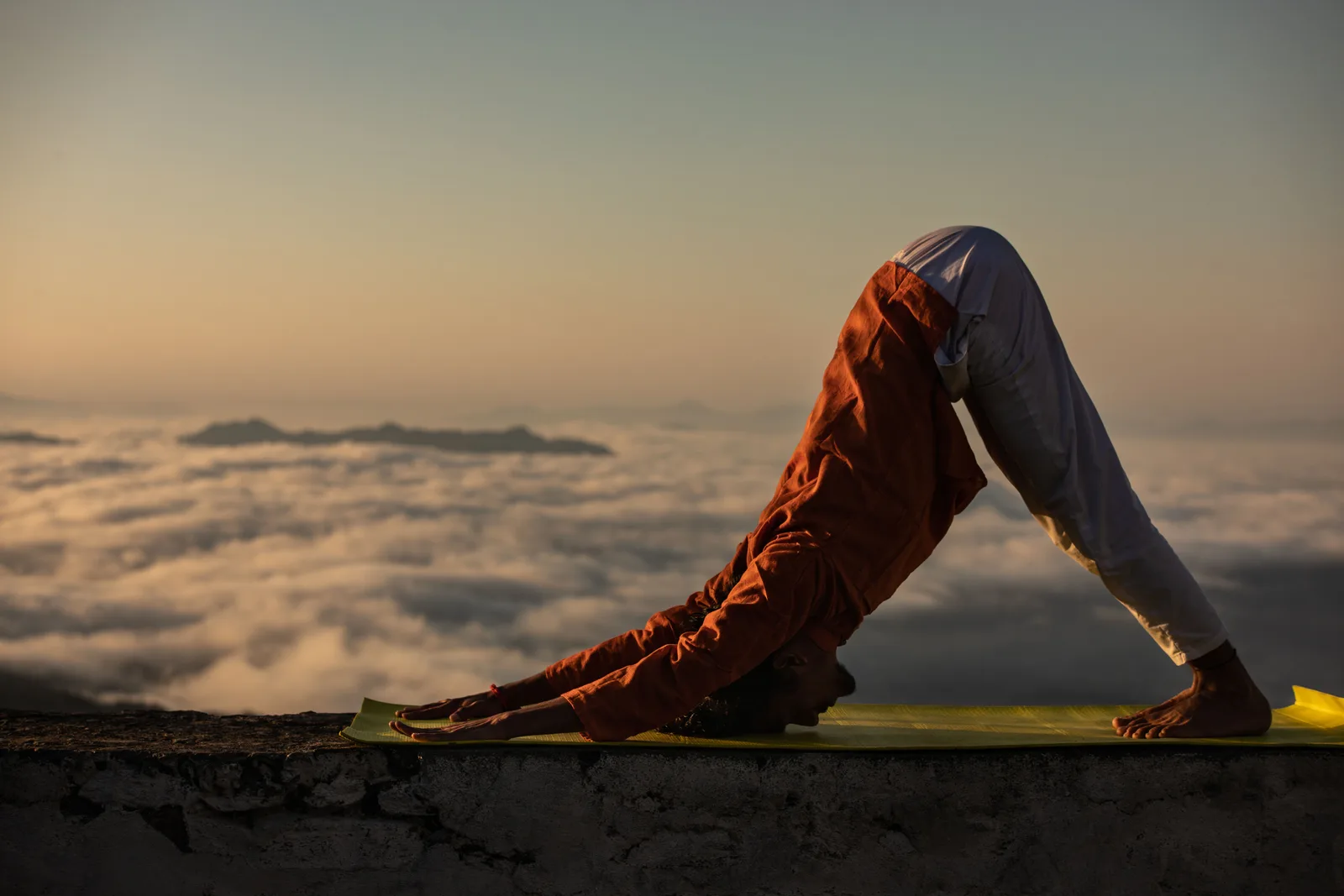
Parvatasana (Mountain Pose) — exhale. Step the left leg back and lift the hips into an inverted "V" (the downward-dog shape).
Ashtanga Namaskara (Eight-Limbed Salute) — breath suspended after the exhale. Lower knees, chest and chin to the floor; hips stay lifted.
Bhujangasana (Cobra Pose) — inhale. Slide forward and lift the chest, elbows soft, shoulders away from the ears.
Parvatasana (Mountain Pose) — exhale. Press back up into the inverted "V".
Ashwa Sanchalanasana (Equestrian Pose) — inhale. Step the right foot forward between the hands, left knee down, gaze up.
Uttanasana (Standing Forward Bend) — exhale. Step the left foot forward and fold.
Urdhva Hastasana (Raised Arms Pose) — inhale. Rise with a long spine, arms sweeping up and slightly back.
Samastithi (Prayer Pose) — exhale. Return to standing, palms at the chest.
That is one half-round, leading with the right leg. Repeat leading with the left leg to complete one full round — 24 movements in all, evenly balancing both sides.
The breath pattern in one line: exhale to fold or lower, inhale to open or lift, and one quiet suspension at step 6. If you remember nothing else, remember this — the breath is the sequence; the shapes are just where it goes.
A tip from our teaching hall: beginners always rush. Your first week, take it as slow as a walking pace — one honest breath per position, even pausing in each shape. Speed is a variation for later, not the starting point.
Surya Namaskar benefits — the honest version
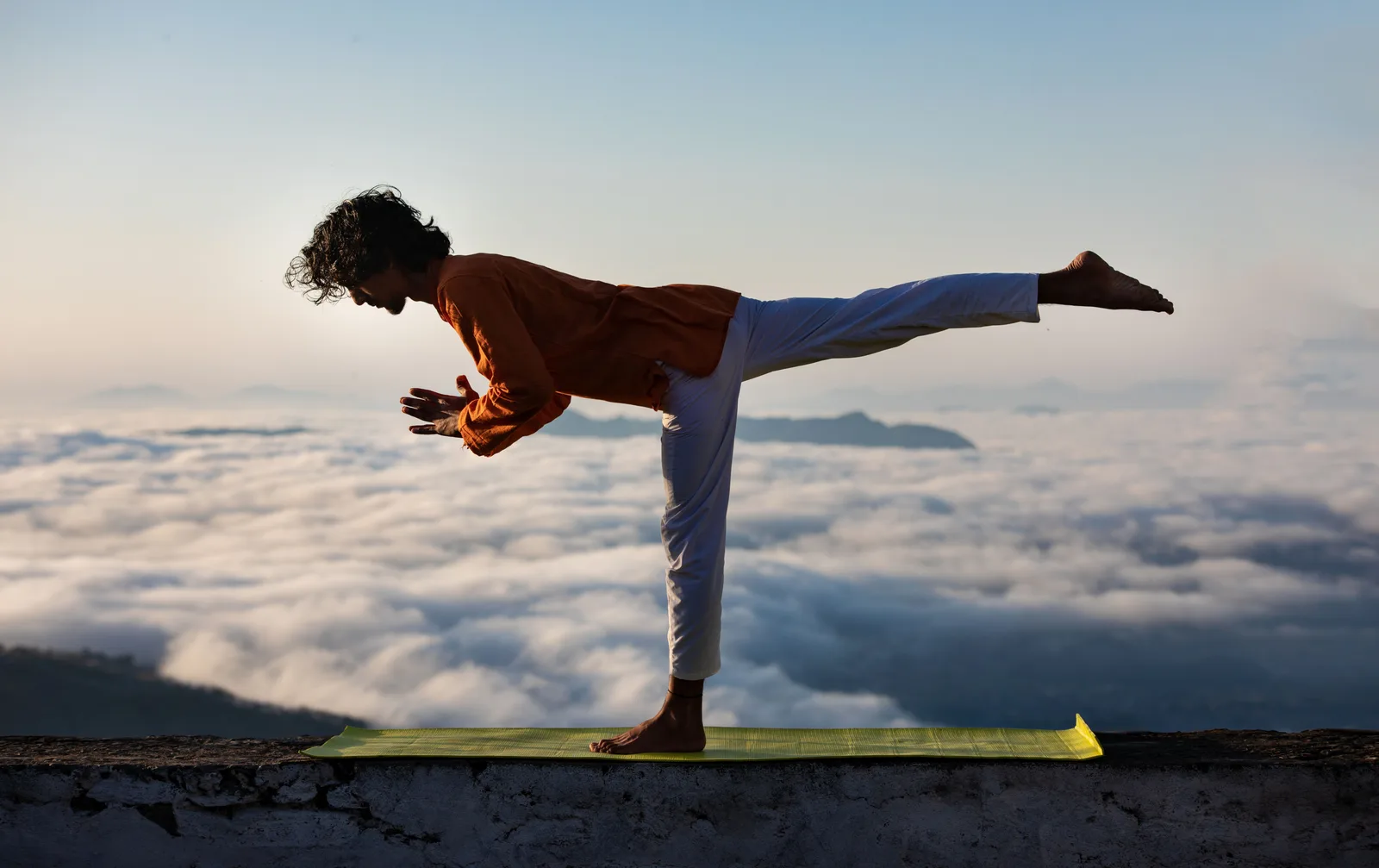
The original version of this article promised that Surya Namaskar detoxifies the body and balances hormones. We've rewritten it, because you deserve better than recycled claims. Here's what regular practice genuinely offers, with the strength of each claim stated plainly:
1. Full-body flexibility and mobility. This is the most direct benefit. In each round your spine folds, extends and lengthens; hamstrings, hip flexors, shoulders and calves all get stretched. Practiced daily, most people notice a real difference within weeks — it's the closest thing yoga has to a complete mobility routine in one unit.
2. Functional strength and endurance. The lunges, the lowering of step 6 and cobra build strength through the legs, arms, shoulders and core — moderate but honest, similar to bodyweight training. What it builds especially well is muscular endurance: round 10 asks more of you than round 1.
3. Cardiovascular exercise — at pace. Practiced briskly and continuously, rounds of Surya Namaskar raise the heart rate and function as genuine aerobic exercise; research on yoga more broadly suggests benefits for general fitness and wellbeing. Practiced slowly, it's a mobility and breath practice instead — both are valid, but be honest with yourself about which one you're doing.
4. Breath training built in. Because every movement is tied to an inhale or exhale, the sequence quietly teaches diaphragmatic, rhythmic breathing — the foundational skill of pranayama practice. Many students find their everyday breathing changes before their flexibility does.
5. A steadier mind. Moving with the breath demands attention, and attention is the point: ten rounds is a moving meditation. Practitioners commonly report feeling calmer and clearer afterwards — consistent with research suggesting yoga practice may help reduce stress, though the studies are on yoga broadly rather than this sequence alone.
6. Digestion and energy — the traditional claims. The tradition holds that Surya Namaskar kindles agni (digestive fire) and builds vitality, which is why it's classically practiced before breakfast. The forward folds and extensions do alternately compress and stretch the abdomen; the modern evidence for direct digestive effects is limited, so we present this as traditional teaching rather than medical fact. What's not in doubt is the subjective energy: a few rounds at sunrise wakes the body up more pleasantly than most alarms.
7. The habit that carries every other benefit. The under-rated benefit: Surya Namaskar is short, complete and equipment-free, which makes it the practice people actually keep. Twelve minutes daily, sustained for a year, beats any ambitious routine abandoned in February.
How many rounds, and when?
Start with 2–4 slow rounds and build gradually. A steady daily practice for most people is 6–12 rounds (12–25 minutes depending on pace). Traditionally, 12 rounds are practiced — one for each of the sun's twelve names, each with its own mantra — and dedicated practitioners go well beyond that; at our school, training students build up to longer sets during morning practice. More rounds at good quality is fine; more rounds at collapsing quality is not.
Best time — the traditional answer: at sunrise, facing east, on an empty stomach. This is the tradition's prescription, tied to the symbolism of greeting the sun, and it has a practical logic: the practice folds the belly deeply enough that a full stomach genuinely gets in the way, and mornings are when a routine survives contact with real life.
The honest modern answer: the best time is the time you'll actually practice. Evening rounds are entirely fine — just leave two to three hours after a full meal, and consider a slower pace at night so you're not energising yourself before bed.
Variations worth knowing
The classical 12-step sequence (taught above) — the version practiced across traditional hatha schools in India, and the one we teach first.
Sun Salutation A and B — the variants used in vinyasa-style and Ashtanga practice. A swaps the lunge pattern for plank and adds jump transitions; B adds chair pose and warrior I. Same DNA, more athletic expression — learn the classical form first and these come easily.
Gentler adaptations — knees down in step 6 (already classical), hands on a wall or chair for limited mobility, or half-rounds (steps 1–3 and 10–12 only) for stiff mornings and absolute beginners. A modified round you do daily is worth more than a full round you avoid.
Common mistakes to avoid
Watching hundreds of students learn this sequence, the same five mistakes appear on almost every mat in week one:
Breathing backwards. Inhaling into the folds, exhaling into the lifts. Fix it by saying the cue silently before each movement — exhale, fold — until the pattern lives in the body.
Collapsing in the low positions. In step 6, hips droop and shoulders hunch by the ears. Keep the hips lifted, elbows hugging the ribs.
Overarching the lower back in cobra. The lift comes from the chest and mid-back, not from cranking the lumbar spine; elbows stay soft.
Racing. Speed hides poor alignment. Earn speed with a month of slow, honest rounds first.
Skipping the pause. Between rounds, stand in prayer pose for one full breath and feel the effects. That pause is where the sequence becomes practice instead of exercise.
Who should be careful (contraindications)
Skip or modify the practice — and take your doctor's advice first — if any of these apply:
Pregnancy — the deep folds and belly-down steps need replacing; practice a prenatal-adapted sequence under qualified guidance instead.
High blood pressure or heart conditions — avoid fast-paced rounds and breath suspension; slow rounds may be acceptable with medical clearance.
Back, wrist, knee or shoulder injuries — the sequence loads all of them; modify (knees down, shorten range) and stop at any sharp pain.
Recent surgery, hernia, or severe joint problems — get individual clearance and ideally in-person teaching first.
Fever or acute illness — rest. The sun will take your salutations next week.
None of this makes the practice dangerous — it makes it exercise, deserving the same respect you'd give any training.
Frequently asked questions
What is the purpose of Surya Namaskar?
Traditionally, it is a moving salutation of gratitude to the sun, practiced at dawn. Practically, it serves as a complete practice-in-miniature: flexibility, strength, breath training and focused attention in one repeatable sequence — which is why nearly every style of modern yoga builds on it.
What time of day is best for Surya Namaskar?
Tradition says sunrise, facing east, on an empty stomach — and mornings do suit it well. But any time works if your stomach is fairly empty (leave 2–3 hours after a full meal). Consistency at a realistic hour beats perfection at an ideal one.
What are the 12 surya namaskars?
The 12 positions of one half-round: prayer pose, raised arms, standing forward bend, equestrian pose, mountain pose, eight-limbed salute, cobra, mountain pose, equestrian pose, standing forward bend, raised arms, prayer pose. The numbered steps above give each Sanskrit name and breath cue.
What happens if I do 10 Surya Namaskar every day?
Kept up for a few weeks, 10 daily rounds (about 15–20 minutes) typically brings noticeably better flexibility, some gains in muscular endurance, steadier breathing and — at a brisk pace — a modest cardio stimulus. What it won't do by itself is dramatically change your weight or "detoxify" anything; pair it with sensible eating and walking for those goals, and let the sequence do what it does best: keep you moving every single day.
Learn it the way it's meant to be taught
You can learn Surya Namaskar from this page — many people have learned it from far less. But the difference between doing the sequence and understanding it — the alignment in each position, the adjustments your body needs, the breath and the tradition it carries — is the difference a teacher makes. At our 200-hour yoga teacher training in Rishikesh, morning practice opens with it daily, and you'll study the sequence deeply enough to teach it. For the wider world of postures it draws from, keep exploring the complete yoga asana library — or message us on WhatsApp with any question about practice or training.
References
National Center for Complementary and Integrative Health (NCCIH) — Yoga: What You Need To Know (general evidence on yoga, fitness and stress).
Patanjali — Yoga Sutras (context for asana and breath in classical practice).
Traditional hatha yoga teaching on Surya Namaskar sequence, timing and mantras (as taught in classical Indian schools; presented here as tradition, not clinical evidence).
Reviewed for health accuracy by Dr. Bhupinder Singh Arora (M.D. Ayurveda), consulting Ayurvedic physician at Pure Soul Yoga School. This article is educational and not a substitute for personal medical advice.
Author note (byline): Gangesha Adi (E-RYT 500) has opened morning practice with Surya Namaskar for students of 50+ nationalities at Pure Soul Yoga School, Rishikesh.