Chakrasana Benefits: What Wheel Pose Gives — and Asks First
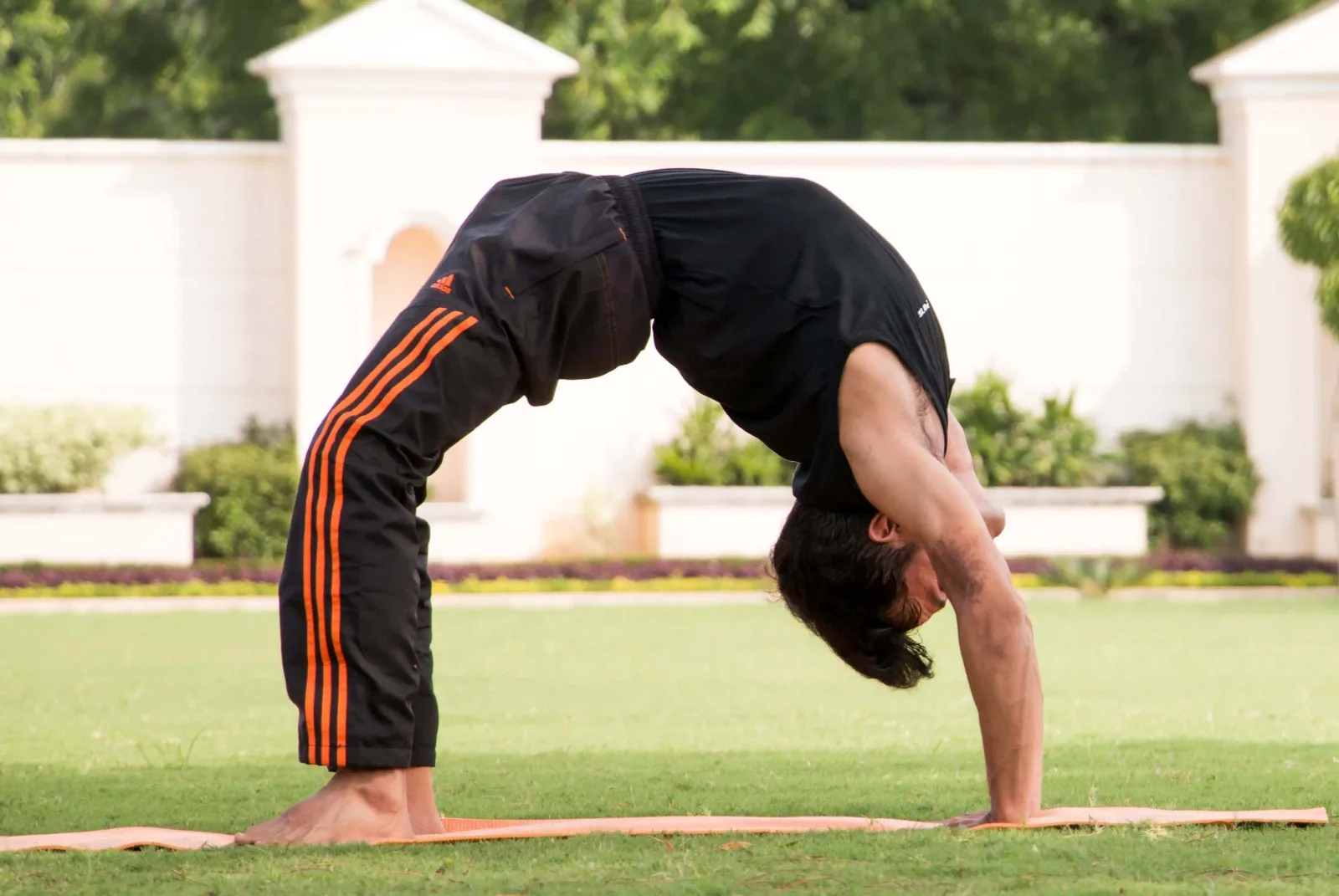
Ask a room full of Indian adults about chakrasana and half of them will tell you they could pop up into it at eight years old, on a school playground, with no warm-up at all. Ask the same room to do it now, and it goes quiet. Chakra means wheel, and Chakrasana — the full backbend, pressed up from the floor onto hands and feet — is the pose that measures, honestly and a little rudely, what years of chairs have done to the front of a body. Its benefits are correspondingly real: it opens everything sitting closes (chest, shoulders, hip flexors), builds genuine strength through the arms, legs, and back, and keeps the spine's backward range alive. But it is an advanced pose with one of the longer contraindication lists in the library, so this guide does the honest thing and weighs both columns — what wheel gives, and what it asks first.
This article is for general education and is not medical advice. Deep backbends are not appropriate for everyone — please read the contraindications below and consult a qualified healthcare professional before attempting this pose.
What is Chakrasana?
Lie on your back, plant the feet close to the hips, place the palms beside the ears with fingers pointing toward the shoulders, and press the whole body up into an arch — that is chakrasana, the wheel. Most modern schools use the name interchangeably with Urdhva Dhanurasana ("upward bow"); same shape, two names. (A small disambiguation for the curious: in the Ashtanga vinyasa method, "chakrasana" also names a backward-rolling transition — context makes clear which is meant, and this article is about the backbend.) In our asana library it sits in the backbend family marked advanced — not because the shape is exotic, but because cobra and locust are the foundations that make it possible, and skipping them sends the whole cost of the pose to the lower back and wrists.
Chakrasana vs Ardha Chakrasana — a quick distinction
Ardha means half, and Ardha Chakrasana is the accessible relative you'll meet in school syllabi and standard yoga protocols across India: usually a standing backbend — hands supporting the lower back, chest lifting toward the ceiling — and sometimes a supported half-wheel closer to bridge pose. It delivers a meaningful share of the front-body opening at a fraction of the demand, with no wrist loading at all. If the contraindications below rule the full wheel out for you, the standing half-wheel is very likely still available — ask a teacher to set it up for your body.
The benefits, weighed honestly
The anti-sitting stretch, at full amplitude. Chairs shorten the hip flexors, close the chest, and round the shoulders forward. Wheel reverses every one of those directions at once — it is the most complete front-body opening in the common repertoire, and regular backbend practice may help counter the stiffness a folded-forward day accumulates.
Strength that surprises people. Holding the arch is hard work: shoulders and arms bear weight overhead, legs and glutes drive the hips up, and the spinal muscles work the whole time. Wheel is as much a strength pose as a flexibility pose — which is exactly why it can't be borrowed from childhood memory.
A spine that keeps its backward range. Spinal extension is the direction adult life uses least, and ranges that go unused tend to shrink. Practiced progressively, wheel keeps that door open — "may help maintain mobility" is the honest phrasing, and it is enough.
The lift in mood and energy. Practitioners very widely describe strong backbends as energising — it is why teachers sequence them mid-practice rather than before rest. We report that as teaching-hall experience and traditional framing, not as a laboratory finding.
The organ claims, labelled. Tradition credits chakrasana with stimulating the abdominal organs and digestion, and popular articles extend this to the thyroid and other glands. We pass those on clearly labelled as tradition: robust modern evidence is lacking, and the demonstrable benefits — mobility, strength, posture support — stand perfectly well on their own.
What wheel asks first: contraindications, stated plainly
This list is deliberately firm. Skip the full pose — and take individual professional advice — if any of these apply:
Wrist injuries or carpal tunnel syndrome — the pose loads the full body weight onto extended wrists.
Shoulder injuries or limited overhead mobility — if the shoulders cannot open fully, the lower back and wrists absorb the difference. This is the most common way wheel goes wrong.
Back conditions — disc problems, spondylolisthesis, or ongoing lower-back pain. Deep extension genuinely helps some backs and genuinely aggravates others; this is a decision for individual professional guidance, never a blanket yes from an article.
High or low blood pressure, or heart conditions — the pose is a strong exertion with the head dropped back and below the heart; get explicit clearance first.
Glaucoma or other eye-pressure conditions — the head-below-heart position raises the same concern as inversions.
Pregnancy, hernia, or recent surgery — each rules out the full pose; a qualified teacher can substitute gentler chest openers.
Headache or vertigo days — skip it; the pose amplifies both.
And for everyone: never attempt wheel cold. It belongs late in a practice, after the body is genuinely warm.
Earning the wheel: the staged path
Open the front line. Low lunges for the hip flexors and cobra pose for the chest and spine, practiced consistently — these are the raw materials.
Build the back body. Locust pose builds the spinal strength every deeper backbend depends on; weeks spent here are never wasted.
Live in bridge pose for a while. Bridge (Setu Bandhasana) is wheel's honest ancestor — same foot position, same leg drive, no wrist load. When you can hold a strong, unshaky bridge with even breath, the conversation about wheel can begin.
Set up the full pose — ideally with a teacher's eyes on you. On your back, heels close to the hips, feet hip-width and parallel; palms beside the ears, fingers toward the shoulders, elbows drawing parallel rather than splaying.
Press to the crown. Lift to the top of the head and pause — this halfway house is where you check: elbows tracking in? Shoulders taking the load? If not, come down and return to stage 3 without apology.
Press to full wheel. Straighten the arms, let the head hang free, drive down through the feet so the legs share the work. Three to five even breaths.
Exit with care. Chin toward chest, lower slowly to the shoulders, rest — then counter gently: knees hugged to the chest, an easy reclined twist. Never snap straight into a deep forward fold.
A tip from our teaching hall: the wheel is earned in the shoulders, not bought from the lower back. If your elbows splay wide as you press up, the shoulders aren't open enough yet — going back to bridge and cobra for a month is progress, not retreat.
Frequently asked questions
What organs benefit from Chakrasana?
Honestly: the confident organ lists in popular articles outrun the evidence. Traditional teaching associates the pose with stimulating the abdominal organs, digestion, and glandular function, and we report that respectfully as tradition. What is demonstrable is musculoskeletal — shoulders, chest, hip flexors, spine, and the strength to hold them — plus the widely reported lift in energy after practice.
What are the disadvantages of Chakrasana?
They are real, and worth stating plainly: loaded, extended wrists; a lower back that absorbs whatever the shoulders can't give; a genuine injury risk when the pose is rushed, practiced cold, or attempted past the contraindications above. Wheel also simply excludes more people than most poses — that is a disadvantage, honestly counted. Practiced warm, staged, and within your preparation, the risk drops sharply; the pose's disadvantages are mostly proportional to impatience.
Can I do Chakrasana daily?
A prepared practitioner with clean form can include brief wheel work most days, always warm and always countered. But it is strength work as much as stretching, and strength adapts during recovery — for most people, two to four focused sessions a week serves better than daily repetition. Beginners should not chase frequency at all until the staged path above is solid.
Is Chakrasana good for weight loss?
No — not meaningfully, and we'd rather say so than borrow the claim. A few breaths of effort burns a trivial amount of energy, and no pose reduces fat from any particular place. Wheel's real gifts are strength, mobility, and posture. If weight is your actual goal, what matters is sustained, regular practice and daily habits — our yoga for weight loss guide takes that question seriously on its own page.
The advanced label is an invitation — with prerequisites
Every pose marked "advanced" in the asana library carries the same quiet message: worth the journey, dangerous as a shortcut. If wheel calls to you, walk the staged path, and let a qualified teacher watch your first full presses — spotting a student safely into a backbend, and knowing who shouldn't be there at all, is exactly the kind of judgement we train on the 200-hour yoga teacher training in Rishikesh. We're on WhatsApp if you have questions.
References
National Center for Complementary and Integrative Health (NCCIH) — Yoga: What You Need To Know (general evidence, including notes on yoga-related injury and safe practice).
NIH resources on flexibility, strengthening exercise, and safe movement progression (context for the staged-preparation approach).
Traditional hatha yoga teaching on chakrasana/urdhva dhanurasana (classical Indian schools; organ and gland claims presented as tradition, not clinical evidence).
Reviewed for health accuracy by Dr. Bhupinder Singh Arora (M.D. Ayurveda), consulting Ayurvedic physician at Pure Soul Yoga School. This article is educational and not a substitute for personal medical advice.
Author note (byline): Gangesha Adi (E-RYT 500) has talked more students out of an early wheel than into one at Pure Soul Yoga School, Rishikesh — and watched nearly all of them arrive there anyway, a patient month or two later, with wrists and backs that thanked them for the wait.