Mantras in Yoga: Meaning, Types & How to Practice Them
A mantra, in yoga, is a sacred sound — a syllable, word or verse in Sanskrit that is repeated aloud, whispered or held silently in the mind as a tool for steadying attention and turning it inward. The word itself is usually explained through its parts: man, from the root meaning "to think," and -tra, a suffix denoting an instrument. A mantra is literally an instrument of thought — and the tradition adds a deeper gloss: mananāt trāyate, "that which protects the one who repeats it in thought."
If you've sat in a yoga class while everyone chanted Om and quietly wondered what you were participating in, this guide is for you: what mantras are, the three main forms of practice, the mantras you're most likely to meet, how to begin — and, because your trust matters more to us than a tidy story, an honest section on whether mantras "work."
What is a mantra, exactly?
Mantras are among the oldest continuously used elements of Indian spiritual practice. The verses of the Vedas — the earliest layer of Sanskrit literature — are themselves called mantras, preserved for many centuries by precise oral chanting before they were written down. Later traditions distilled the practice: single syllables, short formulas and verses became objects of repetition in their own right — to focus the mind, express devotion, and, in the tantric traditions, work with the subtle body.
In yogic thought, sound is not decoration. The Mandukya Upanishad devotes itself entirely to Om, treating the syllable as a map of consciousness itself; and in Patanjali's Yoga Sutras, repetition of Om with reflection on its meaning is given as a direct method for settling the mind — one of the very few specific techniques the Sutras name.
Three honest framings help here:
A mantra is a tool, not a magic word. The tradition itself insists on this: the Sutras specify repetition with reflection on the meaning — without attention, it's called mechanical.
A mantra is not a foreign-language affirmation. Traditional mantras carry centuries of usage, precise sound, and — often — devotional meaning that deserves acknowledgment.
Some mantras are prayers. Om Namah Shivaya honours Shiva; the Gayatri addresses the sun as divine light. You can practice them respectfully without sharing the theology — but knowing what you are saying is basic respect.
Japa, kirtan and chanting: the three forms of practice
Mantra practice comes in three broad forms, and most students meet all three in a training.
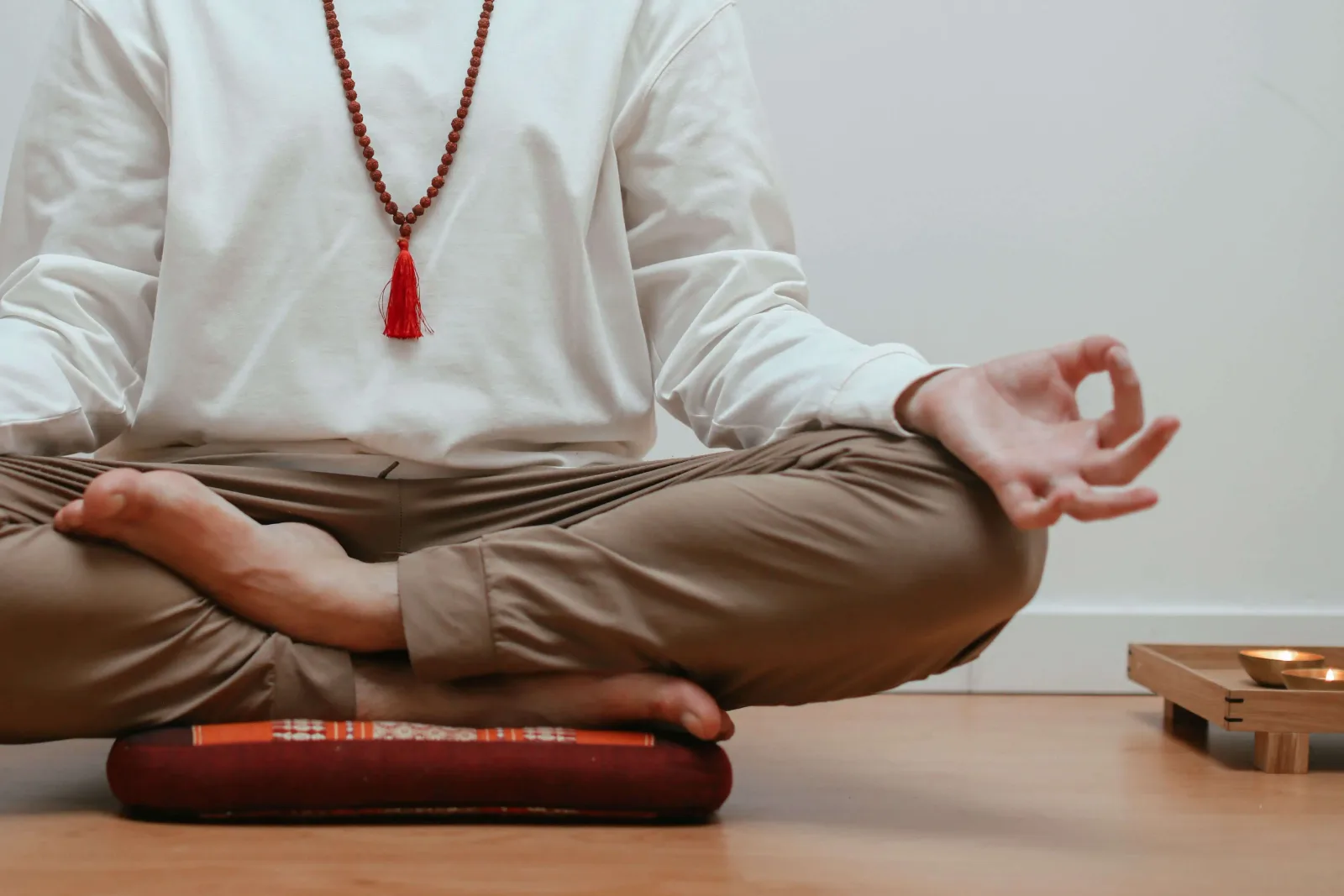
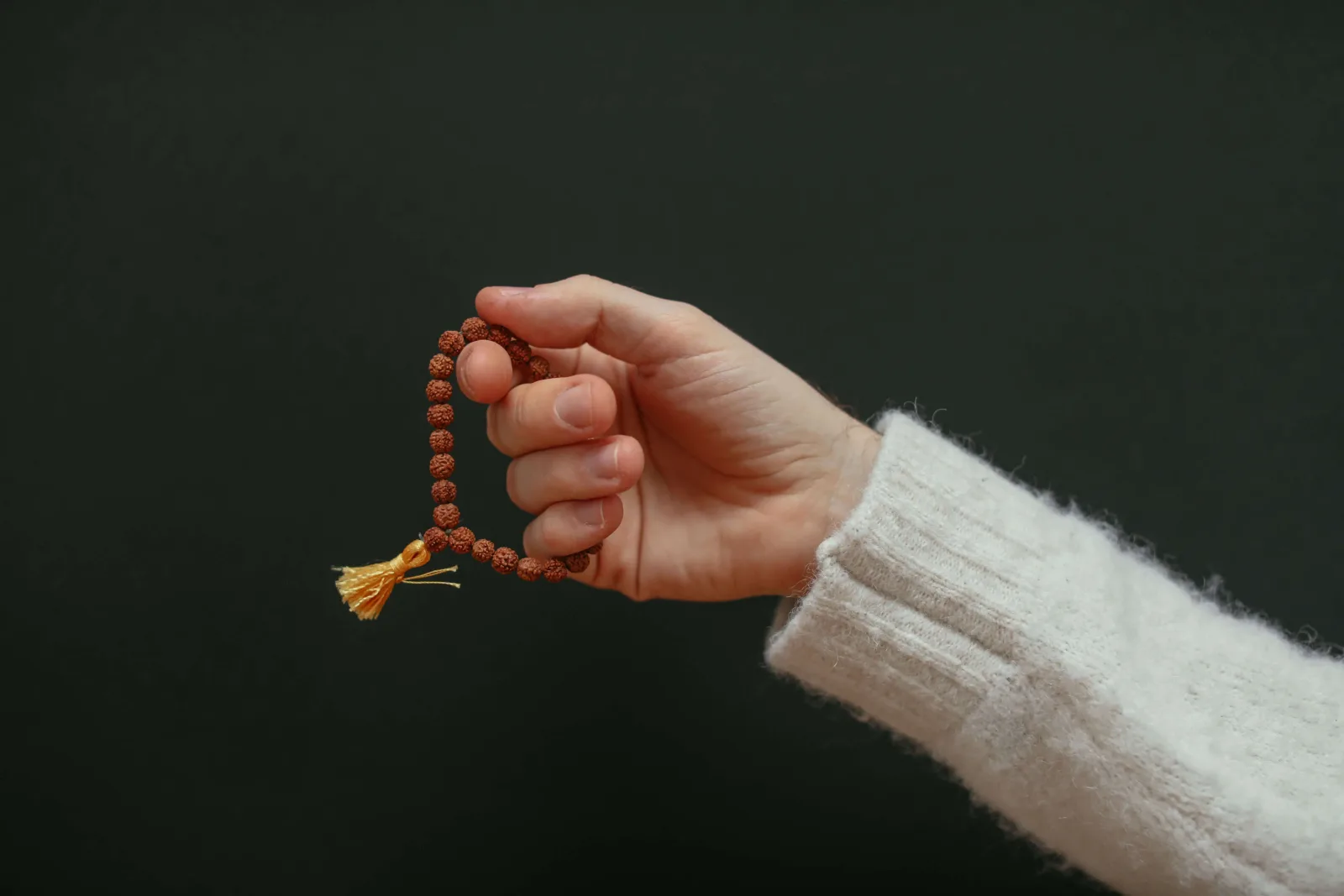
Japa is repetition — the core discipline. A single mantra is repeated a set number of times, traditionally counted on a mala of 108 beads, one repetition per bead. Japa has levels: spoken aloud (vachika), whispered (upamshu), and silent mental repetition (manasika) — ranked most refined, because the mantra has moved fully inside. There is also ajapa japa, the "unrepeated repetition," where the natural breath itself is heard as a mantra (more on So-Ham below).
Kirtan is call-and-response singing — mantras and divine names set to melody, sung in a group, often with harmonium and drums. It belongs to bhakti, the devotional stream of yoga, and it is the most social and least technical form: nobody needs Sanskrit grammar to sing.
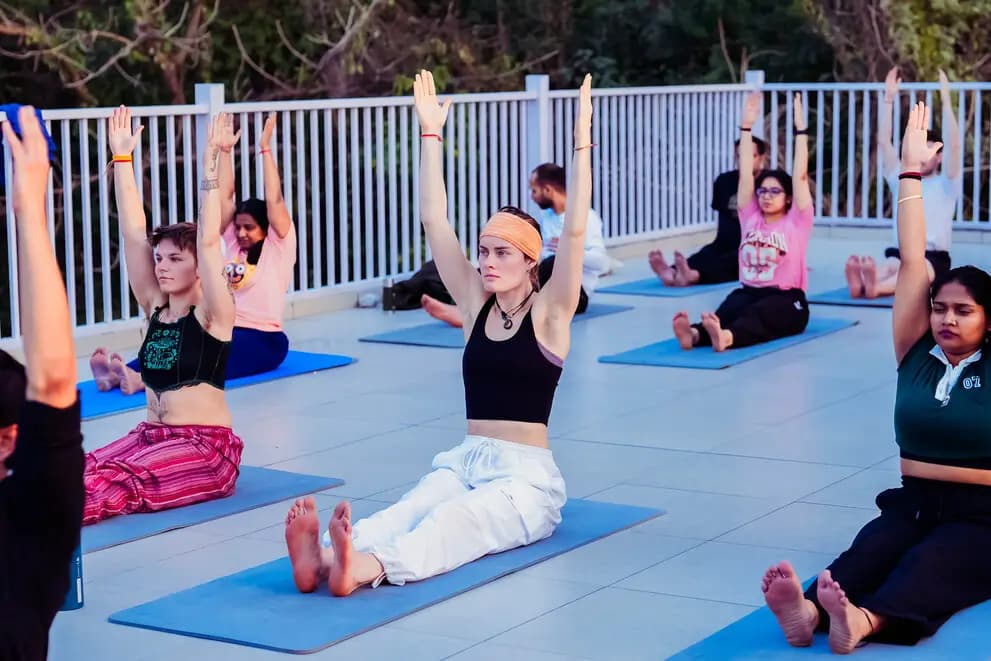
Chanting in class is what most modern practitioners meet first: an Om or three to open practice, a closing chant, perhaps a peace invocation. This is mantra in its simplest role — marking the boundary between ordinary time and practice time.
Common mantras in yoga: meanings, respectfully
Mantra | Traditional meaning | Notes |
|---|---|---|
Om (Aum) | The pranava — the primordial sound; in the Mandukya Upanishad its three sounds (a-u-m) plus the silence after map waking, dreaming, deep sleep and pure consciousness | The most universal mantra in yoga; chanted alone or opening other mantras |
So-Ham | "I am That" — sah (That) + aham (I) | The natural mantra of the breath: so heard on the inhale, ham on the exhale; the basis of ajapa japa |
Gayatri mantra | A Rig Veda verse addressed to the divine light of the sun, asking that it illumine the intellect | One of the most revered verses in the tradition; we give it the full word-by-word treatment in our dedicated guide to the Gayatri mantra's meaning |
Om Namah Shivaya | "Om — homage to Shiva"; its five core syllables give it the name panchakshara, the five-syllable mantra | A devotional mantra of the Shaiva tradition, chanted widely across India — including nightly along the Ganga here in Rishikesh |
Om Shanti Shanti Shanti | "Om — peace, peace, peace" | The closing formula of many Upanishadic recitations; the threefold repetition is traditionally explained as peace at three levels of disturbance |
Lokah Samastah Sukhino Bhavantu | "May all beings everywhere be happy and free" | A traditional Sanskrit benediction, now common as a closing chant; its exact textual origin is unclear, so we present it as received tradition |
Two terms you'll also meet: bija mantras ("seed" mantras) are single potent syllables — the six chakra bijas LAM, VAM, RAM, YAM, HAM and OM, covered in our guide to the 7 chakras, are the best-known set — and a deity mantra is traditionally received from a teacher at initiation.
How to practice mantra: a simple start
You do not need initiation, a perfect accent or a religious commitment to begin. You need a mantra, a seat and ten minutes.
Choose one mantra and stay with it. Om or So-Ham are ideal first choices: short, universal, carrying no obligations you haven't chosen. Switching mantras weekly is the japa equivalent of re-potting a seedling every day.
Sit tall and settle the breath first. Two minutes of quiet breathing prepares the ground — our guide to pranayama breathing techniques pairs naturally with mantra work.
Begin aloud, soft and unhurried. With Om, feel the vibration move from open mouth (a), to rounding lips (u), to closed hum (m), then rest a moment in the silence — the tradition considers that silence part of the mantra.
Move inward over time. After some weeks, let the voice drop to a whisper, then to silent mental repetition. When the mind wanders — it will — the mantra is the place you return to, exactly as the breath is in meditation.
Count if it helps. A mala of 108 beads gives the hands a job and the session a natural length: one round at an easy pace takes ten to fifteen minutes.
A tip from our teaching hall: chant more quietly than feels natural. New students almost always aim the sound outward, as if performing for the room. The mantra is aimed inward — when your Om is soft enough that only you can hear it, it turns from a sound you make into a sound you feel, and that is where the practice begins.
At our school this is not theory: mantra has its own daily class at 15:00 in every teacher training, with a reliable arc — most students find chanting awkward for about two days, and then it quietly becomes one of the classes they'd least willingly give up.
Do mantras work? An honest answer
Here is the section most articles on this topic skip, and the one we insist on.
What the tradition claims: a great deal. Mantras are held to purify the mind, protect the practitioner, awaken subtle energies and, repeated over a lifetime, lead toward liberation. Sound itself is treated as sacred — in some schools, the mantra's vibration matters as much as its meaning. This account is internally coherent, many centuries deep, and sincerely held by millions of practitioners. It is also, in its full form, a matter of faith — and we present it as such, not as fact.
What research suggests — which is much less, and worth stating carefully: mantra repetition is a form of focused-attention meditation, and meditation research in general suggests benefits for stress, mood and attention — though studies vary in quality and effects are typically modest. Some small studies suggest slow chanting (including Om) is associated with relaxation-related changes such as slower breathing and self-reported calm — plausible and unsurprising, since chanting naturally lengthens the exhale, the best-studied calming lever in breathwork. What research does not show is anything specific to Sanskrit, to particular syllables, or to the traditional metaphysics. No mantra has been shown to heal disease, change external events, or outperform any other calming practice — and any teacher claiming laboratory proof of such things is overreaching.
How we hold it: mantra practice sits on two legs. One is well-supported: a repeated sound is a genuinely effective anchor for attention, and chanting trains slow, regulated breathing with a built-in reminder system. The other — the sacred dimension — cannot be measured, and doesn't need to be for you to respect it. Practice the first confidently, hold the second with an open mind, and you're standing exactly where an honest tradition would have you stand.
Where mantra fits in the larger path
In the classical framework, mantra is a thread that runs through the whole of yoga — it serves svadhyaya (self-study, which traditionally included recitation) among the niyamas, supports concentration and meditation in the inner limbs, and in devotional schools is a complete path in itself. For the full map mantra belongs to, our pillar guide to the eight limbs of yoga lays it out honestly. And if the meditative side of sound is what draws you — chanting learned properly, japa practiced daily, theory in its classical context — that is the daily reality of our Meditation Yoga Teacher Training in Rishikesh.
Frequently asked questions
What are some popular mantras in yoga?
The ones you'll meet most often: Om (opening and closing most classes), So-Ham (the silent breath mantra), Om Namah Shivaya (a devotional mantra to Shiva), the Gayatri mantra (a Vedic verse to the divine light), Om Shanti Shanti Shanti (the peace invocation), and Lokah Samastah Sukhino Bhavantu (a benediction for all beings). Each is explained in the table above — and knowing the meaning before chanting is both better practice and basic respect.
What are the types of mantras?
The most useful classification: bija mantras — single seed syllables like OM or the chakra bijas; verse mantras — full scriptural verses like the Gayatri; and devotional mantras — formulas honouring a divine form, like Om Namah Shivaya. Tradition also distinguishes saguna mantras (addressed to a divine form) from nirguna mantras (pointing to formless reality, like So-Ham), and japa by voice: aloud, whispered or silent.
What are the 12 beej mantras?
Beej (bija) means seed — a single-syllable mantra. There is no single agreed list of twelve: different lineages compile different sets, often linked to deities or, in astrological traditions, to the twelve signs. The set you're most likely to meet in yoga is the six chakra bijas — LAM, VAM, RAM, YAM, HAM, OM — plus widely used tantric seeds like HRIM, SHRIM and KLIM. A source offering a definitive list of exactly twelve reflects one lineage's tradition, not a universal canon.
What are the 108 mantras?
The number 108 usually refers not to a list of mantras but to the traditional count of repetitions — a mala carries 108 beads, so one round of japa equals 108 repetitions. The number is sacred across Indian traditions, with many traditional explanations and no single certain origin. There are also traditional collections of 108 names of a deity (ashtottara-shata-namavali) — which may be what a "108 mantras" reference intends.
Do I need a guru to practice mantras?
For the simple, universal mantras — Om, So-Ham, the peace chants — no; they are considered open to everyone, and this guide is enough to begin. Formal initiation (diksha), where a teacher gives a personal mantra, belongs to specific lineages and matters greatly within them; if that path calls you, seek a genuine tradition. What everyone needs, guru or not, is consistency — a mantra reveals itself through repetition, not acquisition.
Can I practice mantras if I'm not Hindu?
Mantras arose within Hindu, Buddhist and Jain traditions, and that heritage deserves respectful acknowledgment — learn what a mantra means before you chant it, and treat devotional mantras as the prayers they are. With that respect in place, the practice is open: students of many faiths and of none sit in our mantra classes. What your own tradition says about such practice is a personal matter — we simply teach what was taught to us, and leave belief where it belongs: with you.
Keep the sound going
Start tonight: ten minutes, one mantra, softer than feels natural. For the companion practices, our guides to pranayama breathing techniques and meditation for beginners cover the breath and stillness that mantra weaves between — and our word-by-word guide to the Gayatri mantra's meaning goes deep on the tradition's most revered verse. To learn it all where it's lived daily, ask us anything about the Meditation Yoga Teacher Training in Rishikesh on WhatsApp. Real humans answer, usually within hours.
References
Patanjali — Yoga Sutras 1.27–1.28 (Om as the designation of Ishvara; its repetition with reflection on meaning). (cite published translation at publish)
Mandukya Upanishad — the classical exposition of Om/Aum and its four quarters. (cite published translation at publish)
The Vedas (Rig Veda) — the Gayatri mantra's source text; Vedic verses as mantras. (cite published translation at publish)
National Center for Complementary and Integrative Health (NCCIH) — research overviews on meditation and health (evidence quality and limits). (verify exact URL at publish)
Peer-reviewed studies on chanting, slow breathing and relaxation-related outcomes. (select exact citations at publish — no specific statistics quoted in this article)
Author note (byline): Gangesha Adi (E-RYT 500) teaches yoga philosophy at Pure Soul Yoga School, Rishikesh, where mantra chanting holds a daily class in every teacher training and students of 50+ nationalities learn these sounds in the town that never stopped chanting them.