Shalabhasana Benefits: Locust Pose for a Stronger Back
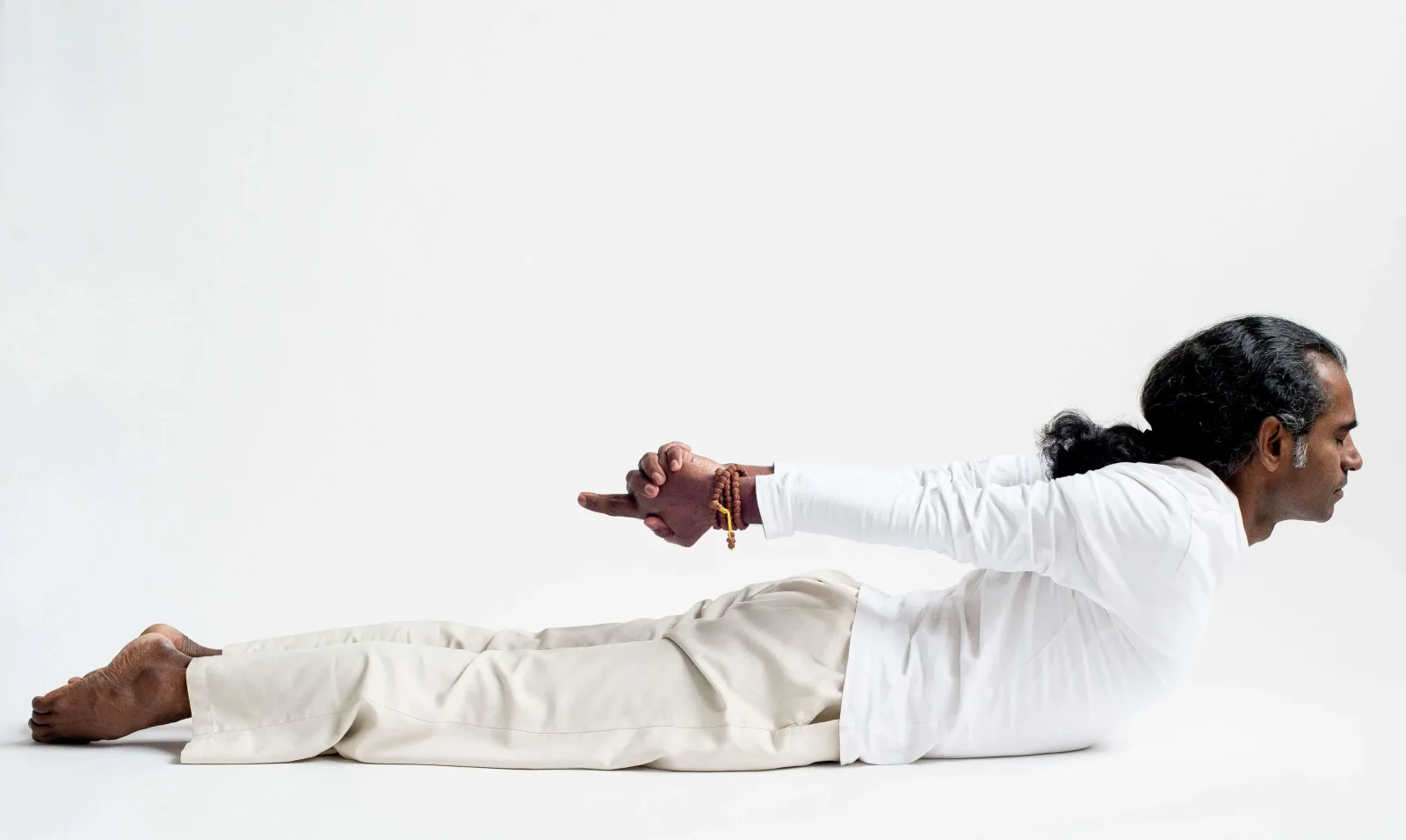
Most backbends ask the spine to open. Shalabhasana — Locust Pose — asks it to work. Lying face-down and lifting chest, arms, and legs against gravity, there is nothing to push off, nothing to hang on: every centimetre of lift is earned by the muscles along the back of the body. That is exactly what makes this humble, faintly awkward-looking pose so valuable. Weak back extensors and glutes are quiet partners in slumped posture and tired, achy backs, and locust trains precisely those muscles — no equipment, no flexibility prerequisite. This guide gives you the honest benefits, the technique details that separate a strong locust from a strained one, and the variations that make it workable on day one.
This article is for general education and is not medical advice. If you have a back injury, ongoing back pain, or any condition listed in the cautions below, please consult a qualified healthcare professional before practicing.
What is Shalabhasana?
Shalabha is Sanskrit for locust or grasshopper — the pose's low, hovering lift is said to resemble the insect at rest. You lie prone, arms alongside the body, and on an inhale raise the head, chest, arms, and legs a modest height off the floor, holding the lift with steady breath. In the asana library it sits in the prone backbend family at beginner level, with a job description worth repeating: locust builds the back-body strength that every deeper backbend depends on. Where Bhujangasana (cobra) teaches the spine to extend with some help from the hands, locust removes the hands from the equation entirely — which is why teachers sequence it before ambitious poses like bow or wheel.
How to practice Shalabhasana (step by step)
Lie on your belly, legs together or hip-width, arms alongside the body with palms facing down or up — your choice; down gives slightly more support.
Rest the forehead on the mat. Lengthen the whole body: crown reaching forward, toes reaching back.
Engage the legs, glutes (firmly but not clenched), and the muscles along the spine before anything lifts.
On an inhale, raise the head, chest, arms, and legs together — smoothly, without a jerk. Height is not the measure of success; the quality of the lift is.
Keep the gaze down-and-forward so the back of the neck stays long. Reach through the fingertips and toes as if being gently pulled from both ends.
Hold for three to five even breaths.
On an exhale, lower everything with the same control you lifted with. Turn one cheek to the mat and rest. Repeat two or three times.
A tip from our teaching hall: think "long, then up." Students who reach forward through the crown and back through the toes before lifting rise into a supported, evenly distributed arch; students who simply hoist upward fold the effort into the lower back. Length first — every time.
Shalabhasana benefits — the honest case
Back strength, the headline benefit. Locust directly works the spinal extensors, glutes, and hamstrings — the chain that holds you upright. Strengthening this chain is a standard element of back-care exercise generally, and a stronger back-body may help with the fatigue and discomfort of long sitting. This is a strengthening effect: it arrives through weeks of regular practice, not single sessions, and pain that worsens with the pose is a signal to stop and seek advice.
Posture support from behind. Slumped posture isn't only tight chest muscles — it's under-worked upper-back muscles losing the tug-of-war. Locust's lift trains the muscles between and below the shoulder blades that hold the chest open, complementing stretch-based posture work from the other direction.
A front-body counter-stretch. The lift extends the hip flexors, abdomen, chest, and shoulders — the territory that chair-sitting shortens — making locust a natural counter-movement to a folded-forward day.
Foundation for deeper backbends. Bow, wheel, and their relatives all assume a back that can generate its own lift. Locust is where that ability is built safely, close to the floor.
The traditional claims, labelled as such. Classical teaching credits shalabhasana with stimulating the abdominal organs and digestion (through the belly's pressure against the floor), boosting energy, and settling the mind. Modern evidence for the organ effects is limited, so we pass those on as tradition respectfully told; the mood-and-alertness effect after practice is common student experience, reported as exactly that.
Common mistakes in Shalabhasana
Jerking into the lift. Momentum bypasses the very muscles the pose exists to train and jolts the lower back. Rise on a slow inhale.
Cranking the head up. Chasing height with the chin compresses the neck. Gaze down-and-forward; the neck is part of the spine's long curve.
All lower back, no legs. If the legs are passive, the lumbar spine does everything. Active legs and engaged glutes spread the work.
Gripping the glutes so hard the lift stalls. Firm engagement, yes; white-knuckle clenching compresses the low back. Aim for strong-but-breathing.
Holding the breath. The lift should coexist with even breathing. If it can't, lower an inch — that's your working height today.
Who should avoid or modify locust
Skip the full pose — and take individual professional advice — if you are pregnant (prone poses need replacing; a qualified prenatal teacher can substitute), have had recent abdominal or spinal surgery, or have a hernia. With diagnosed disc problems, spondylolisthesis, or acute back pain, extension work helps some backs and aggravates others — this is a pose to learn under individual guidance, not from a page. With high blood pressure or heart conditions, the full both-ends lift is a surprisingly strong exertion; keep to gentle half variations with your doctor's clearance. Neck injuries: keep the forehead low and the lift small.
Variations that meet you where you are
Half locust (Ardha Shalabhasana) — lift one leg at a time, upper body resting. The kindest entry point, and genuinely useful in its own right.
Upper-body-only locust — chest and arms lift, legs stay down. Isolates the upper-back work.
Hands under the hips — a traditional variation that supports the pelvis and eases the lower back's share.
Arms forward ("superman" shape) — lengthens the lever and increases the challenge; an intermediate progression, not a starting point.
Interlaced hands behind the back — clasping and lifting the arms adds a strong chest opening for practitioners with the mobility for it.
Frequently asked questions
What are the disadvantages of Shalabhasana?
Practiced with jerky lifts, a cranked neck, or an unprepared lower back, locust can strain exactly what it's meant to strengthen — the lumbar spine and neck are the usual complaint sites. It is also genuinely hard work, which surprises people expecting a gentle stretch. Practiced with control, modest height, and the modifications above, it is a low-risk strengthening pose for most healthy practitioners.
How long should I hold Shalabhasana?
Three to five even breaths — roughly 15 to 30 seconds — repeated two or three times serves most practitioners better than one long, shaking hold. Strength builds through quality repetitions. As the pose matures, holds can lengthen gradually, but the breath remains the referee: when it turns ragged, come down.
Is Shalabhasana good for sciatica?
Sometimes — and sometimes not, which is why we won't give a blanket yes. Strengthening the back body helps some people with sciatic symptoms, and prone extension is used in some rehabilitation approaches; but sciatica has multiple causes, and what relieves one aggravates another. If you have sciatica, get an individual assessment from a physiotherapist or doctor before adding locust, start with half locust, and treat any symptom increase — especially pain radiating down the leg — as an immediate stop.
What are the common mistakes in Shalabhasana?
The big five, detailed above: jerking up with momentum, lifting the chin instead of the chest, leaving the legs passive, over-clenching the glutes, and holding the breath. The single correction that fixes most of them is "long, then up" — reach through crown and toes before you lift.
Where locust fits — and where it leads
Build locust into your practice two or three times a week — after warm-ups, before deeper backbends like cobra's stronger cousins — and let a rest in child's pose balance it afterward. If back care is your real question, our guide to yoga poses for back pain takes the condition-first view. And if you find yourself curious why teachers sequence strength before depth, that logic — sequencing, counterposes, and reading individual backs — is core curriculum at our 200-hour yoga teacher training in Rishikesh. We're on WhatsApp if you have questions.
References
National Center for Complementary and Integrative Health (NCCIH) — Yoga: What You Need To Know (evidence context, including yoga for low-back pain).
NIH / National Institute of Neurological Disorders and Stroke — Low Back Pain information (context on exercise, strengthening, and back care).
Traditional hatha yoga teaching on shalabhasana (classical Indian schools; organ-stimulation and energy claims presented as tradition, not clinical evidence).
Reviewed for health accuracy by Dr. Bhupinder Singh Arora (M.D. Ayurveda), consulting Ayurvedic physician at Pure Soul Yoga School. This article is educational and not a substitute for personal medical advice.
Author note (byline): Gangesha Adi (E-RYT 500) calls shalabhasana the most underrated pose he teaches at Pure Soul Yoga School, Rishikesh — the students who grumble about it in week one are usually the ones whose backbends transform by week four.