Trikonasana Benefits: Triangle Pose, Step by Step
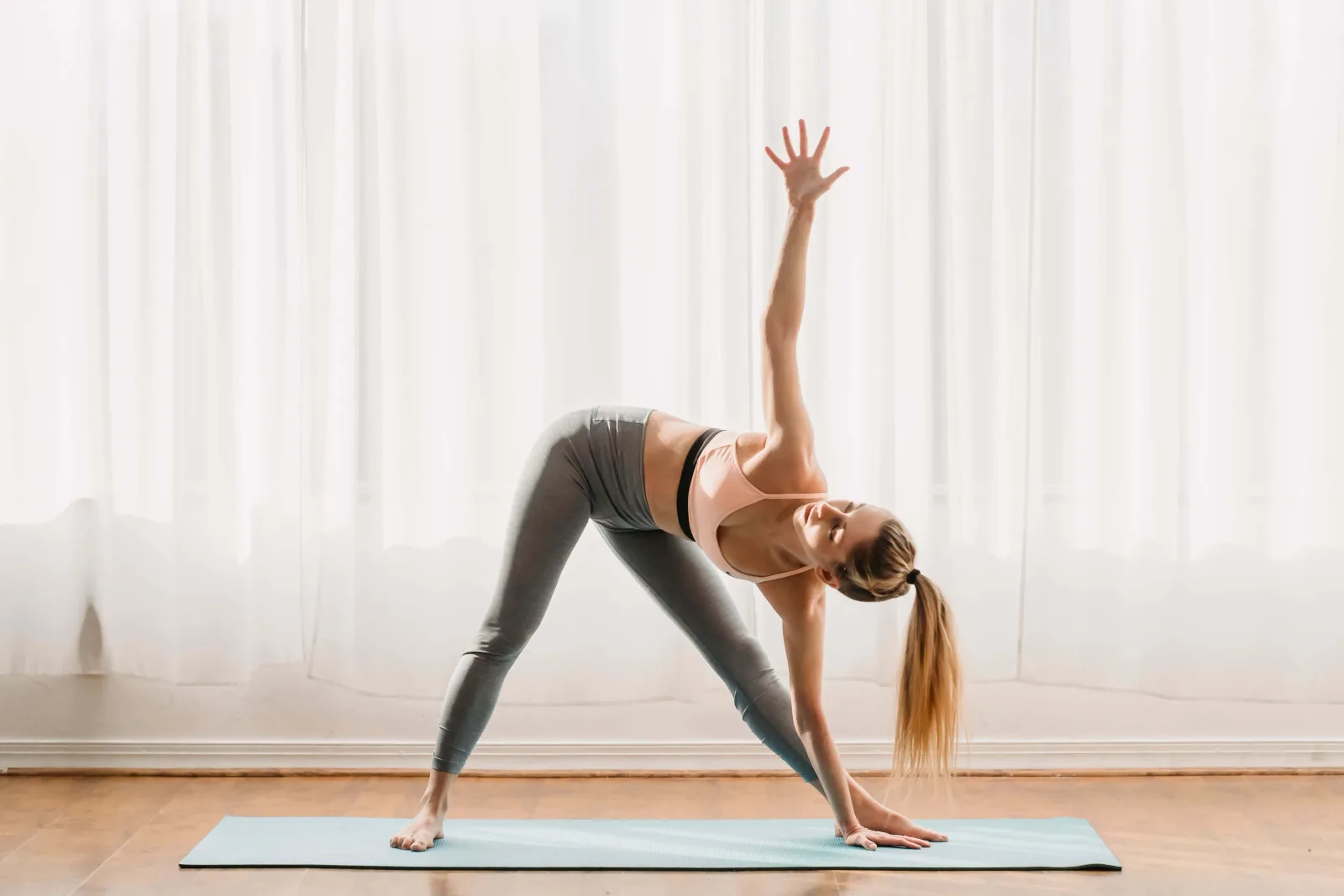
Stand your legs wide, tip sideways over the front leg, and stretch both arms into one vertical line — the shape you've made is a set of triangles, and the pose is Trikonasana. Among standing poses it is the great side-body teacher: where forward bends fold you and backbends open you, triangle lengthens the often-ignored line from outer ankle to fingertips along your flank. Its benefits are those of a well-designed standing stretch — longer hamstrings and inner thighs, more mobile hips, working legs, an open chest and a genuine balance challenge — and it holds one more distinction: it's one of the easiest poses in yoga to fake. Reach too far down and the shape collapses while looking vaguely right. This guide builds the honest version.
This article is for general education and is not medical advice. If you have neck, hip or blood-pressure concerns, please consult a qualified healthcare professional before practicing.
What is Trikonasana?
Trikona means triangle — tri, three; kona, angle — and the pose draws several: the legs and floor form one, the lowered torso and front leg another. The full classical name of the common version is Utthita Trikonasana, Extended Triangle Pose. It appears in virtually every style of modern practice, from slow hatha classes to flowing sequences — if you're exploring which style suits you, you'll meet triangle in nearly all of them, which is reason enough to learn it properly once.
How to do Trikonasana (step by step)
Step your feet wide apart — roughly the length of one of your legs.
Turn your right foot out 90 degrees; turn the left foot in slightly. The right heel lines up with the arch of the left foot.
Ground both feet, lift the kneecaps gently — both legs stay straight but not locked.
Inhale and reach the arms to a T at shoulder height, palms down.
Exhale, reach the torso long over the right leg — think "reach out" before "tilt down" — hinging at the hip, not the waist.
Lower the right hand to your shin, ankle or a block outside the foot. The left arm rises straight up, in line with the right.
Open the chest toward the side wall. Turn the gaze up to the top thumb, or keep it level or down if the neck prefers.
Hold for 20–30 seconds of even breathing, inhale to rise, then repeat on the left side.
A tip from our teaching hall: the pose lives in step 5, not step 6. Reach so far sideways along the front leg that the hand's final resting height stops mattering — a triangle at shin height with a long spine beats a floor-touch with a crumpled one, every single time.
Trikonasana benefits — honestly stated
Hamstring and inner-thigh length. The straight-legged wide stance stretches the back and inside of the front leg substantially; with regular practice most people find a genuine, usable gain in flexibility here.
Hip mobility in a standing pattern. Triangle trains the hip hinge sideways over a grounded leg — mobility you actually use stepping, reaching and bending in daily life, practiced under real load.
A rare stretch for the side body. The waist, ribs and lats along the upper flank get lengthened — territory almost nothing in ordinary movement (or most exercise) reaches. Many students feel their breathing widen in the pose as the ribcage opens; slow breathing in a held stretch is itself part of why standing poses feel settling.
Leg strength and standing stamina. Both legs work isometrically throughout the hold. It's moderate strengthening — honest, but real, and it accumulates across a practice full of standing poses.
Balance and body-sense. The wide base is stable, yet holding a tilted shape with an open chest sharpens proprioception — the sense of where your body is — which is a trainable skill with broad usefulness.
Claims that triangle cures digestive troubles or melts waist fat circulate widely; we don't repeat them. Where classical teaching says the pose stimulates the abdominal organs, we pass that on as tradition, and leave it there.
Common mistakes
Collapsing the chest toward the floor. The torso should open sideways, not fold face-down. If your chest faces the mat, rise until it can face the wall.
Dumping weight into the bottom hand. The hand rests; the legs and core hold you. Try lifting the lower hand for a breath to check.
Locking the front knee back. Hyperextension shifts strain into the joint. Keep a micro-bend and press the top of the shin gently forward.
A stingy stance. Feet too close together turn the triangle into a narrow lean. Widen until the geometry appears.
Cranking the neck upward. Gazing at the thumb is optional decoration, not the pose. A neutral gaze protects a cranky neck completely.
When to avoid Trikonasana (contraindications)
Dizziness or low blood pressure — the tilted hold and the rise back up can provoke lightheadedness; come up slowly, or practice with your back against a wall.
Neck problems — skip the upward gaze; look straight ahead or down instead.
Hamstring tears or acute hip/groin injury — the pose stretches exactly this tissue; let it heal first and return gradually.
Late pregnancy — the wide stable stance can work with modifications (shorter stance, wall support, no deep hold), but take individual guidance from a qualified prenatal teacher.
Uncontrolled high blood pressure or migraine — traditional cautions apply to long holds with the head turned; keep holds brief and the gaze level, and clear practice with your doctor.
Variations and props
Block under the lower hand — the single most useful prop in this pose; it buys spine length at zero cost.
Back against a wall — teaches the open-chest alignment better than any verbal cue, and adds security for balance worries.
Shorter stance — a perfectly legitimate version for tight hamstrings or unsteady days.
Hand on a chair seat — brings the floor up further still; excellent for older students and stiff mornings.
Parivrtta Trikonasana — the revolved triangle, adding a spinal twist; a markedly harder pose best learned later, with a teacher.
Frequently asked questions
What are the 5 benefits of Trikonasana?
The five we'd defend: longer hamstrings and inner thighs, better hip-hinge mobility, a genuine side-body stretch, isometric leg strengthening, and sharper balance. Anything beyond that list is either a downstream effect of those or a traditional claim.
Which body part is affected by Trikonasana?
Mainly the hamstrings and inner thigh of the front leg, the hips, the side of the waist and ribs, the shoulders, and both legs as stabilisers. The chest and breathing muscles get an opening effect from the rotated, extended torso.
When should you avoid Trikonasana?
During dizziness or low blood pressure episodes, with an acute hamstring or hip injury, and in late pregnancy without modified guidance. With neck trouble, do the pose but keep the gaze level. When in doubt about a medical condition, ask your doctor first — it's a two-minute conversation that removes all guesswork.
How long should you hold triangle pose?
Around 20–30 seconds per side is a solid working hold for most practitioners; up to a minute as stamina grows. Two or three shorter, well-aligned holds are worth more than one long, slowly disintegrating one.
Build the rest of your standing practice
Triangle is one corner of the standing-pose family — warriors, wide-legged folds and balances complete it, and the full asana library maps them all. When you're ready to go from doing these poses to understanding and teaching them — alignment, adjustments, sequencing — that's the work of our 200-hour yoga teacher training in Rishikesh. Message us on WhatsApp with any question about practice or courses.
References
National Center for Complementary and Integrative Health (NCCIH) — Yoga: What You Need To Know (general evidence on yoga, flexibility and wellbeing).
Centers for Disease Control and Prevention (CDC) — Physical Activity Basics (context on balance and muscle-strengthening activity).
Traditional hatha yoga teaching on trikonasana (as taught in classical Indian schools; organ-stimulation claims presented as tradition, not clinical evidence).
Reviewed for health accuracy by Dr. Bhupinder Singh Arora (M.D. Ayurveda), consulting Ayurvedic physician at Pure Soul Yoga School. This article is educational and not a substitute for personal medical advice.
Author note (byline): Gangesha Adi (E-RYT 500) uses trikonasana as the alignment test-piece in beginner classes at Pure Soul Yoga School, Rishikesh — it reveals in ten seconds whether a student reaches long or merely bends low.