Yoga for Healthy Aging: A Practical Guide for Every Ability
Yoga is one of the few forms of exercise that directly practices the three abilities aging most reliably erodes — balance, strength and flexibility — while also training the breath and calming the nervous system. That is why it appears so consistently in healthy-aging research and in physical-activity guidelines for older adults, which specifically recommend activities that challenge strength and balance. And because every pose can be practiced standing, supported by a wall, or seated on a chair, there is a version of this practice for nearly every body — including yours, whatever your current mobility.
This is our complete guide to practicing yoga as you age: what actually changes in the body, what yoga can honestly offer (and what it can't), a practice menu organized by ability rather than by age, and a checklist for starting safely. If you want to go straight to fully seated practice, our step-by-step guide to chair yoga for seniors is the companion to this page.
This article is for general education and is not medical advice. If you have a health condition, recent surgery, osteoporosis, or uncontrolled blood pressure, please talk with your doctor before starting any new exercise practice.
In this guide
What changes with age — and what practice can honestly offer
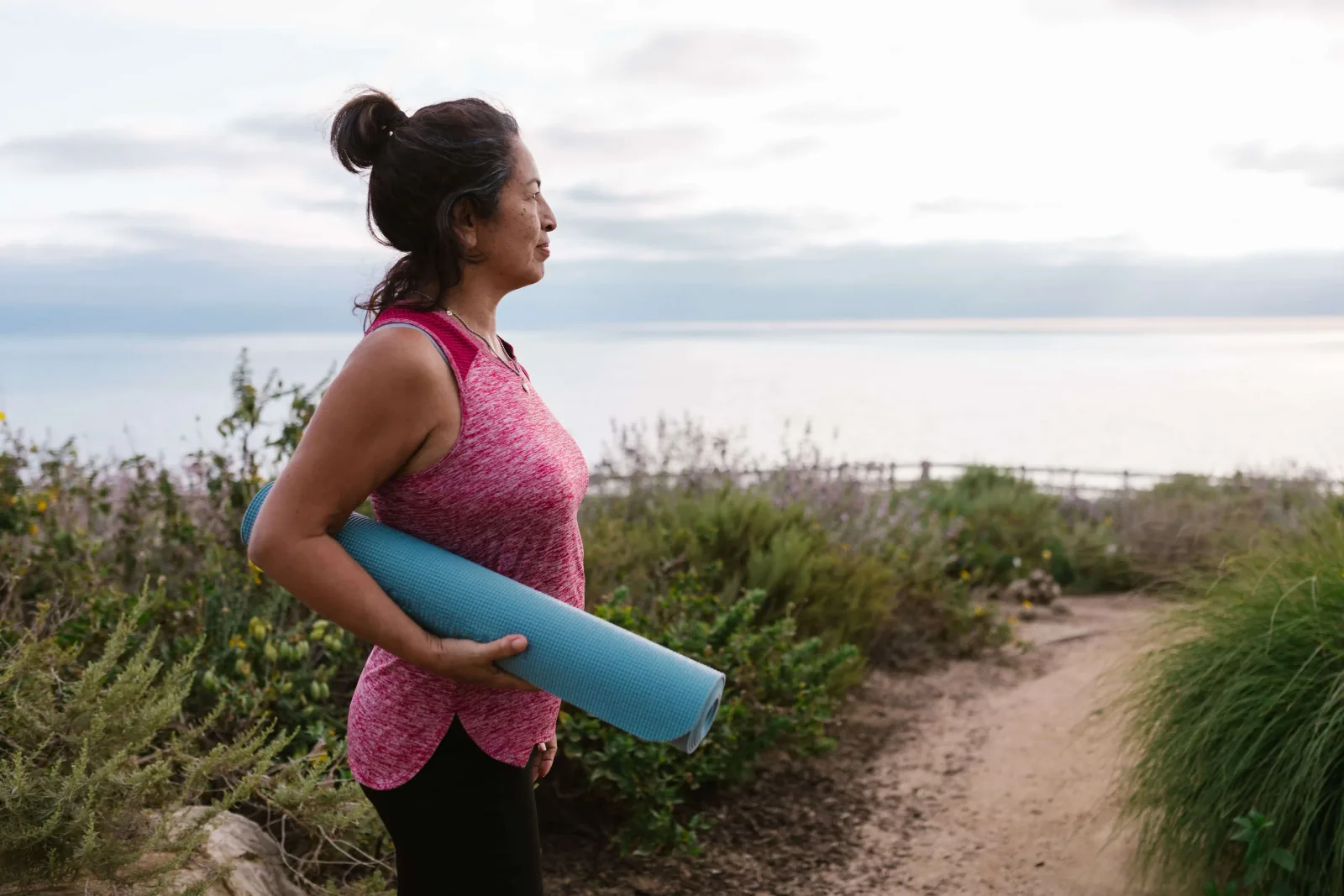
Four changes arrive for nearly everyone, usually so gradually we blame individual mornings rather than the trend. Muscle mass and strength decline from mid-life onward (researchers call it sarcopenia) unless deliberately maintained. Bone density decreases, especially for women after menopause. Balance quietly degrades as strength, joint mobility and body awareness each give a little. And sleep tends to become lighter and more fragmented, right when the body needs its repair time most.
None of this is a verdict; all of it responds to practice. Here is what the research honestly supports:
Balance and mobility: reviews of yoga trials in older adults suggest meaningful improvements in balance and mobility — which matters enormously, because falls are the leading cause of injury among adults 65 and older (CDC). We say "suggest" deliberately: studies vary in size and quality, and yoga works best here as one ingredient alongside walking and strength work, not as a magic bullet.
Strength and flexibility: holding standing poses is genuine load-bearing work for the legs and trunk, and research in older adults links yoga programs with modest gains in lower-body strength and flexibility.
Mood, stress and sleep: studies suggest yoga — particularly its breathing and relaxation practices — may improve sleep quality and reduce stress and anxiety symptoms in older adults. Gentler claims than the internet makes, but well worth having.
Joint comfort: gentle range-of-motion practice is widely recommended for arthritic joints, and some research suggests yoga may help with pain and function — our guide to yoga for arthritis covers this fully.
And what yoga will not do: reverse aging, rebuild lost bone on its own, "detoxify" anything, or replace medical care. Anyone promising those things is selling, not teaching. What a sustained practice reliably offers is slower loss and better function — steadier walking, easier stairs, calmer nights, a body you trust more. Ask anyone who has practiced into their eighties whether that's enough.
Find your level: a practice menu by ability, not age
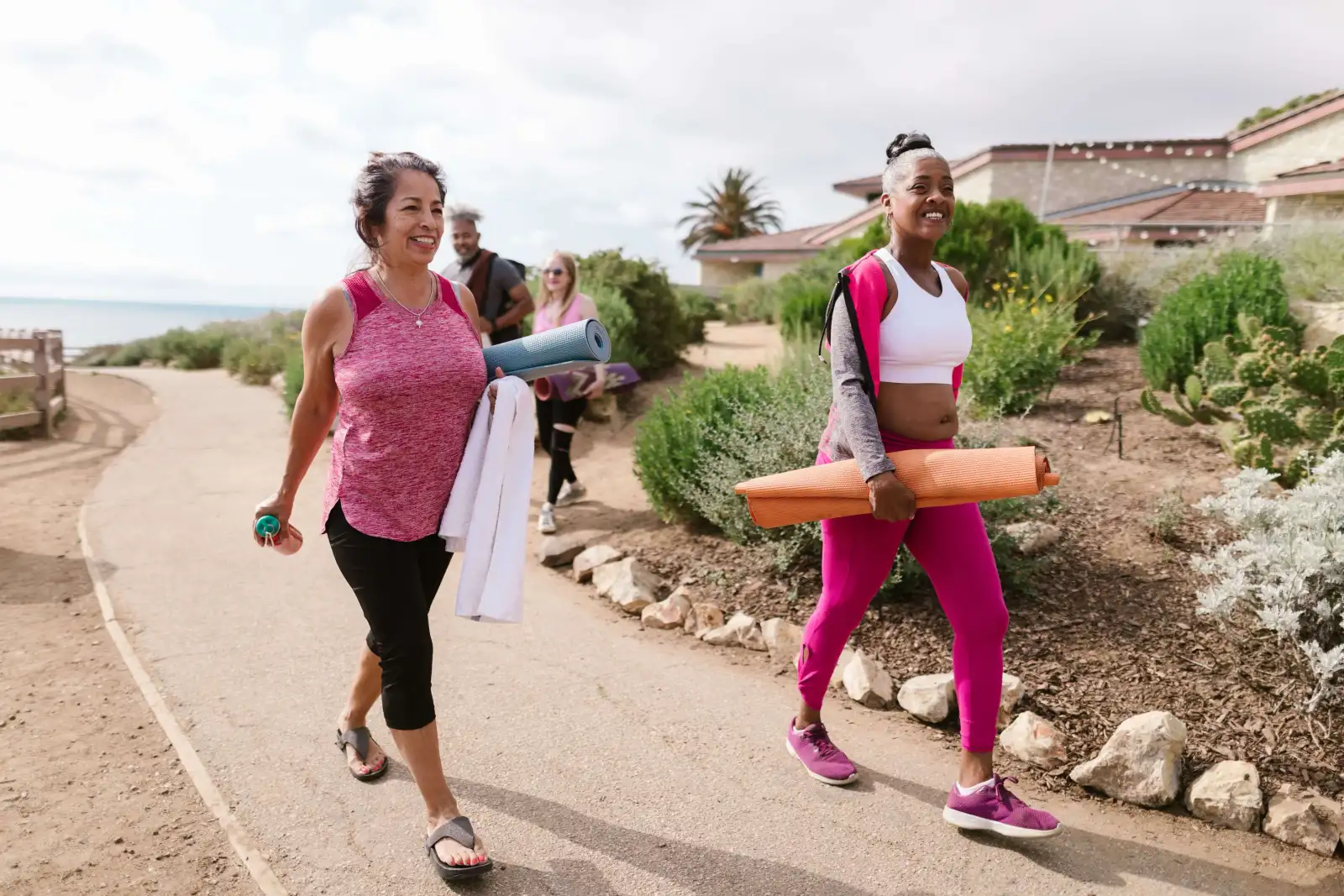
Age is a poor sorting variable — we have taught 70-year-olds who hike Himalayan foothills and 55-year-olds recovering from surgery. Ability is the honest one. Find the level that describes you today, start there, and know that the levels are doors, not boxes: many students practice at two levels in the same week, and movement between them — in both directions, as life happens — is normal and fine.
Level 1 — Standing practice (steady on your feet)
You walk without aids, manage stairs confidently, and can get up from the floor without help. Your practice can look like classic gentle hatha:
Mountain Pose → Tree Pose (near a wall at first) for posture and balance
Warrior II and Side Angle for leg strength and hip mobility
Gentle sun salutations at your own pace — our guide to Surya Namaskar breaks down the sequence — with hands on a chair seat instead of the floor if the full fold is far away today
Bridge Pose for the back body, Cat–Cow for the spine
Legs-up-the-wall and a proper Savasana to finish
Twenty to forty minutes, three or more days a week, is a complete practice at this level. A general hatha or gentle-flow class suits you; our overview of yoga styles helps decode class names.
Level 2 — Supported practice (steady, with backup)
You're mobile but your balance is unreliable, or getting down to the floor and back up is a negotiation. Nothing about that excludes you — support is a strategy, not a defeat. The wall and the chair become your props:
Wall-supported Tree and single-leg stands — fingertips on the wall, gradually lightening the touch
Chair-back Warrior poses — full leg work, hand resting on the chair
Sit-to-stand repetitions from a sturdy chair — unglamorous and priceless (more below)
Standing Cat–Cow with hands on the chair seat, calf raises holding the chair back
Seated or bed-based rest poses instead of floor Savasana
This level is where fear of falling often lives, and practice meets it directly: you rebuild the strength and confidence the fear feeds on, with support always in reach.
Level 3 — Chair practice (seated is your base)
If standing practice isn't available to you — balance, joints, energy, or a wheelchair — the entire logic of yoga translates to sitting, and the benefits of stretching, strengthening and breathwork remain genuinely available. This is exactly why we wrote a complete, step-by-step companion guide: Chair Yoga for Seniors: 10 Gentle Seated Poses to Start Today. It walks through a full seated sequence — seated mountain, cat–cow, eagle arms, seated marching, ankle work, twists and seated relaxation — with safety rules and honest FAQs. If you can sit upright in a chair, you can begin today, and that page is the place to start.
Whichever level you begin at, the deeper practices — breath, attention, rest — are identical across all three. Nobody is doing a lesser yoga.
A practical note on moving between levels: progress by subtraction of support, not by addition of ambition. Lighten the hand on the wall before you leave the wall; practice chair poses standing behind the chair before you practice them in open space. Each level's poses rehearse the next level's, which is the quiet genius of an adaptable tradition — and it means no restart is ever from zero.
Strength and balance: the two priorities worth most of your attention
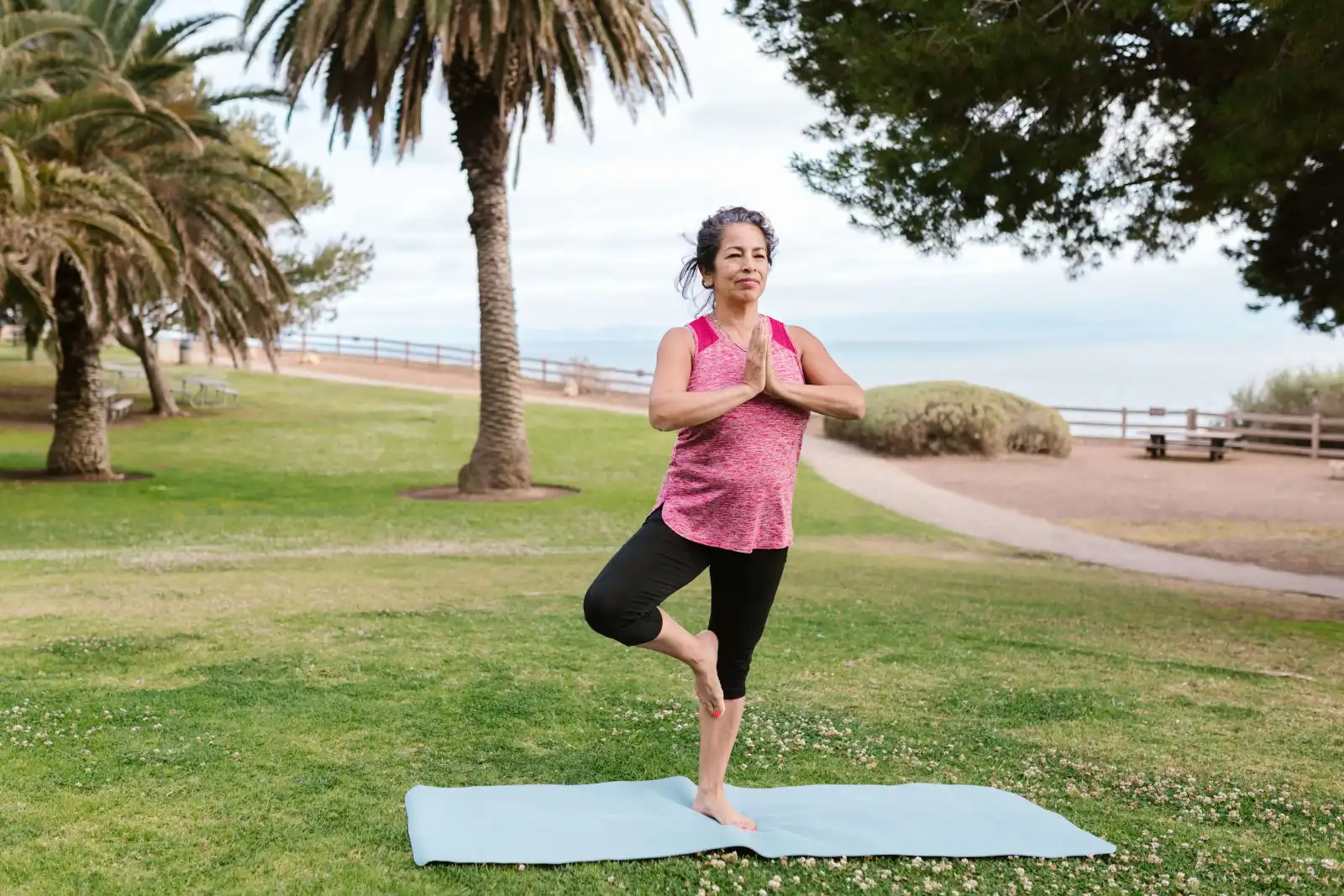
If you take one thing from this page, take this: for aging bodies, the feel-good stretches are the dessert; strength and balance work is the meal. Physical-activity guidelines for older adults specifically call for strength and balance training at least twice a week, precisely because these are the capacities that keep you independent — and they respond to training at every age.
The daily balance minimum. Stand near a wall or counter. Shift your weight to one leg and lift the other foot slightly — even an inch counts. Hold for up to 30 seconds, switch sides, repeat two or three times. As it becomes easy, lighten your hand on the wall to fingertips, then hover. This single habit, practiced most days, trains exactly the reflexes that catch a stumble. Tree Pose is this exercise wearing traditional clothes.
Sit-to-stand: the most useful "pose" on this page. Sit on a firm chair, feet planted. Stand up — using hands on thighs if needed — and sit back down with control, slowly, rather than dropping. Do 5 to 10, once or twice a day. It is squats by another name, it directly maintains the leg strength that getting off toilets, out of cars and up from floors depends on, and how easily you do it is itself a rough strength check worth tracking over months.
Hold your standing poses longer. In a young person's flow class, poses pass in two breaths. For healthy aging, reverse the emphasis: fewer poses, held for five to eight slow breaths. A Warrior II held for 40 seconds is honest isometric leg work; the muscles know it, whatever the class is called.
A tip from our teaching hall: one of the most honest measures of progress is not a pose — it's how long it takes you to stand up from a chair five times in a row. When that number improves, everything else tends to follow: walking confidence, stairs, even mood. Track your own five-rep sit-to-stand time once a month; it is the humblest progress bar in yoga, and the most truthful.
A word on bones. Weight-bearing practice supports bone health as part of an overall active life, but yoga alone shouldn't be sold as osteoporosis treatment. If you have diagnosed osteoporosis, the practice adapts — avoiding deep spinal rounding, aggressive twists, and unsupported balance risks — and your doctor's guidance comes first. Say the word "osteoporosis" to any teacher before class; a good one will know exactly what to do with it.
Breath and sleep: the quiet half of the practice
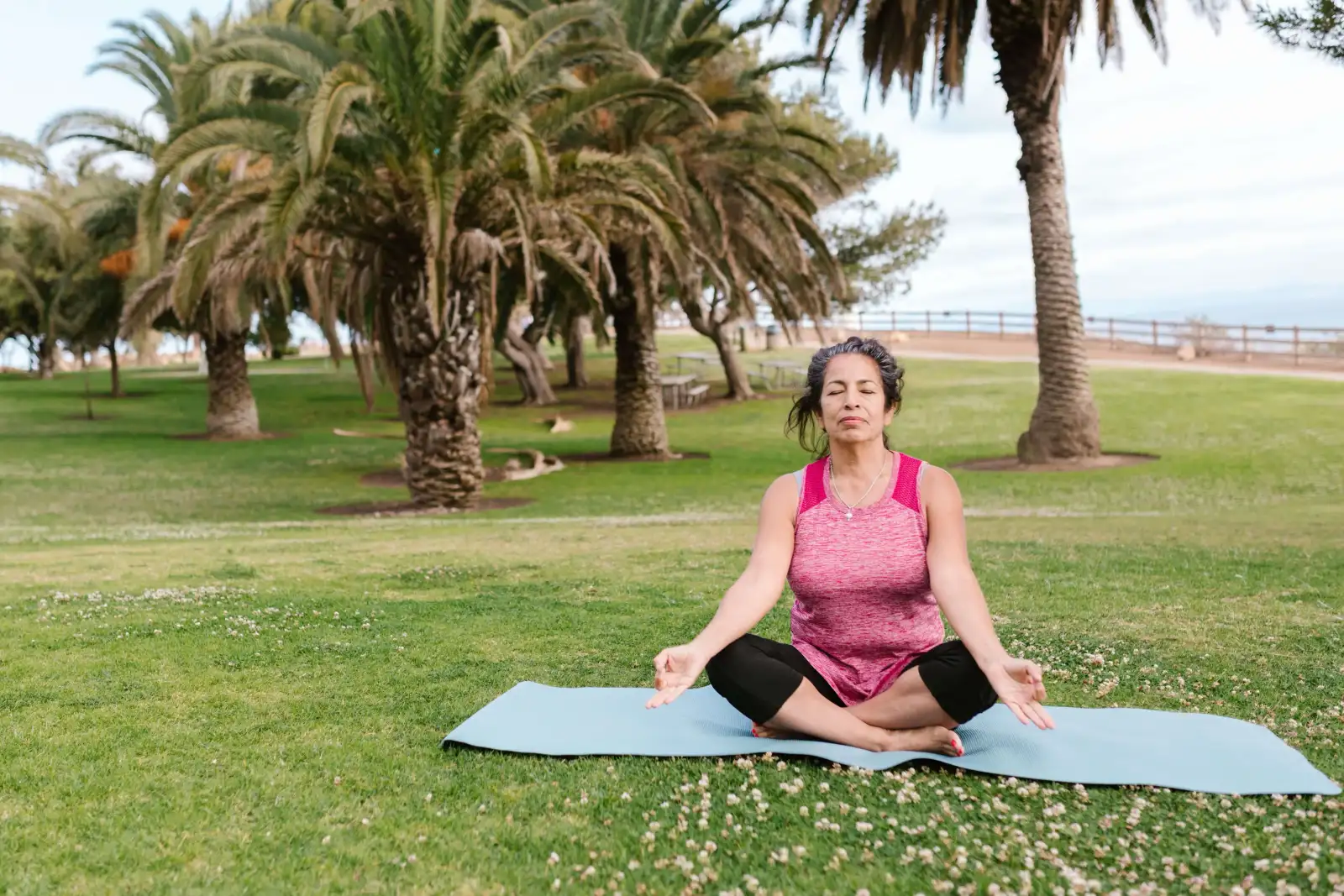
Ask our older guests in Rishikesh what changed their daily life most and surprisingly few say the poses. Most say the breathing — and what it did to their evenings.
Slow, controlled breathing practices activate the body's relaxation response, and research suggests regular practice may help with stress, blood pressure regulation and sleep quality — three things that tend to need help as the decades accumulate. The practices are undramatic and profoundly portable:
Simple breath awareness — five minutes of watching the natural breath, seated comfortably, any time of day.
Gentle extended exhale — inhale for a comfortable count of about four, exhale for about six. The longer exhale is the relaxation lever. Never strain; the breath should stay silky.
Bhramari (humming-bee breath) — a soft hum on the exhale, wonderfully effective before bed.
Our full guide to pranayama breathing techniques teaches these properly, with contraindications. Two cautions for older practitioners: skip breath retention (holding the breath), which can spike blood pressure, and treat any practice that makes you dizzy as a signal to return to natural breathing.
For sleep specifically, the combination our students settle into most often: no practice heroics in the evening — just ten minutes of gentle stretching, then extended-exhale breathing or Bhramari in bed. It is not a cure for insomnia and we won't pretend otherwise; it is a nightly signal to a nervous system that may have forgotten how to receive one.
Starting safely: an 8-point checklist
Clear it with your doctor first if you have a heart condition, uncontrolled blood pressure, osteoporosis, glaucoma, recent surgery or joint replacement, or any condition that affects balance. Not a formality — the answer shapes your practice, and occasionally the honest answer is "not yet."
Start below your ability level, not at it. The first two weeks are for learning how your body responds, not for proving anything.
Tell the teacher everything relevant — conditions, replacements, fears. Small classes make this real: it's why we cap ours at 20.
Pain rules: mild stretching sensation is fine; sharp, pinching, radiating or joint pain means stop. "No pain, no gain" is a slogan for 25-year-olds, and a poor one even for them.
Use props without pride. Wall, chair, blocks, straps — the tradition itself developed props precisely so every body could practice.
Warm up joints before asking things of them — a few minutes of ankle circles, knee bends, shoulder rolls.
Never rush transitions. Getting up from the floor, standing from a chair, coming out of forward folds — slow is the technique, since blood-pressure shifts on standing are common with age and most practice falls happen between poses, not in them.
Consistency over intensity, always. Ten to twenty minutes most days outperforms one ambitious weekly class — the same rule we give in the chair yoga guide, because it is the actual secret at every level.
Frequently asked questions
Which yoga is best for anti-aging?
Honestly: none, in the way "anti-aging" ads mean it — no style reverses aging, and claims otherwise are marketing. The styles that best support healthy aging are the gentle, deliberate ones: hatha for strength and balance held at a humane pace, restorative and yin for flexibility and rest, chair-based practice where standing work isn't available, plus daily breathwork. Choose by your ability level, not by promises on the label.
Which exercise is most anti-aging?
Research on aging consistently points to a combination rather than a champion: strength training, balance work, and aerobic movement (walking counts) together. Yoga's honest place in that mix is strong — it trains balance, maintains strength and flexibility, and adds the breath-and-stress dimension most exercise lacks — but it partners best with regular walking rather than replacing it.
Which yoga is best for seniors?
The version that matches your ability today. Steady on your feet: gentle hatha. Balance unreliable: wall- and chair-supported standing practice. Seated base: chair yoga is a complete practice, not a consolation prize. Across all levels, look for slower classes, longer holds, unhurried transitions and a teacher who asks about your health before the first pose.
How often should seniors do yoga?
Short and frequent beats long and rare: ten to twenty minutes daily, or fuller sessions three or four days a week, with the daily balance minimum and some sit-to-stands on most days. Activity guidelines for older adults recommend strength-and-balance work at least twice weekly — a rhythm even a modest home practice comfortably meets.
Can yoga prevent falls?
It builds the ingredients of fall prevention — leg strength, ankle mobility, balance reflexes, and confidence — and research in older adults is encouraging, though we'd say "reduces risk" rather than "prevents." For meaningful protection, pair regular practice with daily walking and, ideally, your doctor's input on your individual fall risk.
Am I too old to start yoga at 70 (or 80)?
No. Start at the right level — which at first may be a chair, a wall, or five minutes of breathing — and let the practice grow with you. We have taught beginners in their ninth decade. The only true disqualifier is starting at an intensity that belongs to a body you had decades ago; begin where you are, and the practice meets you there.
When home practice deserves deeper support
Everything on this page can be practiced free, at home, starting today — and for many people that is the whole story. Some, though, reach a point where they want a body-specific practice built for them, days structured around movement, rest and nourishing food, and teachers beside them — that is what our Healthy Aging Retreat in Rishikesh offers. It runs on the consultation-first model this school applies to everything: a consultation with our Ayurvedic doctor at the start of your stay — dosha assessment, health history, medications — from which your personal plan is built, with practice adapted to your body (chair-supported where helpful) rather than a standard template. Your stay includes a private room, the doctor's consultation and one complimentary massage; any further Ayurvedic therapies are recommended by the doctor and charged separately, so you only pay for what your body actually needs. Start dates are flexible — any day works. If the question in your mind is "am I too old for a retreat in India?", the answer here is the same as everywhere on this page: no — and you're welcome to ask us anything on WhatsApp first.
References
Centers for Disease Control and Prevention (CDC) — Facts About Falls (older adult fall statistics).
National Center for Complementary and Integrative Health (NCCIH) — Yoga: What You Need To Know (evidence overview).
World Health Organization (WHO) — Physical activity guidelines for adults 65 and over (strength and balance recommendations).
Peer-reviewed reviews of yoga for older adults — balance, mobility, strength and wellbeing outcomes (PMC-indexed; cited as suggestive, with study-quality limitations noted).
NHS — Physical activity guidelines for older adults.
Reviewed for health accuracy by Dr. Bhupinder Singh Arora (M.D. Ayurveda), consulting Ayurvedic physician at Pure Soul Yoga School. This article is educational and not a substitute for personal medical advice.
Author note (byline): Gangesha Adi (E-RYT 500) has taught gentle and therapeutic yoga to students of more than 50 nationalities over the past decade, including many practitioners in their 60s, 70s and 80s at Pure Soul Yoga School's healthy-aging programs in Rishikesh.