Yoga for Stress Relief: 8 Practices and a 10-Minute Daily Routine
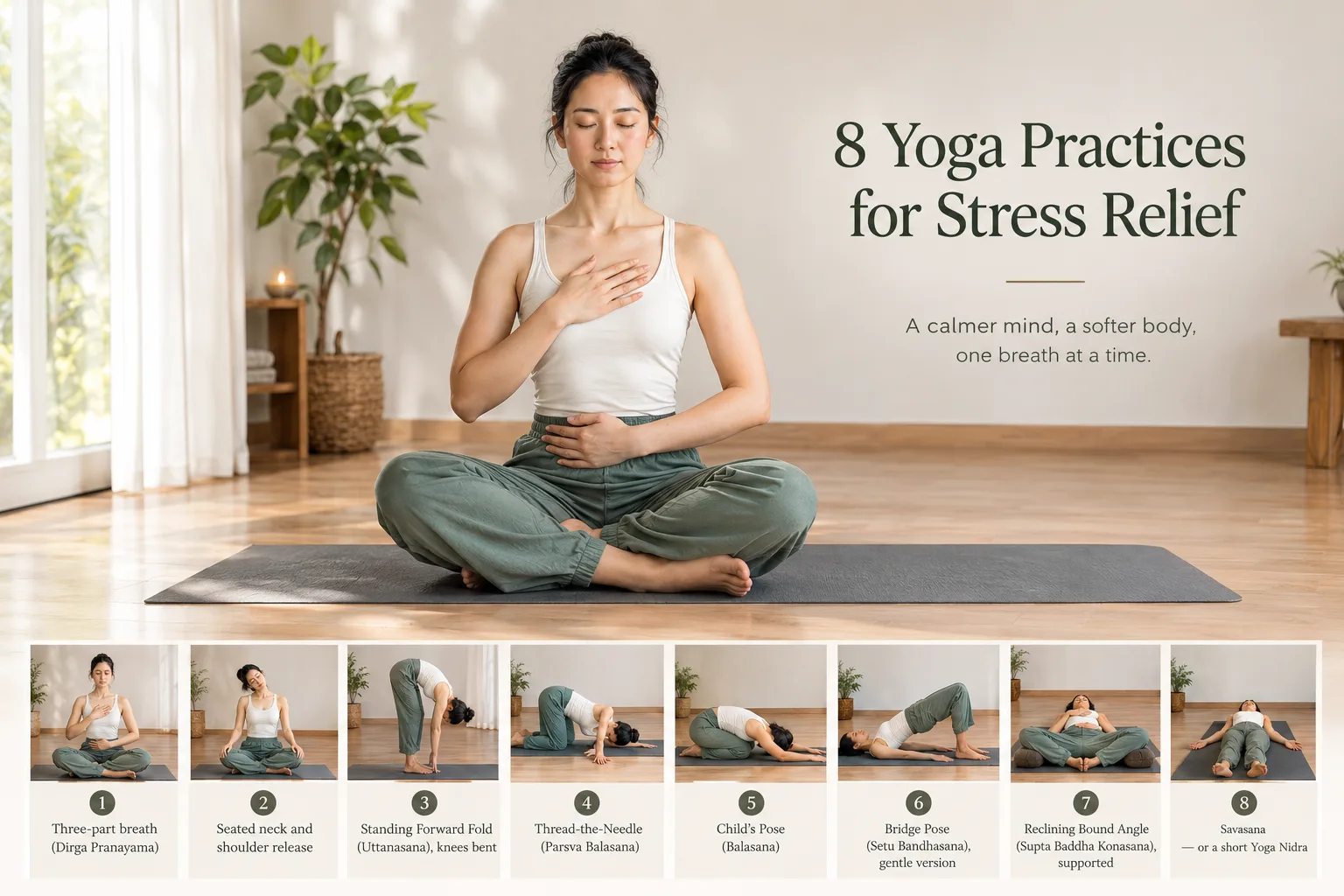
Can yoga actually relieve stress? Research suggests it may — slow movement, deliberate breathing and guided relaxation appear to dial down the body's stress response, easing muscle tension and helping the nervous system shift out of fight-or-flight mode. You don't need flexibility, equipment or an hour of free time. You need ten minutes, a patch of floor, and a handful of practices done slowly enough that your breath — not your to-do list — sets the pace.
This guide is for everyday stress: the deadline weeks, the overfull inbox, the shoulders that live somewhere near your ears. Below: how yoga works on stress (honestly described), eight simple practices, a 10-minute daily routine, desk micro-breaks, and a straight answer about when stress needs more than a yoga mat.
This article is for general education and is not medical advice. If stress is affecting your health, sleep or daily functioning, please consult a qualified healthcare professional about your individual situation.
How does yoga relieve stress?
Stress is not just a mood — it's a full-body state. Under pressure, the sympathetic nervous system releases stress hormones such as cortisol, the heart speeds up, breathing turns shallow, and muscles brace, especially in the neck, shoulders and jaw. Useful for escaping real danger; exhausting when it runs all day over emails.
Yoga appears to work on this state from three directions at once. Slow breathing — particularly a soft, long exhale — seems to stimulate the parasympathetic nervous system, the "rest and digest" branch that counters fight-or-flight. Gentle stretching releases the muscle tension stress creates. And attention anchored in breath and sensation gives the looping, list-making mind something quieter to hold.
The research deserves an honest summary. A systematic review of studies on yoga and stress reported reductions in perceived stress with regular practice, and some studies have measured lower cortisol over time; the National Center for Complementary and Integrative Health notes yoga may help with stress management and wellbeing. What the evidence does not show is instant transformation: one session often feels calming, but steadier change typically takes several weeks of consistency. A genuinely useful tool — not a magic switch.
Stress or anxiety? A quick word before you start
The two overlap, but they are not the same, and it changes what helps. Stress is a response to real, present demands — workload, caring responsibilities, finances — and tends to ease when the demand eases. Anxiety is persistent worry that hangs around even when nothing specific is wrong, and it can be a medical condition in its own right. This page is about stress. If what you're feeling looks more like constant worry, panic or dread, our guide to yoga for anxiety is written for exactly that, including honest guidance on when to seek professional help.
8 yoga practices for stress relief
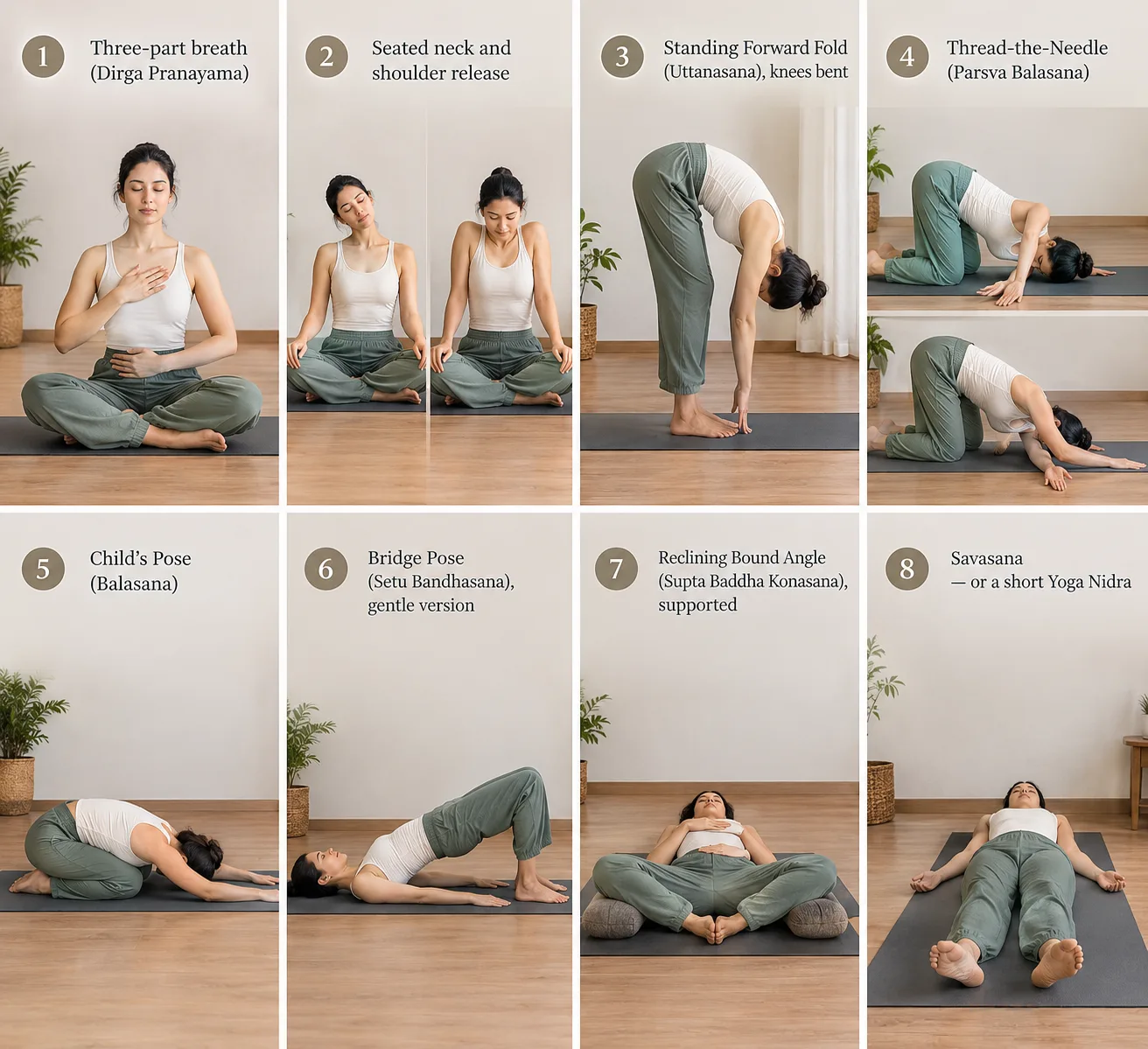
Do them in this order and you have a complete session; each one also works alone. Move slowly, breathe through the nose, and stop anything that hurts.
1. Three-part breath (Dirga Pranayama) — two minutes that change the hour
Sit or lie down comfortably. Inhale slowly into the belly, then the ribs, then the upper chest; exhale in reverse, letting the chest, ribs and belly soften in turn. Continue for two to three minutes.
Why it helps: stressed breathing is shallow and fast; this practice slows and deepens both, and a slower breath appears to nudge the whole nervous system toward its calmer setting. It is the foundation everything else here builds on. If breathwork interests you, our full guide to pranayama breathing techniques covers this and six other practices in depth.
2. Seated neck and shoulder release — where stress physically lives
Sit tall. Drop your right ear toward your right shoulder and take three slow breaths; repeat left. Then roll the shoulders up toward the ears on an inhale and let them drop heavily on an exhale, five times.
Why it helps: the neck and shoulders are where most people store tension without noticing. Releasing them interrupts the loop in which tight muscles keep signalling "stress" back to the brain.
3. Standing Forward Fold (Uttanasana), knees bent
Stand with feet hip-width, bend your knees generously, and fold forward, letting your head and arms hang completely heavy. Sway gently if it feels good. Five to eight slow breaths, then roll up slowly, one vertebra at a time.
Why it helps: letting the head hang below the heart with the neck fully released is one of the fastest ways to feel a busy day drain out of the upper body. The bent knees matter — this is about release, not hamstrings.
4. Thread-the-Needle (Parsva Balasana)
From hands and knees, slide your right arm under your left, lowering the right shoulder and ear to the mat. Take three to five breaths into the upper back, then switch sides.
Why it helps: it wrings gentle movement into the upper back and shoulder blades — the exact region that stiffens during desk work — and the head resting on the floor is quietly soothing.
A tip from our teaching hall: if you only remember one instruction from this whole page, make it this — on every exhale, deliberately let your shoulders drop. Students spend whole classes discovering their shoulders were up near their ears without a single complaint from the body. Stress is quiet like that.
5. Child's Pose (Balasana)
Kneel, bring the big toes together and knees wide, and fold forward until your forehead rests on the mat or a cushion. Arms forward or alongside the body. Stay for one to two minutes, breathing into the back of the ribs.
Why it helps: folding inward with the forehead supported tells the body it is safe to stand down. Many students describe this as the moment a stressful day finally goes still.
6. Bridge Pose (Setu Bandhasana), gentle version
Lie on your back, knees bent, feet hip-width and close to the hips. Press through the feet and lift the hips a comfortable height — halfway is plenty. Three to five breaths, lower slowly, repeat twice.
Why it helps: stress posture is hunched — chest closed, shoulders forward. Bridge opens the front of the chest and shoulders, counteracting the day's slump, and the steady leg engagement gives restless energy somewhere useful to go.
7. Reclining Bound Angle (Supta Baddha Konasana), supported
Lie on your back, bring the soles of the feet together and let the knees fall open, with a cushion or rolled blanket under each knee so the legs can fully relax. Rest one hand on the belly, one on the heart. Stay for two to three minutes.
Why it helps: with the hips and chest supported open and nothing to hold, this restorative shape lets the body do what it rarely gets permission to do mid-week: absolutely nothing. The hand on the belly deepens the breath without effort.
8. Savasana — or a short Yoga Nidra
Lie flat, legs relaxed, palms up, and rest for at least three minutes, following your natural breath. If your mind keeps drafting emails, use a guided Yoga Nidra instead — a systematic, voice-led relaxation practiced lying down. At our school in Rishikesh the teaching day closes with an evening meditation or Yoga Nidra session — the practice stressed students most often name as the one they take home — and we teach it in depth on our dedicated Yoga Nidra teacher training.
Why it helps: deliberate rest is where the downshift consolidates. Rushing straight back to your phone undoes a surprising amount of the previous nine minutes.
Your 10-minute daily de-stress routine
Same practices, sensible timing. Mornings set the tone for the day; evenings help the day let go of you — either works. Consistency matters more than the clock.
Minutes | Practice |
|---|---|
0–2 | Three-part breath |
2–3 | Neck and shoulder release |
3–4 | Standing Forward Fold |
4–5 | Thread-the-Needle (30 seconds per side) |
5–6½ | Child's Pose |
6½–7½ | Bridge Pose (2 rounds) |
7½–9 | Supta Baddha Konasana |
9–10 | Savasana |
On days when even ten minutes is fantasy, do practices 1 and 5 — two minutes of three-part breath and a minute in Child's Pose is a real practice, not a failure to do the full one.
Stress management by yoga at work: micro-breaks that fit between meetings
You do not need a mat to interrupt the stress spiral. These fit in ordinary clothes, at a desk, in two minutes or less:
The 10-breath reset. Sit back from the screen, feet flat, and take ten slow breaths with exhales longer than inhales. Nobody will notice; your nervous system will.
Seated shoulder rolls and ear-to-shoulder stretch — practice 2 above, chair edition.
Standing desk fold. Stand, soften the knees, fold forward for five breaths (skip if it makes you dizzy or you have uncontrolled high blood pressure — a seated version, chest toward thighs, works too).
Wrist and hand release. Gently draw the fingers of each extended hand back, then shake both hands loose. Small, and strangely relieving after hours of typing.
One-minute belly breathing before a difficult call. One hand on the belly, breathe so the hand moves. Walking into pressure with a slower heartbeat is a practical advantage.
Three or four micro-breaks scattered through a workday keep stress from compounding — easier than unwinding a fully wound spring at 9 p.m.
When stress needs more than yoga
We teach yoga for a living, and we'll say this plainly: some stress should not be managed on a mat alone. Please talk to a doctor or mental-health professional if:
stress is constant for weeks, with no recovery even on days off
your sleep, appetite or health is visibly suffering
you're relying on alcohol or other substances to switch off
you feel emotionally numb, hopeless or burned out to the point that rest doesn't restore you
what you're calling stress looks more like persistent worry or panic — see our yoga for anxiety guide, which covers this honestly, including when to seek professional help
Chronic stress is a health issue, not a character flaw, and support — from workload changes to talking therapy — works. Yoga sits comfortably alongside all of it; it should never be the reason you delay asking for help.
Frequently asked questions
Which type of yoga is best for stress relief?
Slow, gentle styles: Hatha, Yin and Restorative, plus breathing practice and Yoga Nidra. Vigorous flowing styles can discharge stress too — some people unwind better through movement — but for a calmer nervous system, slow practice with long exhales is the reliable recipe. Our guide to the types of yoga helps you choose.
Does yoga actually reduce stress?
Research suggests it helps many people: reviews report reduced perceived stress with regular practice, and some trials have measured lower cortisol over time. The honest caveats: studies vary in quality, and yoga works best as one part of stress management — alongside sleep, movement, boundaries and human support — not as a cure-all.
How long does it take for yoga to help with stress?
Most people feel calmer after a single slow session — real, but temporary. Steadier changes in how you carry stress typically appear after several weeks of consistency, which is why the ten-minute daily routine beats an occasional long class.
What are the best activities for stress relief besides yoga?
The well-supported basics: regular physical activity of any kind, consistent sleep, time outdoors, time with people you feel safe with, limiting caffeine and alcohol, and slow-breathing or meditation practices. Yoga combines movement, breath and rest in one — which is exactly why it earns its place among them.
How do I deal with extreme stress and anxiety?
If stress feels extreme — or has tipped into persistent anxiety or panic — the best first step is professional support, not a longer yoga routine. Talk to your doctor or a mental-health professional; effective help exists. Use this page as a companion alongside that support, and see our yoga for anxiety guide for the anxiety-specific picture.
Can yoga help with stress-related sleep problems?
Often, yes. An evening wind-down — practices 7 and 8, or a guided Yoga Nidra — may help the body downshift before bed. If sleeplessness persists for weeks regardless, mention it to your doctor; ongoing insomnia deserves proper attention.
When ten minutes a day isn't enough space
Sometimes the honest problem isn't the routine — it's that life has no room in it. Our De-stress Yoga Retreat in Rishikesh exists for that situation: days built around gentle practice, breathing, Yoga Nidra and genuine rest, in a private room, at the pace of the Ganga rather than your inbox. It begins consultation-first — a doctor's consultation on arrival, with any therapies prescribed to you, never sold to you — start dates are flexible, and it's a place to learn everything on this page properly, with teachers beside you and nothing on your calendar. If you're wondering whether you're "stressed enough" to justify it, that question usually answers itself.
References
National Center for Complementary and Integrative Health (NCCIH) — Yoga: What You Need To Know.
Khajuria A. et al. — Reducing Stress with Yoga: A Systematic Review Based on Transdisciplinary Perspectives (PubMed Central).
Research on restorative yoga and diurnal cortisol dynamics in adults (PubMed Central pilot/comparison studies).
American Psychological Association (APA) — Stress effects on the body.
Reviewed for health accuracy by Dr. Bhupinder Singh Arora (M.D. Ayurveda), consulting Ayurvedic physician at Pure Soul Yoga School. This article is educational and not a substitute for personal medical advice.
Author note (byline): Gangesha Adi (E-RYT 500) leads the teaching team at Pure Soul Yoga School in Rishikesh, where students of 50+ nationalities — many arriving mid-burnout — end each teaching day with the meditation and Yoga Nidra sessions he oversees.